Tuesday, October 31, 2006

Selling Yourself Short

I believe that many business people cheat because they cannot differentiate any more between who they are and what they do for a living. Missing that big sale, or missing this month's numbers, feels like suffering some lessening of personal value—as if the big sale you missed was a limb that has just been sliced off. It’s worth most kinds of cheating to avoid the pain.

Here's a posting from Penelope Trunk that is worth reading and thinking about. It's called: "Moralists, ethicists and philosophers".


This is part of what she says:
But then I read that almost 50% of all graduate students cheat. Not sure what to make of this except that the same problem that makes grad students cheat—no ability to separate themselves from their grades—is the thing that makes businesspeople cheat—so wrapped up in their work that they are willing to sacrifice their morality.

So what should you do? Get a life outside of work, outside of school. That way when things go bad, you can remember that you have a life that is separate from what is going bad and you won’t feel compelled to cheat to fix it.
This is excellent advice. We often think about work/life balance as something essential to physical health and well-being. It's probably even more important for your mental functioning. Workaholics lose any sense of a boundary between themselves and their work. Without working, they feel as if they no longer exist. I suspect that many of the CEOs and other executives now behind bars were equally confused about where their own personality and existence ended and their position as CEO, and their super-star status, began. That is mental illness, pure and simple.

So make sure you take the time to retain a proper sense of proportion. Work is work. However much you value it, however much you enjoy it, it is not you. You are always far more that your job, your position, your salary, or your stock options. If you aren't, then you are worth nothing after all.

Add to Technorati Favorites Stumble Upon Toolbar

Is Business Creative? Many Think It Is Not

Here's an interesting point from the blog "Presentation Zen." The article is called Creativity, presentations, and "design thinking", and is about making business presentations. But I believe what it says applies much more widely to business attitudes in general. The author describes giving a presentation to college students like this:
When I asked for a show of hands, most said they were not particularly 'creative.' After all, they said, they are not designers or artists, they are business students. Then I asked them if they thought creating and delivering a business presentation or a conference presentation was 'a creative endeavor' or something requiring a creative process. Only a few felt that it was.
If this represents a common situation, and not one where chance brought together an odd set of students, it suggests our business education system has some serious flaws. Because if business students think they do not need to be creative, what does that say about the future of our organizations? That they will need only dedicated followers, doing whatever a small cadre of leaders tell them to do? That repeating what is done today, only with greater efficiency, is all that will be needed to stay in front of the rest of the world? Don't make me laugh!

Creativity is too often seen as the preserve of "arty types" and "geeks and weirdoes" who must be kept safely in specific departments, like design, IT, or marketing, and not allowed to interfere with the serious, practical process of running a business.
I suspect the attitude of this student group is not at all uncommon. Creativity is too often seen as the preserve of "arty types" and "geeks and weirdoes" who must be kept safely in specific departments, like design, IT, or marketing, and not allowed to interfere with the serious, practical process of running a business. That is for people who don't allow themselves to be lead astray by such frivolous kinds of impractical self-indulgence.

Who says that leadership is only about managing existing process and making administration run smoothly? Who believes that we already know all we need to know about how to do it well? If that is what the managers and leaders of tomorrow believe, they must be learning it from somewhere, and the only places will be either their MBA courses or current managers. Heaven help our industry if its leaders go on thinking they don't need to be creative to succeed. They couldn't do anything more calculated to hand over an unassailable advantage to just about every overseas business you can imagine.

The author of the article that started this piece goes on to praise Stanford Business School (and the Silicon Valley area in general) for being an exception to this dead-head attitude to creativity in business. Let's hope he is correct.

Add to Technorati Favorites Stumble Upon Toolbar

"Slow Leadership" Book Published Today

This new book, “Slow Leadership: Civilizing the Organization” is published today and is now available through bookstores and via Amazon.com and Barnes & Noble.com.

Here’s what Kirkus Discoveries has to say about it:
A warm salute to conducting business with the brakes on. Savage, who has toiled for years in the trenches of the corporate world, brings the enticements of the slow-food movement—to reflect upon deeply and savor what one is doing—to bear on another aspect of life that is equally quotidian: working. In the frenzy to meet the latest unreasonable bottom line, he says, we are burning out, compromising and ever-anxious—the perfect environment to encourage dubious behavior and practices. Business ethics—indeed, life ethics—have been shelved as we race for short-term results. Slow down, says Savage; good decision-making can’t be rushed. It requires a firm grasp of the situation, and that requires due time and thought: “Slow Leadership isn’t slow for the sake of slowness. It’s slow because worthwhile and healthful ways of conducting business—and especially dealing with the people involved—can’t be hurried. . . It takes time to consider information fully, think through alternatives and their consequences, and make certain that nothing foreseeable has been missed or ignored.” Finding a balance between work and life outside work is essential for your family, health and sanity. Everyone, from CEO to clerk, benefits from patience and restraint, trust, appreciation and gratitude. In such a milieu, Savage notes, creativity will have time to flower and hard work will be more than just window dressing. Decency and happiness breed good character, an important quality in business dealings that command respect in the pursuit of success. Sure to be ignored by those who need it most, but Savage offers bright, humanistic business thinking.
If you support the ideas and ideals of this site, please take a look at the book. Buy a copy. Better still, buy several for your friends too (Christmas is approaching!). The more people read and talk about the book, the more impact Slow Leadership will start to have on the workplace.

SLOW LEADERSHIP: Creating a Civilized Workplace
Pusch Ridge Publishing
(207 pp.)
ISBN: 0-9788467-0-2
Add to Technorati Favorites Stumble Upon Toolbar

Monday, October 30, 2006

Take an Extra Hour in Bed . . . to Grow Smarter?

Here's a happy thought from Britain's Daily Telegraph newspaper, in an article called: Don't feel guilty about that extra hour in bed this morning. It's made you smarter:
Extra hours in bed really are good for the brain, according to findings announced on the weekend that the clocks go back, giving people 60 minutes more sleep. Three psychologists at the University of Rome analyzed more than 100 studies on the effects of sleep on cognitive tasks and found that being awake for too long could have a serious effect on the ability to learn and remember new information. For students, a bad night's sleep could result in worse grades, they discovered.
It seems that students with higher grades reported going to bed earlier, getting more sleep, and having "more stable" sleeping patterns at weekends. Students with poor sleep patterns are more likely to fail at school and develop poor learning patterns.

It's easy to speculate on what all those students who stay up late are doing instead of learning, but there is a serious point here. Many overworked managers and professionals are forcing themselves to get by on only a few hours of sleep each night—and the definitely aren't spending all that extra waking time on anything remotely likely to cause a jolt of envy in anyone.

So give yourself a break and stay a little longer in bed. After all, you can now claim that you are doing it for your employer's sake too, so you'll be cleverer when you do—finally—make it to work.

Add to Technorati Favorites Stumble Upon Toolbar

The “Natural” Basis of Competition . . . and Meritocracies

Many people claim that competition is natural: that animals compete for mates and food, and that dominance is part of the social pattern in creatures as diverse as birds, wolves, and chimpanzees. This usually referred to as Social Darwinism: the belief that inequalities in human societies are both entirely natural and justified by the meritocratic principle. In the past, people have used perverted forms of Social Darwinism (which has nothing whatsoever to do with Charles Darwin and his theory of evolution) to justify eugenics, racialism, slavery, oppression, and ethnic cleansing. Today, in Western (and especially American) society, we are brought up to believe that competition is a good way to motivate people, that it guarantees an optimal distribution of resources, and that it buildscharacter.

Is this correct? Maybe the best way to decide is to see whether it works.

A child who experiences the pain of being a loser may try harder as result; that is the theory. However, what happens at least as often, and maybe more so, is that the child resolves to avoid such pain in future by accepting the “loser” position voluntarily.
Does being labeled either a winner or a loser motivate people? It seems that it should, so long as people like being winners and dislike being called losers. However, that ignores a powerful factor in human behavior: fear. A child who experiences the pain of being a loser may try harder as result; that is the theory. However, what happens at least as often, and maybe more so, is that the child resolves to avoid such pain in future by accepting the “loser” position voluntarily. The reasoning is that it is less painful to label yourself a loser, and stay out of the competition as a result, than it is to compete and lose.

Now we have the opposite of what we wanted: a group of people who are thoroughly demotivated by competition, to the extent that they no longer even try. If this becomes institutionalized in whole segments of society, so that large numbers of people never attempt to compete, because they believe they have no chance of winning and every chance of being humiliated, you have produced alienation and a rejection of society’s (competitive)norms—which is what seems to cause riots by racial minorities in France, the miserable educational progress of many children from poor areas in the United States, and the flow of people willing to commit suicide for terrorist masters in the Middle East. People remember how wretched they felt when they lost, so they find other means of avoiding the pain than trying to win next time—in large part because they have lost the confidence that they ever can win.

It is even worse when those forced to compete have no confidence in the basis of the judgment of who has won or lost.
It is even worse when those forced to compete have no confidence in the basis of the judgment of who has won or lost. If you think that the judges are biased, maybe by favoritism, by racial or gender bias, or by basing their decision on possession of the “right background” or the “right parents,” why should you compete? What if you suspect that the decisions are made on a totally subjective basis, with each judge having a different idea about what is needed to be declared the winner? That is the truth of the situation in many organizations today. Not only are people anxious about being forced to compete at all, they strongly suspect the judges may be biased or the precise criteria for success more or less random.

“Up or out” is a philosophy that can be found in many businesses. You either make it up the corporate ladder (with the competition becoming more severe with every step), or you are ejected or must leave because of your failure to advance.
The more extreme the competition, the more likely that this negative result will be produced. Many of today’s business are fiercely competitive. Not only is winning seen as everything (sometimes justifying extreme, even criminal, behavior), but losing is the ultimate disgrace. What results is not just loss of face, it is extinction. “Up or out” is a philosophy that can be found in many businesses. You either make it up the corporate ladder (with the competition becoming more severe with every step), or you are ejected or must leave because of your failure to advance.

If the effect on the losers can be terribly harmful, what about the winners? Surely that are, literally, “up the ladder,” rejoicing in their success and powerfully motivated to do ever better?

Many “high fliers” are continually wracked with anxiety at the mere thought of failure—though they have probably never yet failed in their lives.
Not so. If success is so sweet, failure become a hideous nightmare. Many “high fliers” are continually wracked with anxiety at the mere thought of failure—though they have probably never yet failed in their lives. As a result, they are amongst the most superstitious and anxious people there are. Whether it is the star sports personality who must always put on his left sock before the right one when dressing for a game (because he first won after doing that); or the pop star who must be more bitchy, more outrageous, or throw bigger tantrums than everyone else (because that produces the constant reassurance of publicity, however negative); or the CEO who cannot tolerate subordinates who might threaten her position of corporate stardom (and smells treachery everywhere), the basis of their crippling fear is the same: the mere notion of failure.

You cannot even argue that such a situation might be bad news for the individual, but it will produce exceptional striving and success for the organization (Though that would be a level of cynicism and disregard for individual welfare that might be seen as remarkable even today). “Star” CEOs, blinded by fear of failure and anxiety that every subordinate is plotting to take their position, are often driven to take crazy risks, betting the future of the organization as a whole on the chance that they can, once again, experience the ecstasy of winning and fend off the black terror of seeing someone else do so.

Why do we persist in believing that the best way to organize people . . . is by using competition to produce distinctions between them—as if Nature had not made people distinctive enough already?
Businesses are communities. They exist to do what no individual can do alone. Why do we persist in believing that the best way to organize people within these communities is by using competition to produce distinctions between them—as if Nature had not made people distinctive enough already?

Take monstrosities like “performance management.” Why should anyone believe that regularly and rigorously sorting people into “sheep” and “goats” will be a positive experience for anyone involved? Most managers hate doing it; most employees hate it being done to them. It is the organizational equivalent of taking a length of two-by-four and whacking people across the head to encourage them to do what they would do anyway, if they were treated like rational human beings. As Tony DiRomualdo wrote recently in an article called The Myth of Performance-based Management:
In the performance-based organization, tough-minded managers push everyone to their limits (and beyond) in pursuit of extraordinary levels of performance. Performance management systems are used to track and evaluate everyone in the organization to make sure they are performing to the standards set for them. Those who don’t produce are punished or terminated. . . . Proponents of performance-based management assume that [the] objectives are derived from objective data and judgments. Cynics suspect they are based on the performance goals the CEO needs to make his or her bonus. . . . but the fact that so many of these management approaches fail to produce the results expected suggests there may be other, more productive and less stressful ways to keep an organization on the right performance track.
Competition is not any kind of panacea. It has as many bad aspects as (theoretically) good ones. Creating a meritocracy sounds like a rational and logical way to decide on matters of reward, advancement, or selection for high office, but that depends on what is seen as the basis of “merit.” Using competition as the mechanism for sorting out the deserving few from the undeserving many is simply elitism hidden behind a more acceptable facade. Merit has nothing to do with competition in itself. It is all about value, which is something every human being (and every creature) possesses.

In a civilized organization, value should be openly discussed, openly weighed, and convey no suggestion that those who did not fit one particular set of needs are in any way diminished as a result. There will always be a need to choose between people in business and organizational settings, but nothing says that it must be done by using the extremely blunt and dangerous instrument of poorly-judged competition.

Add to Technorati Favorites Stumble Upon Toolbar

Sunday, October 29, 2006

People and Principles

David Maister has written an interesting post that tries to deal with the clash that can occur between personal principles and the belief that, in business, you should accept—even seek out—business wherever it comes from. His post is called: "Guns for Hire." He says:
"It’s all about trust. If I knew that all my colleagues, bosses, partners, owners, etc., shared a common set of standards, then I would have the courage to make selective decisions based on those standards. However, if I think they do not share my values, ideologies, principles and preferences, then I will not take the risk and expose myself to criticism by turning away cash under any circumstances. And the organization’s decision-making gets driven to the lowest common denominator. We’ll shoot at anything that moves, serve anyone with anything, as long as they pay.
He suggests that many CEOs and other top executives feel as compromised in their personal integrity as the most idealistic junior in the organization. Yet they still persist in seeing themselves as "guns for hire," who cannot afford—maybe because of their interpretation of fiduciary duty to the shareholders—to turn away business, even if they feel it is tainted.

I'm not a lawyer, so I cannot comment on that interpretation of the law, but there are plenty of examples every day of other businesses turning away potential customers whom they don't want to serve. I think David has it right about trust—but I would go further. I suspect that there is a feeling that sharing your own values openly with your colleagues is inappropriate, because the business world is supposed to be "hard headed."

I think that is wrong. The trouble with making an ethical compromise, whatever the reasoning behind it, is that one easily leads into another. We have seen plenty of recent examples of executives and organizations getting into big trouble because of a naive belief that making money, by whatever means, is all that matters. Many business decisions are ethical by their very nature. You cannot change that by oversimplifying them into decisions about whether or not you will make money on the outcome.

We should be having an open discussion about business ethics and the limits of a director's fiduciary duty to shareholders, especially when there appears to be a clash between doing what will make money and doing what is right. David's post is a useful start.

Add to Technorati Favorites Stumble Upon Toolbar

Saturday, October 28, 2006

Work Less, Gain More

Thanks to Management Issues, I found this article, called "Work less, gain more." It seems that research is confirming a key element in Slow Leadership: that productivity does not depend on working longer hours.
Offering key employees the opportunity to work fewer hours at reduced pay and benefits might seem like heresy – particularly in U.S. corporations. But a new study has revealed that some household name employers have woken up to the very real benefits that such flexibility can bring.

According to Dr. Ellen Ernst Kossek of Michigan State University's School of Labor and Industrial Relations, flexible work schedules that offer reduced workloads could be a key way of attracting, retaining and motivating top-performing employees.
In a study that included such big names as IBM, Starbucks, Deloitte & Touche, and General Mills, Dr. Kossek and Mary Dean Lee of McGill University in Montreal showed that reduced-load work arrangements can produce benefits for employers, including greater productivity, less turnover and cost savings. Employees working fewer hours were less stressed, able to manage family commitments and felt they performed their job better. They also exhibited a greater loyalty to the organization.

This is what we have been saying here since this site began, so it is very gratifying to find independently-produced support from researchers at a highly reputable university.

Add to Technorati Favorites Stumble Upon Toolbar

Friday, October 27, 2006

Myths About Workplace Stress

Here's an interesting post from Penelope Trunk, over at Brazen Careerist, titled: "Myths we hold about workplace stress." She writes:
First of all, stress at the workplace does not always cause unhappiness. Your workplace happiness hinges more on whether or not you like your work than on whether or not your work is stressful, according to Alan Krueger, professor at Princeton University.

That said, declaring that you thrive under stress is a delusional justification for procrastination. Sure, there are people who can't figure out how to deliver on anything until the last minute. But this is a crisis in confidence (fear of starting for fear of failing) as opposed to stunning brilliance unlocked by stress.
I think stress is, by its very nature, always negative. Pressure may create stress, but pressure is not negative in itself. Some pressure is even enjoyable, getting the blood racing and the mind whirring. What turns pressure into stress may be any of these added factors:
  • Tiredness. Lack of time or opportunity to relax between bouts of pressure. Almost any stimulus, if continued for too long, become unpleasant or painful. It's the same with pressure.

  • Fear. If the outcome of the situation causes you anxiety or dread, there is no way it can remain a positive experience. A great deal of workplace pressure comes into this category, since there is often an implied threat if you fail to produce whatever is required, on time and to order.

  • Haste. Doing things in a rush tends to make you feel anxious. You may fear you have not had time to do a good job, or that you have been forced to cut too many corners for comfort.

  • Riskiness. Pleasurable pressure is usually either risk-free, or comes with the kind of risk people enjoy taking (like skiing fast downhill). Stress arises when the risks produce real anxiety and apprehension.

  • Feeling out of control. No one can avoid stress when they feel that their lives are being forced down a path over which they have no control. Feeling that you are no longer in control of important parts of your well-being is inherently stressful.

  • Excess. We all have a natural tolerance level for pressure. As soon as it increases beyond that level, we start to feel stress. It's like an aircraft wing. It is designed to withstand a certain range of pressures, plus a safety margin. If the pressures on it increase beyond the design limits, stress results. Too much stress and the wing will break off.
Many people dismiss the idea of slowing down, or taking work/life balance seriously, out of a mixture of bravado and the idea that pressure is natural. It is, and so is stress. We can all withstand some level of stress, especially if it comes in short bursts, with gaps in between for recovery. What leads to burnout and sickness is long-term, unrelenting levels of stress. When that happens, things go badly wrong and may not be recoverable.

Add to Technorati Favorites Stumble Upon Toolbar

Problems, Predicaments and Sleight of Hand


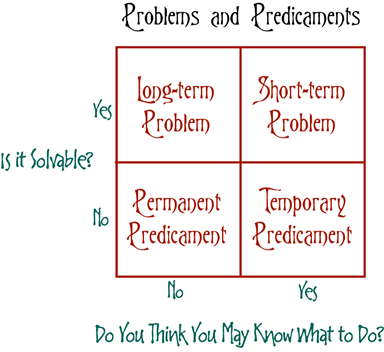
How many times have you heard organizational types talk about the need for problem-solvers? Or spout clichés about “dealing with the problems that confront us in this competitive environment?” Or saying that they “face many problems, which we will overcome, as we have overcome those in the past?” The sad fact is that problems are not the problem, so to speak. What really causes leaders and managers difficulty and heartache, not to mention most of their failures, are predicaments.

A problem, properly speaking, has a solution, You may not know what that solution is, nor even how or where to look for it, but you can be reasonably confident that it exists—somewhere.
A problem, properly speaking, has a solution, You may not know what that solution is, nor even how or where to look for it, but you can be reasonably confident that it exists—somewhere. Science has solved many problems and will likely solve many more in years to come. Technology has also solved some of our problems, such as how to handle vast amounts of data; how to transmit messages nearly instantly to anyone, anywhere in the world; and how to wake you up with a cup of coffee ready made, when you can’t afford a servant to make it for you, and your partner tells you to go jump in a lake when you hint that it might be his or her role to make it. Problems have solutions. If you characterize a manager or a leader as a problem-solver, you are saying that he or she is adept at finding and applying the necessary solution to deal with various workplace problems.

Now that’s a very useful skill, but it will only take you so far. While there are, indeed, many problems to be faced in the world of work, the most difficult, the commonest, and the most intractable problems are not problems at all, because they have no clear, graspable solution. They cannot be “solved” by any technique. They are not problems. They are predicaments.

. . . the most intractable problems are not problems at all, because they have no clear, graspable solution. They cannot be “solved” by any technique. They are not problems. They are predicaments.
Take the “problem” of succeeding in a competitive market. The way that we usually see organizations try to deal with this is by employing a series of assumed solutions, derived from the actions taken by fortunate companies who achieved success in similar situations in the past. That is why every successful product, marketing campaign, form of business organization, or approach to financing is copied within hours or days of the world registering its success. There is no bandwagon that others will not jump onto in the belief that what worked for others will work for them.

Of course, this approach does not work, either consistently or sometimes at all. If it did, no one would have any problem with competitive markets ever again. Not only does copying others contain the causes of its own failure (what everyone does no longer gives anyone a competitive advantage), but it assumes that what you think led to success (or what the happy organization said it did) actually did so. Most times, success was due to luck and an unexpected coming together of actions and reactions. Not only can no one else replicate it, even the company that was successful in the first place usually cannot repeat their own past good fortune either.

Just about all the fundamental “leadership” issues that beset organizations are . . . predicaments: situations that have no solution now—and never will have one, because they are not capable of being “solved” by any one set of actions.
So why doesn’t life play fair and do what it is supposed to do? If I could answer that, maybe I too could become a major guru and live in luxury for the rest of my days. What I can see, however, is that difficulties like dealing with competitive situations—along with just about all the fundamental “leadership” issues that beset organizations—are not problems at all. They are predicaments: situations that have no solution now—and never will have one, because they are not capable of being “solved” by any one set of actions.

Problems remain essentially the same. Predicaments constantly shift and change their details as “solutions” are tried. As soon as one business gains a competitive advantage, others copy it (so it is no longer unique or unusual), while others adapt their own actions to block it. Competitive advantages are, by their very nature, temporary. And since the universe changes constantly in random ways, any source of competitive advantage today will likely become worthless—even potential a drawback—within a short time. Replacing people by machines and computers once gave an advantage. Now everyone does it, so organizations who use actual people in certain areas, like answering customer service calls, find that an advantage instead. Then, with the coming of out-sourcing, the advantage comes from having the phones answered by someone who doesn’t sound as if they are in Mumbai.

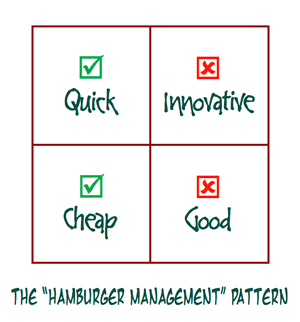
Hamburger Management (the process of serving up whatever approach is quickest, simplest, and cheapest) is a curse because it negates every way of dealing with the predicaments of business life, turning each one into a problem for which there must be a known solution technique (even if there isn’t).
Predicaments are not solvable. All you or anyone can do is to try to cope with them as effectively as you can. And since any technique you apply that seems to work will very quickly produce a counter-technique, or a copy, or a random change in circumstances, the only two “tools” that remain useful again and again are time and thought: to have enough time to consider the options, plus the ability to reflect on whatever you can know of the circumstances and come up with a creative approach that may help for a while. Even that will fail in time, of course, so there can be no end to the need for either enough time or sufficient creative thought.

Hamburger Management (the process of serving up whatever approach is quickest, simplest, and cheapest) is a curse because it negates every way of dealing with the predicaments of business life, turning each one into a problem for which there must be a known solution technique (even if there isn’t). Like stage magicians and illusionists, Hamburger Managers rely on moving fast to confuse onlookers (and bosses) into believing that what they have just seen is truly magic. There’s no time to think or be creative. Just produce the next quarter’s numbers out of the top hat and get off the stage before anyone asks too many questions. Oh . . . and remember to clear away up the smoke and mirrors on your way.

If you demand impossible miracles on a daily basis, you’ll force people into being illusionists and confidence tricksters. All the other guys will fail and be removed.
As I’ve said many times before, I don’t blame these managers. Organizations get the managers they deserve, based on the culture they nurture. If you demand impossible miracles on a daily basis, you’ll force people into being illusionists and confidence tricksters. All the other guys will fail and be removed. Any organization that systematically denies people the time and opportunity to work out how to cope with business predicaments, will cause frustration, stress, and a sense that all that truly matters is to seem to be doing something useful—even if you know that it’s all illusory and based on luck and some creative use of data. Tomorrow you may not be around to worry, and it will be your successor (who will denigrate everything you did anyway) who has to clean up the mess.

Add to Technorati Favorites Stumble Upon Toolbar

Thursday, October 26, 2006

Why Not Let People Use Their Intelligence?

Here's a truly radical idea, reported on October 14th this year in the Toronto Star newspaper. A Canadian company called Algorithmics thinks that its staff should be allowed—even encouraged—to use their intelligence at work. Here's a snippet from the article, called: A premium placed on intelligence:
We encourage creativity,' said Zerbs, one of the youngest employees when the firm started in 1989 and now one of the company elders at the age of 42. 'It's a very fast moving industry, so you can not just manage it top down, you have to allow people to basically think about new ideas, present new ideas, feel comfortable discussing new ideas with peers.'

That's backed up by a recent survey the company carried out among a group of Toronto staff.

'The thing that is most appreciated is the opportunity to use their intellect, that's the thing that attracts them,' said Deborah Troister, vice-president of human resources. 'That's the most important thing to them. It is way above the salary, if you ask them to list priorities that is the one that successively comes out on top.'

Otherwise, Algorithmics' research and development staff, who make up about 60 per cent of the Toronto employees, 'are just regular people who happen to be really smart,' said Troister.
It would be easy to start a cynical, sarcastic rant at this point, but I will resist. It is sufficient to say that companies who recruit smart people, then deny them the chance to use their intelligence for whatever reason, are purposely throwing away large amounts of shareholders' money, and should be treated appropriately. Sadly, that group seems to include the vast majority of major corporations today.

Succeeding in business is not easy. It takes brains as well as determination. Besides, clever, creative people don't relish being denied the opportunity to use what they have probably come to see as their greatest strength. If they walk out, who can blame them? And what will be left? An organization full of people who didn't leave, probably because intelligence is not their greatest strength. Which may well explain why many organizations behave as they do.

Add to Technorati Favorites Stumble Upon Toolbar

The Wonder of Letting Go

Patricia Soldati, writing in Management Issues recently, points to a key reason why people put up with the misery and stress of Hamburger Management. In an article called The allure of scarcity, she writes about meeting a former colleague who admitted to being fed up and burned out, but who went on to say that he was at least grateful that he still had a job. Here's what she writes next:
Later, the encounter caused me to recall this quote by the Buddhist monk and poet, Thich Nhat Hanh: 'People have a hard time letting go of their suffering. Out of a fear of the unknown, they prefer suffering that is familiar.'

Now, if that doesn't describe Jim – and maybe lots of other corporate professionals, I don't know what does. No matter how stressed, stifled, or disgusted, they cling to what is safe…or at least to the perception of what is safe.

The string of thinking goes like this: Even though I'm desperately unhappy, it's a paycheck. I might not find another job.

Then, there's sugar-coating: Anyway, we're all floating in the same boat. I guess I'm really not so bad off.

And the clincher: Besides, making a change would be a heck of a lot of work. I don't have the energy for that.

So you stay stuck, wishing for things to stay the same, but get better.
What logic is there in being grateful for what we already have, if we know we could do so much better?
That is precisely the line of thinking so many people are following today. Each and every day, they convince themselves that the world is a terrifying place, where disaster lurks around every corner. Best be grateful for whatever you have, even if you know you could do better. Any change might unleash the forces of chaos and make things far worse. So they cling tenaciously to their little plank in the vastness of the ocean, even though there may be an empty lifeboat, filled with provisions, only a few yards away. To get to the lifeboat means letting go of the plank, and that is just too scary.

What logic is there in being grateful for what we already have, if we know we could do so much better? Why should we hang on to ways of living and working that produce stress and misery, when all it takes to move towards a better way is to let go of the pattern we are stuck in today? Might change be for the worse? Sure. Nothing in this world is certain. But if we are unwilling to move, things might well get worse where we are today.

The search for certainty is the ultimate in fools' errands.
The search for certainty is the ultimate in fools' errands. It doesn't matter if you call it risk management, strategic planning, business forecasting, or holding to conservative values, it's the same thing: a doomed desire to control your world and keep out anything threatening. All it produces is stagnation, frustration, and very likely the exact things you are trying to avoid. Life is change and uncertainty. Only death is certain and unchanging.

Life is scary, but it is also wonderful, exhilarating, exciting, and full of possibilities.
The first step in making life and work fun again is the simplest—and the hardest—for may people. It is to let go of whatever you have today and move into the future. And what you will most likely find is that many of the things you were clinging to so desperately turn out to be no loss; and some of the best of them bob along with you anyway. You don't need to cling to them. They are part of who you are.

Why add the stress and turmoil of clinging to all the other pressures of life? Why create your own fear of loss to increase the fears that are all around you? Life is scary, but it is also wonderful, exhilarating, exciting, and full of possibilities. You can be like the guy who trains himself to see only threats and fears in the faces of other people, or the one who decides instead that the people around her are most likely a source of abundant joy and surprise, if only she is willing to let go and float with the tide of life. It is always your choice.

Add to Technorati Favorites Stumble Upon Toolbar

Wednesday, October 25, 2006

Why You Should Quit Following Trends

Sometimes I find interesting snippets in unexpected places. Take this article by David Weinberger. It appeared in in KMWorld: a trade magazine dealing with Content, Document and Knowledge Management in July of this year, entitled: The philosophy of business knowledge. Here's what he has to say about trends:
The problem is that much of what business knows about the world calls non-existent things into existence. For instance, take a trend. Trends are interesting because they predict the future: If you see a trend developing, you better jump on it before your competitors do! But, suppose what looked like a trend turns out to have been an aberration? The future it foretold fails to materialize. Turns out it wasn't a trend at all. So, we can only know that something is a trend in the past tense, but they're only interesting because of the future tense they promise. It's easy to believe in trends, but trends actually are just a symptom of belief itself: A trend is not a thing but is the belief in a thing.
I love the insight that much of what business "knows" about the world calls non-existent things into existence. Every plan, budget, marketing campaign, and sales campaign aims to do just that: to call into existence situations that do not currently exist.

What a wonderful paradox! A trend is nothing more than lots of people believing it exists and acting on that belief.
That's what makes following trends so seductive. As Mr. Weinerger's article explains, you can only be certain of a trend after the event, but it is useful only as a way of predicting the future. What a wonderful paradox! A trend is nothing more than lots of people believing it exists and acting on that belief. If enough share that belief, it will, indeed, prove to be an important trend—and you had better get aboard or risk being left behind. If the critical mass of belief is not met, it will fizzle out, making everyone who did leap aboard look foolish and very possibly leaving them with significant financial losses too.

Getting on a trend early is purely a matter of luck. Sure, once you've done it, people will hail you as a visionary, and you can bask in their praise if that is what turns you on. But you and I know you had absolutely, definitely no way of knowing at the start that the trend you decided to back would reach critical mass.
So how can you tell the difference between a real trend and one that will turn out to be an illusion? You cannot, at least not in advance (which is when it matters). At that point, both types will appear identical—because they are identical. They are beliefs looking for a critical mass of people to bring them into existence as real phenomena. If they achieve that critical mass, they become not just "real" but obvious (in hindsight). If they fail, they become nothing more than one of the many fads and failed ideas that litter human history and are forgotten in short order.

What this points to is obvious, but usually ignored for all that. Getting on a trend early is purely a matter of luck. Sure, once you've done it, people will hail you as a visionary, and you can bask in their praise if that is what turns you on. But you and I know you had absolutely, definitely no way of knowing at the start that the trend you decided to back would reach critical mass. That's why successful entrepreneurs are willing to back many, many trends and lose out on most of them. The one that wins will usually cover all their losses and make the a fortune as well.

If you want to make money, you must create a trend yourself. How do you do this? By being yourself and backing your own ideas, regardless of the support for them at the start.
Following trends is a mug's game. If they are already out there, too many people will be on board to make your share of the winnings worth while. If you wait until the trend is proven (which is what most of toady's chronically risk-averse corporations do), you have already missed the boat. Your participation is now purely defensive: you are on board because you cannot afford not to be, though there are probably no significant profits left in the idea.

If you want to make money, you must create a trend yourself. How do you do this? By being yourself and backing your own ideas, regardless of the support for them at the start. Most will fail, so you need to be ready for that. But if even one wins through, you will stand a chance to create more wealth than you can imagine, and no one will be able to beat you to it.

Don't follow trends. Follow your heart and create your own. And keep your fingers crossed. You will need all the luck you can get!

Add to Technorati Favorites Stumble Upon Toolbar

Listen to The Words

From time to time, I am suddenly reminded of an important source of wisdom and insight that is usually either overlooked or derided. That happened to me again last Thursday, when I was driving to have lunch with my wife. I put a CD on in my car to help me pass the time I was spending waiting in traffic. The CD I selected was made in 2000 by a wonderful singer-songwriter called Mary Chapin Carpenter. The song that I want to draw your attention to is called “The Long Way Home.” It’s from her album titled Time* Sex* Love*. If you want to hear what I heard, go to iTunes or buy a copy. The CD still available.

As I listened, the words of the song suddenly hit me. Here’s part of the second verse (You can see all the words here):
Now you could be this woman, she’s the CEO
She’s got her power-suits and her IPOs
She punched a hole in the ceiling years ago
And she hasn’t pulled back since
Now there’s a gardener for the flowers, a maid for the laundry,
An accountant for the bills
A walker for the dog and a trainer for when she feels
The need to lose an inch . . .
It would be hard to find a better description of what so many people see as the state they are striving so hard to achieve, with all those long working days, frequent-flier miles, BlackBerries, and hours spent in meetings. But the song doesn’t stop there. It continues:
Funny how it all goes by so fast
One day she’s looking over her shoulder at the past
When everybody had to go, had to be, had to get somewhere
Somehow she forgot about what got here there . . .
What have you forgotten about in your life? What did you once have time to enjoy that you don’t have time for any more? Was losing whatever it was worth whatever you got in its place? Is it better to have the money to employ a walker for the dog, or to spend time with the dog yourself? To reach the top seat, or to have time to play with your partner, or your children? The choice is yours. And remember, it all goes by so fast. When you’re looking over your shoulder at the past, what will you see back there that you will regret leaving behind?

There are some beautiful lines in the rest of the song too, like these:
Accidents and inspiration lead you to your destination . . .

See your life as a gift from the great unknown and your task to receive it . . . Call in well sometimes and laugh when they believe it . . .
So the next time you listen to a song, try listening to the words as well as the music. I can’t guarantee that it will always be a good learning experience. Some songwriters, like some writers, have a gift for the banal and the trite. But sometimes, just sometimes, you will be rewarded with a gem that sets your mind thinking about the reality of life for days afterwards.

Add to Technorati Favorites Stumble Upon Toolbar

Tuesday, October 24, 2006

Obsession with Leadership Undermining Organisations

Thanks to Management Issues, I noted that Henry Mintzberg has fired off another broadside against today's near obsession with leadership as an organizational panacea. You can find the complete posting via this link. Here's a sample:
Controversial management Professor Henry Mintzberg has launched a broadside at his own colleagues in management education with a robust denunciation of the current obsession that business schools seem to have with teaching 'leadership'. Writing in today's Financial Times, Prof Mintzberg says: "We have this obsession with 'leadership'. Its intention may be to empower people, but its effect is often to disempower them." By focusing on the single person, he argues, "leadership becomes part of the syndrome of individuality" that is "undermining organizations."

Prof Mintzberg, a strategy professor at McGill University in Montreal, also lays into "managers who sit on 'top', pronouncing their great visions, grand strategies and abstract performance standards."
Let's stop kidding ourselves. If there is a generic problem from the "syndrome of individuality" that is certainly present today, it's not a lack of leadership; it's a lack of actual individuality and innovation at the top.
It certainly makes little sense to assume that "leadership" (whatever that is—no two gurus seem to agree in any detail) is going to save an organization from its own folly. Besides, even those leaders who do, in Professor Mintzberg's words, sit at the top and pronounce great visions, must be doing a thoroughly poor job of it. All that I see is a pattern of imitation and repetition throughout industry. What one company does today, everyone else does tomorrow. If that constitutes the work of a leader, all I can say is that any line of Army Ants in the jungle is full of outstanding leaders, since they follow one another perfectly for days at a time. Let's stop kidding ourselves. If there is a generic problem from the "syndrome of individuality" that is certainly present today, it's not a lack of leadership; it's a lack of actual individuality and innovation at the top.

All the emphasis on individual leaders is like the stupid cult of the individual in team sports. No individual can do the work of a team, even a small one. If you have a movie that's a turkey (and there are lots and lots of those), putting a big star even in a key role role won't rescue it from the ridicule and obscurity it deserves. Organizations are not star vehicles. Business is a group endeavor, not something that can be done by a "star" CEO and a team of sycophantic acolytes.

Professor Mintzberg has it right. All the fuss about leadership is crap. The real reason for it is that leadership training can be sold and business success can only be won by the dedicated work of a community of people.

Add to Technorati Favorites Stumble Upon Toolbar

Save Time for What Matters by Delegating Better

Penelope Trunk at Brazen Careerist has two interesting posts on the topic, beginning with Save what matters by delegating what doesn't She says
Look at your life for the things that are not at the core. Admit that the core is small. Question everything you think you need to do yourself. It comes down to how much are you willing to give up control, and how much you value your time.
Delegation is often misunderstood. It also hits at the core of what drives many of today's management practices, which is an obsession with control.

I particularly liked this quote from the second post:
This is a great opening to talk about one of the most misunderstood parts of delegating: You should delegate your most important work and keep the crappiest work for yourself. This way the people you delegate to will love what they are doing, and they will appreciate how much trust you have in them. You should do the crappy work yourself because it is so hard to lead people effectively if you are giving them crap to do.

If you are worried that they won't do a good job on the important stuff, then coach them. Management does not mean getting the crap work off your plate to make time for important work. It means doing the crap work and doing a lot of coaching, and, if you're really good, making time to take on projects to expand your own skills.
It's worth reading what she says in full.


Add to Technorati Favorites Stumble Upon Toolbar

Monday, October 23, 2006

To Succeed, First Forget About Leadership Technique

There is an epidemic today that is more virulent and destructive than Bird Flu. It has found its way into business schools, into boardrooms, and into workplaces throughout the land. It infects every human resources department and just about every consulting group. It is extremely contagious, attacking the infected individual with unsurpassed rapidity, and it slowly and inexorably chokes every spark of creativity and fresh thinking out of the poor devils who catch it. Worst of all, people don’t pay to get some kind of immunization shot to ward off this menace. They usually pay good money to be infected.

The virus I am thinking of is the virulent belief that success—in just about any business or leadership endeavor—comes from one simple source: technique.
All of this comes from a simple and erroneous belief: that it is possible to discover and understand the root causes of success, translate them into a simple series of techniques almost anyone can grasp, and then reproduce the original success again and again, on demand and without further thought.
The people who transmit this disease—consultants, trainers, academics, and writers—are some of those with the most chronic infections. To them, success is a simple matter of applying the correct technique (theirs, of course) to any given situation. To sugar the pill of infection, they present their ideas in the form of simple lists of techniques and actions for people to follow. Like the marks of the bubonic plague that once terrified Europe, you can see the sure sign of infection: the numbered list of things to do. The Seven Habits of This, or the Eight Steps to That, or The Ten Simple Things Every Successful Leader Knows. The more technologically-minded among them produce software packages so that their techniques can be applied more simply and consistently. You need neither to think nor choose. Plug in the data and the software will tell you exactly what needs to be done.

All of this comes from a simple and erroneous belief: that it is possible to discover and understand the root causes of success, translate them into a simple series of techniques almost anyone can grasp, and then reproduce the original success again and again, on demand and without further thought. What could be simpler or more desirable?

Management theory is riddled with this mistaken kind of thinking. The world of popular self-help manuals is almost entirely based on similar errors of understanding.
Unfortunately, this edifice of marvels rest on extremely shaky foundations. Causality is full of pitfalls. It is easy to note that two events happen one after the other, then jump to the conclusion that the first caused the second. Management theory is riddled with this mistaken kind of thinking. The world of popular self-help manuals is almost entirely based on similar errors of understanding. It ought to be plain that there is something seriously wrong with this line of thought, of course, because it does not work. If even a single group of techniques brought sure-fire success—if just one of those lists of six, seven, eight, or ten steps to follow truly delivered what it promises—the person who produced it would be a billionaire and all the other books, tapes, courses, and programs would be chucked into the garbage.

How much more unlikely is it that ordinary, non-expert managers will be able to produce the perfect marketing plan, the perfect product mix, the perfect recruitment scheme, or the perfect office environment, just by learning and applying a few, simple techniques listed on a flip-chart?
There are many different approaches precisely because:
  1. None of them work consistently, regularly, or even predictably—if they work at all; and
  2. People are desperate for help and cling to the belief that, one day, they will find the magic button to press.
There are other obvious flaws too. Even if you could understand fully enough how some natural process of leadership or management works (and most are so complex that this is far from likely), that does not mean you can control it and produce the outcome you want. We know pretty much how the weather works, but there is no way to control whether or not it will rain tomorrow—or even to predict it with anything approaching certainty. We understand quite a lot about how children grow, learn, and develop, but no one (sane) believes they can produce perfect human beings as a result. How much more unlikely is it that ordinary, non-expert managers will be able to produce the perfect marketing plan, the perfect product mix, the perfect recruitment scheme, or the perfect office environment, just by learning and applying a few, simple techniques listed on a flip-chart?

Techniques are like tools. There are many of them. Some are simple and some very complex. Some fit easily into the hand, while others require machinery or computers to operate. Using the wrong tool will screw things up, but having the right one is no guarantee of doing the job well. That takes expertise, years of learning and practice, careful thought, and (often) highly-developed skill. I can go to the hardware store this afternoon and buy saws, hammers, drills, planes, and routers (plus a dozen manuals), but that won’t make me a carpenter. A trip to the music store for a guitar and a book of playing techniques won’t make me a musician—or even someone whose playing you could listen to without pain.

What is it with this (largely American, I’m sad to say) delusion that having the right technique is all you need to be successful?

Forget worrying all those smart leadership techniques until you have developed the judgment, understanding, insight, trust, wisdom, and compassion necessary to become a leader.
Technique is simple and saleable—and it plays to mankind’s wish to be able to get great results easily. We want to believe in it, however often we are disappointed as a result. Reality is very different. Thought counts for more, knowledge is more useful, skill is more essential, experience counts in more instances, and luck—which is usually ignored completely—probably matters more than any of these. In fact, all of them matter more than techniques. An unskillful, inexperienced, ignorant, thoughtless, and unlucky person is a blight on any business. Arm that person with a battery of personal, organizational, and computer techniques and you have all the Biblical plagues of Egypt rolled into one. He or she will get things done—but I, for one, don’t want to be depending on the outcome.

Forget worrying all those smart leadership techniques until you have developed the judgment, understanding, insight, trust, wisdom, and compassion necessary to become a leader. Until you do, giving you good techniques is like arming a blind person with a machine gun and telling him or her to go into your yard and shoot some rabbits. In place of courses to teach techniques, what about some time devoted to:
  • learning how to think straight;
  • how to spot false conclusions and faulty notions of causality;
  • how to understand the rights and wrongs of evidence;
  • and how to apply civilized values to day-to-day business situations?
Now that would be a course worth taking.

Add to Technorati Favorites Stumble Upon Toolbar

Saturday, October 21, 2006

Why "Industry Standard" is a Dumb (Hamburger Management) Idea

Bob Sutton's extended rant against companies that use the excuse that their bad behavior is "standard in the industry" is well worth reading in full: Why "Industry Standard" is a Dumb Excuse. As he writes:
. . . mindless imitation of what has always been done in an industry or a company is one of the surest paths to destruction. And even great companies . . . often do many stupid things. Think of the most successful people you know—many do unwise and destructive things, and they succeed despite themselves.

Breaking out of a dumb industry standard is how newcomers—or reformed old-timers—come to dominate an industry.
Following "industry standards," or so-called industry best practice, is an essential part of Hamburger Management. It makes decisions quick and easy (both HM obsessions), because there's no need for thinking; you simply do what everyone else does. It also offers a degree of imagined safety from personal accountability. If things go wrong, you shrug and point out that all you did was what everyone else does, so it's not your fault.

Of course, companies still look for ways to find some competitive advantage. If everyone is doing the "simple" thing, there's not much leeway there. So they go for quicker and cheaper. "Hey, never mind the quality, feel the speed!" Imagine using this excuse in other areas of life. Wouldn't that lead to the ultimate "Wham! Bam! Thank you, ma'am!" approach?

"We're the lowest cost producer." So what, if the quality and value are rubbish? Being cheap isn't much of way to recommend yourself. Like most of the mantras of Hamburger management, it's also totally inward looking. It really means: "We can make the same kind of stuff as everyone else, but because we do it more cheaply, it brings us much more profit." Never mind the customer, look at our bottom-line profit.

As Bob Sutton write of his experience with HP:
The people at HP were very polite and never argued with me, but like at AOL, are just trapped in a bad system and are apparently trained to say dumb things. It also smells like one of those cases where, to hit short-term numbers, a company puts in place a system that can cause long-term damage to customer relationships—like AOL.
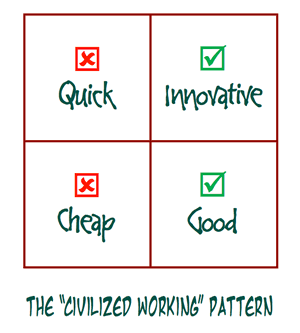
Good business is not about being quick, simple, or cheap. It's about being better at what you do than anyone else. And that includes service, quality, and innovation too.

Add to Technorati Favorites Stumble Upon Toolbar

Friday, October 20, 2006

Office Egos and Hamburger Management

Over at Management Issues, Susan Debnam has an interesting post called "Office egos uncovered". Here's some of what she writes:
Wherever we look we see egos at work. In business (most boardroom battles are about ego), politics, themedia, the church, the armed forces or the local voluntary group. There will always be those who ask primarily 'what's in it for me? How will I look? How will this action affect my career, my status, my credibility?'

So what? You could say organisations have been living with the garrulous, demanding, calculating behavioural manifestations of ego-driven individuals for decades. Some might even argue that corporate life would be the poorer without the energy and charge that egos deliver.

Egos aren't intrinsically bad. They have drive and energy that can be infectious and, if used appropriately, can be highly productive. But they don't come with a user manual. When they reside in individuals or organisations that lack awareness of their impact they can wreak personal and corporate havoc.
Egotism seems to be an intrinsic part of Hamburger Management. I suspect that is because these macho management styles are sold to people on the basis that getting things done, even when it all seems impossible given the time and resources, will make you look good. And egotism is all about me, isn't it? My career, my targets, my job security.

Here are the business qualities and behaviors Ms. Debnam gives as examples of ego-free leadership:
  1. Put the business agenda ahead of your own agenda
  2. Recruit the best person for the role – not just personal supporters
  3. Discourage empires and cliques
  4. Encourage people to challenge the status quo and question existing methods and strategies
  5. Encourage leadership to flourish at all levels of the organisation
  6. Respond to change initiatives according to business need vs personal need
  7. Leave a legacy of ongoing excellence
This sounds very like Slow Leadership to me. All I would want to add is something like this:
  1. Encourage good work and discourage cutting corners, even if it takes longer
  2. Delegate everything you can (and then some)
  3. Never trade off thinking time for mere busyness
  4. Remember success is about creating long-term value, not snatching short-term profits
  5. Enjoy life, it's the only one you have
As Ms. Debnam concludes:
The ripple effect of ego-free leadership is to create a culture in which people are free to take risks, to learn from mistakes and deliver in a way that's less stressful and more creative than in an ego-driven environment.


Add to Technorati Favorites Stumble Upon Toolbar

Avoiding Hamburger Management

Over at The Canning Collaborative Learning Commons, Zach has written in support of my posting on Hamburger Management. His comments about an actual case are worth reading. Here's part of them:
"The other day I introduced a client I’ve been working with to a systems based view of organizational dynamics. After a couple of diagraming sessions, they were believers. The sources of the stress and pressure they were facing were captured clearly in a series of arrows, actions and loops. Suddenly they could see why the problem was not one thing, it was everything.

If it’s everything, where do you begin? Two places—simultaneously.

One: you. You must must change; learn how to adapt to the complexity around you.
Two: somewhere. The nice thing about systems is they’re fundamentally circular. To facilitate change you can begin anywhere. However, choosing a place where you have leverage is key.

So, if you don’t want to be a hamburger manager change yourself. Change the way you prioritize and allocate time."


One of the worst aspects of Hamburger Management is the way it feeds on itself, denying managers the time and space even to look and see why they are feeling so stressed and short of time. So, start anywhere you can to make changes. Systems interlock, so if you keep at it, you'll deal with everything in due time.


Add to Technorati Favorites Stumble Upon Toolbar

Thursday, October 19, 2006

A Regulatory Tipping Point?

Here's an intereresting thought, courtesy of Management Issues. Today, they published a political article called Britain at a regulatory tipping point. Here's a sample:
Britain's sense of adventure, enterprise and competitive edge is being fatally undermined by a growing army of bureaucrats and politicians terrified of risk and determined to regulate for every eventuality.

This damaging indictment of Britain's political culture is the key message of a new report from the government's own Better Regulation Commission (BRC), a body established in 2005 to provide independent advice to government about the impact of regulatory proposals and about the government's overall regulatory performance.

'Risk, Responsibility, Regulation: Whose Risk Is It Anyway?' argues that regulatory overkill and intrusive government intervention is in danger of taking the place of personal responsibility and that the national attitude to risk is becoming defensive and disproportionate.
Replace the word "Britain" with the name of just about any major corporation you can think of and ask yourself whether this isn't just a true of them. Too many corporations are "being fatally undermined by a growing army of bureaucrats . . . terrified of risk and determined to regulate for every eventuality."

Risk is something none of us can avoid. Life is risky. Only the dead are pretty much free from all risks. Politicians, and business leaders, seem to be addicted to bringing out ever more rules, regulations, policies, guidelines, and standardized practices. Ethics are being replaced by compliance. Commonsense has long departed from many boardrooms.

It seems that even business leaders are terrified to think and accept responsibility for their decisions (which is what their big salaries are supposed to compensate for). Instead, they turn to mechanistic ways to limit their liability and avoid having to admit to mistakes.

Instead of cluttering up the workplace with such garbage, why not try trusting subordinates to do their jobs, and give them the space, time, and support to make it happen?
Nothing slows business down more than a mass of needless rules, but it's not the kind of slow leadership we advocate here. Instead of cluttering up the workplace with such garbage, why not try trusting subordinates to do their jobs, and give them the space, time, and support to make it happen? If more corporations tried that approach, I believe they would discover they have plenty of time to get everything done without all the stress and long hours. All they need to do is to free themselves from pointless reporting, useless meetings, the collection of meaningless statistics, the preparing of endless PowerPoint presentations and justifications for any and every action . . . and all the other common means of covering those delicate executive butts.

Add to Technorati Favorites Stumble Upon Toolbar

Take Back Your Time Day

Here in the United States, next Tuesday (October 24th) is Take Back Your Time Day. It is held 9 weeks before the end of the year, to emphasize the fact that Americans work an average of 9 weeks more per year than do European workers. The aim of Take Back Your Time Day is to draw attention to imbalances in work and leisure in American cultural life.

This year, the sponsors are inviting people to "Take Four Windows of Time, " suggesting that you choose four windows of time between October 24th, Take Back Your Time Day, and December 31st, 2006 to:
  • Rest yourself in body and mind;
  • reconnect with your family, friends, and community;
  • revive your energy for life; and
  • recreate a much-needed sense of balance.
If you need help, a site called “Living 5 to 9” offers a Productivity Profiler to “diagnose your Productivity Profile and . . . recommend tips to help you start maximizing your personal work ethic so you can slow down, take back your time, and ultimately get out of the office and back to your life.”

In today’s Washington Post blog, Leslie Morgan Steiner writes:
We're working way too much and need some perspective. While the folks behind Take Back Your Time Day have a bunch of smart policy suggestions (more vacation, guaranteed sick time, paid family leave), that's not what sets them apart. What I really like is their call to step back and reflect on the craziness that is daily life . . .
You might also want to download these Adult Playground Rules and post them up somewhere to remind you to give yourself (and others) a break now and then.