Wednesday, January 31, 2007

Hamburger-Management-prone organizations may be born, not made

In May, 2006, David Brooks wrote an article for the New York Times (subscription), which began by referring to an experiment in gauging the natural self-control of infants:
Around 1970, Walter Mischel launched a classic experiment. He left a succession of 4-year-olds in a room with a bell and a marshmallow. If they rang the bell, he would come back and they could eat the marshmallow. If, however, they didn’t ring the bell and waited for him to come back on his own, they could then have two marshmallows.

In videos of the experiment, you can see the children squirming, kicking, hiding their eyes—desperately trying to exercise self-control so they can wait and get two marshmallows. Their performance varied widely. Some broke down and rang the bell within a minute. Others lasted 15 minutes.

The children who waited longer went on to get higher SAT scores. They got into better colleges and had, on average, better adult outcomes. The children who rang the bell quickest were more likely to become bullies. They received worse teacher and parental evaluations 10 years on and were more likely to have drug problems at age 32.
It makes you think, doesn’t it? Self-control and delaying personal gratification may well be essential elements in living a good life. Brooks concludes:
Young people who can delay gratification can sit through sometimes boring classes to get a degree. They can perform rote tasks in order to, say, master a language. They can avoid drugs and alcohol. For people without self-control skills, however, school is a series of failed ordeals. No wonder they drop out. Life is a parade of foolish decisions: teen pregnancy, drugs, gambling, truancy and crime.
Hamburger Management is instant gratification translated into a corporate context. It is putting short-term desires above both long-term benefits and the common good. And it is using crude, short-term pressure to make that happen. To echo Mr. Brooks’ article, Hamburger Management is often a parade of essentially foolish decisions, hastily covered up by shifting the blame and distracting other people with a show of zeal and excessive effort.

Is Hamburger Management innate in an organization, or created by current business conditions?

I suspect the answer, as so often, is that both contribute to its prevalence. The most common set of corporate norms today, created by failed ideas such as motivation by monetary incentives and the mantra of “advancing stakeholder value,” certainly make Hamburger Management more likely—and more acceptable. Since most organizations also recruit people they believe will fit in with present norms, there is probably an unconscious selection for anyone whose willingness to do what is generally approved make utilization of Hamburger Management approaches still more common.

Still, I do think that you can distinguish between organizations who seem to possess abundant self-control and those who don’t. Those that have a long-term outlook built into their corporate culture fall into the first group. They seem to find it relatively easy to persist with stable strategies through good times and bad. They often place a higher value on creativity, research, and projects that will not show full results for many years ahead. They don’t fall for fads or indulge in high-risk, quick-fix actions. As a result, they tend to last, steadily making their way towards the forefront of their industries, but rarely displaying any sudden or spectacular surges of growth.

In contrast, there are organizations that seem to make a specialty of chasing every management and business fad around. Their fortunes go up like a rocket and down like the stick. They are the darlings of Wall Street one year, and on the verge of bankruptcy the next. Mostly, they don’t last very long, either crashing and burning (often in a mess of criminal charges and ethics violations), or being bought out by other, equally short-term businesses hoping to make a quick killing through mergers.

Do organizations also move between these categories? I think so. In the past few years Ford has moved from being a huge, vertically-organized, ultra-blue chip business to laying off tens of thousands of workers and closing plants to stay afloat. Is the problem simply market conditions? Surely not. In the run up to Ford’s current woes, we saw a period of rapid acquisitions, seemingly driven as much by trying to deny those companies to others as by any merit in buying them for their own sakes. We saw a high-profile, glamorous CEO in charge, and some significant problems with the ethical handling of product quality failures. The Telecom industry also indulged in a mad period of mergers and acquisitions, paid ridiculous sums of money for cellphone licenses, claimed to be about to change the world of communications … and crashed in a mess of criminal prosecutions and evaporating profits.

Maybe, like people, organizations find exercising self-control either relatively easy (perhaps because that ability has been part of their corporate psyche from an early age), or extremely difficult. Also like human beings, those who behaved in controlled ways for many years can suddenly burst out in a fury of self-indulgence and instant gratification, perhaps under the influence of new leadership chosen to be “less boring and staid” that what went before (HP might be a case in point). When this happens, the organization has little or no experience of how to operate in such risky ways, and often makes a complete mess of the attempt to be suddenly “hip.” Just as in the old story of the prodigal son, decades of carefully-saved resources can be spent in a few wild years of non-stop sensation seeking.

As an investor, I would start to worry as soon as I saw any organization whose shares I owned begin to act like a four-year old with an uncontrollable urge for a marshmallow now. As an employee, I would swiftly polish my resumé and scan the job market. And as a competitor, I would rejoice and settle back to watch the fun.

Self-control is never sexy and rarely fashionable. Still, that doesn’t make it wrong. Today’s Hamburger Management organizations are exactly like teens addicted to drugs: willing to sacrifice almost anything for the next “fix.” Only they aren’t using cocaine or meth. Their drugs of choice are outsourcing, mega-mergers, quick profits, huge payoffs for a few at the top, and unethical or criminal behavior to keep the “highs” rolling in.

We prosecute drug-pushers and suppliers of illegal substances. Maybe we should think about applying similar sanctions to the consultancies, purveyors of dubious accounting practices, financiers, and management gurus who supply our organizations with the “drugs” they crave to give them an instant high—and, like their counterparts among the drug dealers of Colombia or Mexico, make fortunes as a result.



Email Newsletter icon, E-mail Newsletter icon, Email List icon, E-mail List icon
Sign up for our Email Newsletter


Add to Technorati Favorites Stumble Upon Toolbar

Tuesday, January 30, 2007

Picky, picky . . . or compliant team-player?

Look at this statement from Great Britain about the coming year’s cadre of university graduates entering the job market:
There were also worries that graduates were becoming increasingly selective and demanding, with many dismissing industries because of a negative perception about them or being unwilling to travel or relocate to other parts of the country to land a job.
It seems that: “employers are increasingly worried that picky university leavers lack not only the right skills and qualifications, but even the right outlook to get on in the world of work.” Among the “problems” that British employers note are “finding applicants with the right combination of skills, particularly those with ‘soft’ skills such as team-working or leadership.”

Words such a team-working appear clear enough, but I suspect there is a coded message in here. The word “picky” gives it away. For traditional employers, team-working means fitting in, doing what you are told, and putting the needs of the “team” (read “organization”) above your own. Leadership means making sure that those under your charge behave as good team-workers.

From this standpoint, when problems arise, the place for change is clear: it’s you. If an organization is falling behind in terms of creativity or product innovation, the problem is that the workers aren’t creative enough. If customer service is poor, that’s down to the people involved. Replace them, re-train them, put in new bosses to whip them into shape. If the whole organization is failing, sack the CEO and hire some high-profile “company doctor” to sort it all out.

Many problems are not due to employees at all: they’re caused by organizational failings and lousy systems. Corporate culture has often been able to “solve” them, without recourse to difficult changes of policy or structure, by requiring individuals to change themselves and their lives in order to dig the organization out of the hole it has put itself in.

It doesn’t seem surprising to me that employees are becoming picky. Marketing has been training consumers to be more and more picky, promising the ability to “customize” virtually anything. Why not customize your job? Why not refuse to relocate at the employer’s whim, work hours that you don’t want to work, or put up with bosses who make your teeth ache? If you feel good about your prospects (and most freshly graduated young people do), you’ll be tempted to lay down your terms, not just accept those on offer.

Do employees have to “fit in” and accept compromises?
Yes, but not in every instance, or as a matter of course.
Do organizations need team-workers?
Yes, but not in every job.

Just as the casual meaning of “work/life balance” assumes a false contrast between working and living, so casual assumptions about the need for complaint workers miss the point that there must be a balance between what organizations should ask of their employees, and where organizations must adapt to better fit those same employees’ needs and aspirations for a good life.

A civilized organization is one that takes these questions seriously and seeks to find good answers. Today’s typical organization whines about picky employees and assumes that the “correct” state of mind to be sought in recruits is one where what the organization wants is seen as inviolable law.

Those who run our society, whether in business or politics, naturally hanker after a totally compliant population. It makes their lives easier and ensures that they are not asked awkward questions. Yet democracy, which we hold up as the ultimate form of government, requires exactly the opposite: a population ready to question, probe, and refuse support to those who no long put the general good before their own interests. In business , those in charge are faced with the same ethical choice: aim for the common good, or run things to suit their private interests.

With a complaint workforce, they don’t have to face that issue at all. That’s why we should maybe applaud those picky British graduates for refusing to toe the corporate line.


Email Newsletter icon, E-mail Newsletter icon, Email List icon, E-mail List icon
Sign up for our Email Newsletter


Add to Technorati Favorites Stumble Upon Toolbar

Monday, January 29, 2007

If actions speak louder than words . . . what do yours say?

There are many reasons put forward to explain why change is so hard to initiate and so difficult to implement. Perhaps an exploration of what has been proposed as the 1/9/90 Law for blogging can throw more light on the phenomenon.

Earlier this week, I came across a mention of a supposed "law" of blogging: the 1/9/90 Law [link] . This states that of every 100 people, just one will write a blog and create content, putting forward their ideas and starting a dialog. Another nine will post comments on that blog and thus contribute to the dialog by sharing their responses to the original idea. They enrich the content created. The other 90 will read the bog . . . and do nothing else. They simply consume the content.

I have no idea whether any of this is true, but it seems plausible. If I contrast the number of people who are recorded as looking at this blog with the number who leave comments, a ratio of 9:1 seems overly generous. My own guess would be that far fewer than 9% of readers ever post any kind of comment.

However, this post is not about blogging, and my reason for mentioning the 1/9/90 Law is that it seems to me to apply really well to the topic of people's reactions to change and whatever serves as the prevailing culture and established norms in their place of work.

Maybe just one in 100 people will come up with ideas for change and decide to try to see them implemented. That one person is very likely to make him or herself unpopular as a result; perhaps even to the extent of being fired. It takes a great deal of courage to challenge the prevailing corporate culture (some would use the term foolhardiness instead) and to do so openly.

However, it does happen and there is usually a response. Maybe between 5% and 9% of people will respond by taking up the idea and looking to see if it has any merit. They will discuss it and add to it, maybe alter it somewhat, and exhibit at least some willingness to see it turned into action. If the one person who started the process is the creator, the catalyst for change, these folk are the polishers, enrichers and implementors.

Of course, if the initial idea is a bad one, they'll likely choose to leave it alone. And if the response from on high is unusually ferocious and negative, they'll probably put self-preservation above any interest the idea aroused in them. After all, it wasn't their idea. They just thought it might have something in it, and were looking to see what that something might be and how it might be made to work.

Inertia rules?

The remaining 90% will almost certainly do nothing, and outwardly register little or no interest either. Is that simply inertia or apathy? Are most people immune to curiosity; or totally unconcerned with things that might make their working lives better?

I don't think so. Some may be, but this seems to me to be an unduly negative view of the human condition. What I think is happening in that vast majority of people (be it 90% or some other number) is far more complex. Understanding it may point to why change—even beneficial change—can seem to slow to emerge and so easy to squash.

Most people accept the status quo, even if they don't like it much, because:
  • They have been led to believe that there is no other viable way.

  • They fear that being seen to be on the side of change will harm their career. Those in charge will consider them lacking in commitment, disloyal, or disaffected.

  • They have become cynical and disillusioned. They've seen so many previous attempts at change fail and noted how the instigators have been treated.

What do your actions say about you?

This brings me back to the headline of this article. If you're the one person who constantly instigates change, your actions speak of your courage (or foolhardiness), your creativity, your willingness to stand up for what you believe—and possibly your long history of being forced to change jobs and accept loss of prospects. If you're typically one of the nine or so percent of polishers and enrichers of other people's ideas, your actions likely speak about your curiosity, your ability to take an initial idea and work to improve it, your willingness to discuss many options, and your openness to change as a continual possibility. They also probably suggest that you have a better sense of self-preservation that the one percent who constantly go out on a limb.

For the rest, lack of action may be due to need (I can't afford to risk this job for anything), or satisfaction with the way things are (This works for me and I don't want it changed). But your inaction may just as easily suggest fear, cynicism, disillusionment, and a sense that the future offers few alternatives.

Which of these is right—if any of them are—only you can say. I'm not going to make any sweeping generalizations or label anyone. But I do think you might want to take a little while to think about the picture I have painted. Even if it has only some partial truth in it, it may help you reflect on what does seem to be a fairly general workplace malaise: whining about the miseries of work and doing nothing about them.

Not everyone wants to come up with new ideas. Not everyone can do it, or is willing to accept the risks. But surely everyone can think about the ideas raised, add their two cents to the discussion, and maybe support any useful initiatives that result?

Then we might have a new—and better—version of the 1/9/90 Law. One where 90% explore and support ideas, 9% produce them, and only 1% sit on their hands and complain.


Email Newsletter icon, E-mail Newsletter icon, Email List icon, E-mail List icon
Sign up for our Email Newsletter


Add to Technorati Favorites Stumble Upon Toolbar

Friday, January 26, 2007

How to Make Problems Work for You

Thanks to an article in the Toronto Star, [link] I came across a book by Professor Thomas Homer-Dixon from the University of Toronto. His book is called The Upside of Down; Catastrophe, Creativity, and the Renewal of Civilization. Despite the title, it’s actually quite a hopeful book.

Professor Homer-Dixon sees the current state of our world as untenable in the long term. But he isn’t simply a doom-monger, prophesying the end of civilization or the extinction of the human race. He certainly foresees some kind of breakdown, but looks to the middle ground between the (untenable) status quo and the (catastrophic) collapse of intelligent life on earth as a source of hope. I’m not going to rehearse his ecological and scientific arguments—you can read the book for yourself—but I will borrow some of his ideas to apply to similar mounting stresses in the business world today.

Just as the world has become extensively interconnected, so a disastrous breakdown anywhere will spread to all (like the rolling electricity blackouts that have affected North America and Europe in the recent past). Organizations have become internally and externally dependent on one another. Computerization and centralization of data mean that a single computer glitch (hardly an unusual event) can bring a massive organization to a standstill. Externally, organizations and markets are so tightly linked together that an economic downturn spreads around the globe faster than any virus—and has equally negative effects.

By shutting down the natural change processes, we risk a build-up in tensions whose eventual release could be more than we, and our commercial and political systems (or our world), can handle.
The professor actually sees some degree of breakdown as a positive outcome that may be what it takes to break out of inflexible systems and substitute better ones. In his view, the worst that can happen is that the “revolutionary” breakout is shut down by conservative forces before real change can take place. The penalty for such actions is that the next breakdown is likely to be more violent and upsetting. By shutting down the natural change processes, we risk a build-up in tensions whose eventual release could be more than we, and our commercial and political systems (or our world), can handle.

Organizations are, as a rule, very conservative places. Change is difficult and slow, and must always struggle to overcome both apathy and strong counter-measure by those who defend the status quo. By blocking off the middle-ground of reasoned change, such organizations leave themselves only the extremes of no change at all or catastrophic breakdown, leading either to extinction or revolution.

If you think this is overstating the situation, consider how few of the household name organizations of even a decade ago are still with us. Most have either been swallowed up in mergers or acquisitions—usually brought on by dismal results or impending collapse—or have disappeared altogether. And if today’s corporate behemoths look impregnable, so did their predecessors in their day.

In my experience, rather few people or organizations are ready to consider significant change without some strong sense that to do otherwise will be far, far worse. Most hold out against it as long as they can. That s why so many discover, too late, that the opportunity to save themselves—however painful that process might be—has passed, and only catastrophe, revolution, or voluntary extinction remain.

We mistake stubbornness (which refuses to budge) and complacency (which refuses to listen) for resilience (which means bending and shifting whenever the alternative is to break altogether).
There seems to be an innate desire in many people to avoid change of any kind. Despite all the evidence that the future, just like the past, is comprised of equal parts of volatility, surprise, and unexpected reversals of fortune, we cling to the insane belief that this time things will be different. Our institutions, our ways of thinking, even our future plans, will somehow manage to remain stable. We mistake stubbornness (which refuses to budge) and complacency (which refuses to listen) for resilience (which means bending and shifting whenever the alternative is to break altogether).

Here’s what you can do to make the problems that life brings work for you:
  • Slow down, spend time watching and thinking, and open your mind to the widest range of options that you can envisage. Rushing down the current path, eyes wide shut (as most people and organizations are doing), simply gets you to the point of catastrophe faster.

  • Be imaginative. Stop assuming things cannot be different than they are.

  • Accept that breakdowns and problems will always occur, and that the future is unknowable. Try to concentrate on becoming more flexible and resilient. Work out what can be sacrificed, in what order, before you have to accept defeat. Stop treating the status quo as anything other than a temporary state that deserves no particular reverence.

  • Try to keep pace with external changes as far as you can. That means being ready to accept new ideas (even if they seem risky) and let go of old favorites (however dear).

  • Reverence only creativity and the power of rational thought to preserve you from the consequences of your own folly.
Organizational histories are packed with examples of complacency and short-term thinking gone horribly wrong. It seems that groups of people have the potential to act even more stupidly than individuals do—especially when status and influence are at risk. That’s when you need rules, norms, and corporate cultures strong enough to expose the stupidity and force people into acting smarter.

We live in a complex, interdependent, continually changing world. Our current, Hamburger Management style of management thinking ignores this in favor of simplistic answers, short-term profit, and a cult of frantic busyness. It is amazing that so few people see the disconnects and the looming disaster it foretells.


Email Newsletter icon, E-mail Newsletter icon, Email List icon, E-mail List icon
Sign up for our Email Newsletter


Add to Technorati Favorites Stumble Upon Toolbar

Thursday, January 25, 2007

If You Don’t Slow Down and Think Now, You’ll Curse Yourself Later

This posting on Newsvine struck a chord with me. I have written several times about the way that people—especially many managers and executives—ignore the extent to which sheer chance influences the success of businesses and organizations. It’s as if we cannot accept that our “control” over our future is strictly limited. As the article states:
Human beings are genetically predisposed to find patterns and to assume that events are linked in time by cause and effect, and it’s quite easy to see why. If you assume that a rustling in the bushes means that a tiger is about to pounce, then being wrong nine times out of ten is probably better than failing to make that connection once. This contributes to a natural human inclination to simplify memory by constructing a single linear narrative.

History is taught to schoolchildren as if events were the consequence of a series of decisions and actions by leaders and heroes. “Napoleon lost the battle of Waterloo.” When this cannot be done causes may be located in physical or emotional pressures. “The Pilgrims set sail for the New World to escape religious persecution in their homeland.”
In businesses, rising sales are typically attributed to the brilliance of management strategies. Falling sales are blamed on external competition, lack of effort by staff, or changes in fashion. No one ever says “I don’t know why.” The pundits who comment on the stockmarkets of the world are perhaps the worst of all at attributing events to clear, simple causes when the reality is almost certainly so complex that it defies any kind of explanation.

This process may seem to be harmless enough: a case of the media once again over-simplifying events to get a good headline and keep the word count low. You may blame it on the rooted belief in many circles that you cannot possibly under-estimate the public’s intelligence and attention-span (See? I’m producing instant explanations now!). But whatever “cause” you choose, the harm remains the same. When people seize on an explanation for events, that explanation conditions how they will respond.

If you assume a reason, then look for it, you will almost certainly find it.
When people force events into some pattern that seems to make sense, that sense always matches their assumptions, beliefs and prejudices. If you assume a reason, then look for it, you will almost certainly find it. This is made infinitely worse by the well-documented tendency in people to link things causally simply because the happen closely together in time. You give someone a pay increase and notice that person produces a series of sales. Bingo! Salary incentives increase results from sales people. But maybe the sales would have happened anyway—simply by chance.

It’s dangerous to have an explanation for everything—or even to assume one exists. It blocks your mind from considering alternatives. It makes you blind to data that doesn’t fit your supposed explanation. It lowers creativity and increases the tendency to rush into action without adequate thought.

Speed, stress, pressure, and short-termism all inflame this tendency. That’s why Hamburger Management is such a curse. When people grab for quick, simple, and, above all, quick answers, they lay themselves wide open to the mistakes collectively called attribution error: this process of assuming links and patterns where none exist.

Slow down. Think. Reflect on other options. Skepticism is more useful in this life than belief: the skepticism that looks for actual evidence, then tests it rigorously before placing any reliance on what it seems to say. Even then, you should always by open to discovering that what you thought that you knew turns out to be wrong.

The speed that Hamburger Management offers is an illusion—and a dangerous one at that.
Of course, this will slow things down. But not as much as making a series of mistakes and ill-considered actions that you will have to put right later. The speed that Hamburger Management offers is an illusion—and a dangerous one at that.


Email Newsletter icon, E-mail Newsletter icon, Email List icon, E-mail List icon
Sign up for our Email Newsletter


Add to Technorati Favorites Stumble Upon Toolbar

Wednesday, January 24, 2007

Here's A Quick Way to Lower Your Stress


There are many, many causes of stress at work and in life: too many to list. But one or two of them are such major producers of stress and anxiety that dealing with them alone will lower your overall stress level by a massive amount. Here are two, linked stress producers that you can tackle right away. Reduce their impact on your life and you will see a major lessening of stress overall.

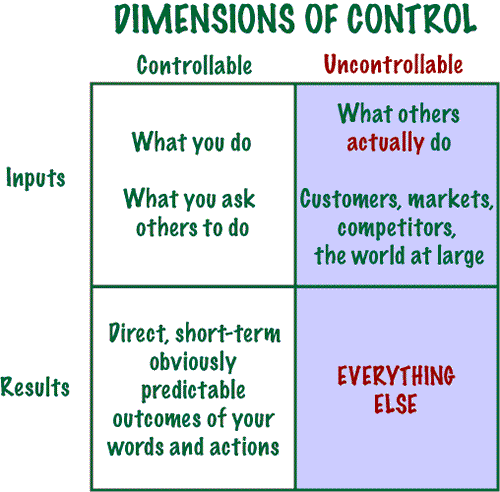
Amongst all the causes of stress, two stand out from the rest as massive producers of every sort of anxiety: trying to control other people and trying to control the future. These two probably account for more than half of all stress in the workplace—probably in life in general. They are linked because both are, fundamentally, attempts to control what is not controllable.

Controlling Others


Aren’t managers and supervisors paid to control the members of their team? Don’t organizations exist to marshal and control large numbers of people and focus all their efforts on a few, chosen goals? That is the theory, at least. But however many people assume it to be true, the facts show otherwise.

How do you propose to exercise this control? By discipline? Even bloodthirsty tyrants, who will kill opponents (or anyone else) without a moment’s thought, eventually fail when they try to coerce people to bow to their will. No organization has sufficent power to force compliance by discipline alone. By persuasion? Better, but still unlikely to produce more than partial success. There will always be some who refuse to be persuaded. Bribery? Organizations are full of legal forms of bribery (usually called incentives) whose purpose is to get people to conform. Do they work? Sometimes, and sometimes not. They also have a limited shelf life. Today’s incentive becomes tomorrow’s norm.

The underlying problem with all attempts to control others is the same: by doing so, you make yourself responsible for each and every situation in which people don’t do exactly what you wanted them to do, say what you wanted them to say, or respond exactly as prescribed. In effect, they take the action and you take the blame.

Believing that you can control people at work in anything but the most general sense is futile. Accepting responsibility for doing it is going to send your stress levels through the roof.
However hard you try, getting even a few people to act exactly as ordered is difficult. The military, who used to have a culture of absolute, unquestioning obedience to superiors, eventually accepted that it did not work. Organizations have no such culture. Nor do they have available any sanctions that go beyond being fired. Plenty of people will choose to lose their jobs rather than do something they don’t agree with or don’t want to take part in. Believing that you can control people at work in anything but the most general sense is futile. Accepting responsibility for doing it is going to send your stress levels through the roof.

Controlling the Future


When you look at this phrase, “controlling the future’” it’s obviously a non-starter. How on earth will you do that? Can you make the markets and your competitors shift at your whim? Can you control the global economy—or even the fashions that often drive spending? Do you have supernatural powers of foresight and divination to know what will happen next week, next month, or next year?

Nonsense, isn’t it? Yet every day, hundreds of thousands of working people agree to be held responsible for controlling at least their part of the future. It’s called “getting results” or “delivering the goods.” They agree that if the desired results don’t materialize on time and on budget, it is down to them. What happens in the future is their responsibility. They will “make it happen.”

Armed with everything from sheer determination to sophisticated planning and scheduling software, that is what they try to do. They accept that the task is both possible and reasonable. If they fail, they must, therefore, accept the blame.

Is it any wonder that stress is more prevalent in the workplace than the common cold? They are both taking on an impossible task and agreeing to be judged by the results. Not their effort, their input of time, expertise, or skill, but the actual result: the one thing in that list over which they have no control whatsoever. You can control how much effort you make. You can control how much you work to apply your skill and knowledge to the task before you. Within the limits of a 24-hour day, and however long you can stay awake, you can control your input of time. Will any of these guarantee success? No. Will the results depend entirely on what you do? No again.

Things will always go wrong. The future will always disappoint, just as there will always be lucky breaks and unexpected good times. Yet by claiming the credit when luck is on your side, you find yourself accepting the blame for when it isn’t.
My own guess is that maybe 75% of all workplace stress comes from people agreeing to be held responsible for outcomes that are not under their control, whatever they do. Things will always go wrong. The future will always disappoint, just as there will always be lucky breaks and unexpected good times. Yet by claiming the credit when luck is on your side, you find yourself accepting the blame for when it isn’t.

Human beings dislike the idea of blind chance. They long for some way to control what happens to them, whether it’s by sacrificing animals (as used to the norm in the ancient world), prayer to their chosen god, or simple belief in their own determination to make things turn out as they want. Since reality is essentially random and many outcomes are due to little more than chance, each one of these approaches will seem to work on occasion. You will always be able to find someone who slaughtered a chicken, prayed in a particular way, or demonstrated personal drive verging on mad obsession, and got the result that he or she wanted. That’s how chance works. You’ll be able to find just as many people who did all of those things and got a load of lemons instead. But we don’t want to think about those, because they undermine our faith that there is something, or someone, somewhere who is in charge of events and whose actions we can influence in our favor.

But don’t accept the absurd idea that you can control the future or other people.
Give it up. By all means try, pray, or do whatever you hope may increase the probability of success (short of abusing helpless and innocent animals). But don’t accept the absurd idea that you can control the future or other people. Being fallible is part of being human. So is dealing with the times when everything goes wrong. If you pretend that either is your fault, you’ll never be short of stress in your life—plus a massive dose of guilt to add to your woes and anxiety.

Smile. Shrug. Let it all go. Get on with life. That won’t affect the future either, but at least it will drastically lower the amount of stress that will come with it.


Email Newsletter icon, E-mail Newsletter icon, Email List icon, E-mail List icon
Sign up for our Email Newsletter


Add to Technorati Favorites Stumble Upon Toolbar

Tuesday, January 23, 2007

Success You Can be Proud Of

Going through some “to read” saved blog links, these words from Steve Olson jumped out at me:
Many of our interpersonal anxieties and social problems revolve around a dysfunctional belief that money is a measurement of fairness, equality, and human value. [via]
He linked to a piece by Charles Wheelan at Yahoo! Finance [link] which quotes research showing that people are often more motivated by a sense of competition than by the absolute amount they earn. That is, they want to feel they are doing better than others more than they want to get any particular level of reward.

Here’s Mr. Wheelan’s key point:
In other words, we care less about how much money we have than we do about how much money we have relative to everyone else. In a fascinating survey, Cornell economist Robert Frank found that a majority of Americans would prefer to earn $100,000 while everyone else earns $85,000, rather than earning $110,000 while everyone else earns $200,000.
This ties in with similar behavior in other fields, such as “competing” over who works the longest hours or suffers the greatest amount of stress [link]. It seems that our competitive society has so infiltrated people’s minds that they care more about “beating” others than anything else.

This is the path to madness.

If all you achieve is the same again, the sense of pride and excitement quickly goes out of it.
The trouble is that achievers must continue to achieve, and we have built a whole business culture around a cult of personal achievement. In many ways, achievement is always relative. Even if your are not openly competing against someone else’s success, you are competing against your own in the past. Whatever you do today can be done better tomorrow. If all you achieve is the same again, the sense of pride and excitement quickly goes out of it. Like the old saying, “Nothing succeeds like success,” you could say that nothing gives you a buzz like succeeding more than you did the last time—or more than somebody else. Just as in sport, the belief goes around that winning isn’t everything, it’s the only thing.

Is competition somehow wrong? Should we be trying to set up some kind of collaborative utopia, where no one ever competes with anyone else?

I cannot see that this makes any sense either. Competition is everywhere throughout the natural world. Many of the comforts that we enjoy were discovered and developed from a sense of competition. Our whole capitalist economic system is based on competition.

Still, competition needs to be kept in perspective. Winning isn’t the only thing—even in sport. If it were, there would be no reason to stop athletes from using drugs to increase their chances. Much of the pleasure of a sporting match comes from it being a fair test of skill between opponents. At the end, everyone lives to play another day. The winner who humiliates and belittles the loser is seen as doing something reprehensible. Crowds love to support the underdog and see the proud champion brought down a peg or two.

If people would only take the time to slow down and reflect on what is really going on, I don’t believe there would be a problem with competition.
In business, as everywhere else, competition needs to be tempered by compassion and a sense of fairness. Payment should reflect proper reward for work done, not be used as yet another forum to display crude one-upmanship. Those who do well are rightly praised; but those who do not manage quite the same standard (yet) should be encouraged, not humiliated. That is something everyone should bear in mind as the dreaded (and typically negative) performance appraisals come around.

If people would only take the time to slow down and reflect on what is really going on, I don’t believe there would be a problem with competition. It gets out of hand because people are carried away by the thrill of winning (over almost anything) and never stop to consider the implications, or the other people involved. I hope most of us aren’t really so crude and uncivilized as to want to crow over others regardless.

Years ago, I talked with a man who was a keen tennis player, as well as a ruthless competitor at work. He told me he played tennis with his 11-year old son every weekend. “I wipe him off the court,” he said. I felt amazed (and a little sick) and so asked him why he did it. “So that one day, if he is ever good enough to beat me, he’ll feel the triumph,” he said. Then he laughed, and added: “Not that it will ever happen.” He was sick. It never seemed to occur to him that beating a child in a game of tennis was hardly an achievement; or that the constant reminder to his son of who was “top dog” was probably doing terrible things to the child’s mind.

An extreme case, of course, but it makes a point. Winning isn’t everything. Sometimes, it isn’t even anything. Success that you can be proud of comes from fair and reasonable competition. And setting a boundary on success isn’t a sign of weakness; it’s proof that the person involved has thought it through and decided that when enough is enough, keeping some balance between life’s many aspects counts for more than being better than the next guy in any one of them. Earning more doesn’t make you a better person. Nor does having a grander job title or a bigger office—especially if what it took to reach that position soiled and diminished your true worth as a human being along the way.

Add to Technorati Favorites Stumble Upon Toolbar

Monday, January 22, 2007

Thinking About Success (Part 3)

This is the third in this short series. You can find Part 1 and Part 2 via these links. Once you have decided what success is—at least for you—the next step is to work out how best to achieve it. The subject of this posting is the clashes this can cause in your life. Achieving success raises both practical and, quite often, emotional and ethical questions. Most people experience some clashes between the actions that they believe are most likely to bring them success and prosperity and their personal values and beliefs. Work/life balance is usually seen purely as a problem of scheduling time. This is far too superficial. The reason why it is often so difficult to obtain a balance between the working and non-working aspects of life is the clash of values and expectations that lead to the symptoms of scheduling problems.

It’s easy to assume that personal achievement and workplace success are more or less identical; and that material prosperity is probably more important as an external sign of success than for the extra comforts and richer lifestyle if provides. Looked at this way, long hours, constant availability for workplace demands, and the expectation that work will always come first are expressions of an underlying set of values. Work is what matters most, because success at work is the most important aspect of a “good life”. All other aspects of living must be held subordinate to the central drive to do well in career terms. And since that matters so much, it’s obvious that you must do whatever it takes to achieve that goal. Seen through the filter of this value set, there are no scheduling problems; no issue of work/life balance. Work comes first. Period.

The hidden problem lies in the phrase: “do whatever it takes.” In reality, while many ambitious people are prepared to take this almost literally, even they will have some inner boundaries that they will not cross easily, or without bad feelings afterwards. For the rest of us, the demand to do whatever it takes to achieve working success causes far more obvious clashes. That’s why there is a prevailing sense that to be successful usually means “selling out” to the corporation. Given the unspoken expectation in most organizations that fitting in with every corporate demand comes with the paycheck, it’s clear that setting boundaries on what you are willing to go along with is going to cause trouble some time.

If we look at some of the most common activities associated with career success, it’s easy to spot the potential problem areas:
  • Playing office politics.

  • Putting advancement before friendship or loyalty.

  • Never questioning the corporate line.

  • Subordinating all other aspects of life to the organization’s needs.

  • Making yourself visible (and amenable) to the demands of the “movers and shakers.”

  • Following the expected script (to the letter) in all external dealings.

  • Putting organizational needs and interests before our own or those of your family.

  • Doing whatever it takes (those words again) to achieve your goals and budgets, however demanding (or unreasonable) they may be.
It’s easy to characterize work as a kind of paid slavery to the all-powerful employer, but that isn’t really how it works. Most people fit in more or less willingly with what they see as the inevitable demands of a successful career. They want the money, the prestige, the recognition, and the status. They’re willing to “pay” a price for getting these things, because that’s how the world works. You cannot be an independent spirit and still succeed in the corporate world. At least, that’s the general assumption.

Yet our inner values and needs won’t simply go away. You may believe that smooching the big bosses, and displaying yourself to best advantage on every minor occasion, will get you to the top. But if, deep down, such behavior makes you feel bad, what you are creating is an internal dissonance that will eventually cause you great stress and upset. Those inner values are part of you. They define who you are. If what you have become and who you are don’t match reasonably well, there will be problems.

The major questions about how to achieve success are not the practical, superficial ones about what job to choose, or which career to pursue. Those things matter, but they can be changed and adjusted until you get them right. The real problems of attaining success are matters of value:
  • What kind of success best fits with your personal values?

  • Can you honestly do what it will take to achieve that success in that context and still be who you are?

  • How can you decide on which compromises are acceptable, if what you value in different aspects of your life turn out to be incompatible?

  • How far does your personal view of life’s priorities match with what your employer expects?
Most of us live in societies where material and career success are highly valued; where questioning the prevailing view of the “good life” is seen as both suspicious and lacking justification. I suspect it has always been like this. But, in the past, people had many fewer options and far lower expectations. In the remote past, survival alone would have been enough. Even in the 19th century, few peoples’ expectations ran much beyond a life of modest comfort and a reputation for basic respectability.

In recent times, the meteoric rise of the advertising and marketing industries has changed that. Almost every moment of our waking time, we are bombarded with images of desirable goods and services. We are encouraged to aspire to “lifestyles” that necessarily include a certain level of disposable wealth. We are constantly urged to push ourselves towards even more prosperous ways of living, because doing so demands that we spend more. No one urges a life of simplicity and modest aspirations. There’s no money in it. The 1960s produced an urge to drop out, but it didn’t last. Aside from those dealing in drugs, no one else in the commercial world could base a business on a lifestyle like that.

Achieving real inner success is never going to be easy, not just because it may demand considerable determination and talent, but because it will almost always require you to act in ways that are contrary to the prevailing expectations of others.
The inner values that tell you what is right, wrong, good, or bad are essentially personal. It’s almost impossible to explain them to anyone else, since what formed them was a set of life experiences unique to you. Yet our own values always feel unquestionably right and inevitable. Since they determine how we see the world, and everything in it, we cannot view reality in any other way. So if our values do not quite match those of the people around us, we must either suppress them (and “sell out”), or risk being seen as eccentric or worse. Achieving real inner success is never going to be easy, not just because it may demand considerable determination and talent, but because it will almost always require you to act in ways that are contrary to the prevailing expectations of others.

Truly happy and successful people—however much or little they earn—are always those who have managed to match their life choices to their inner values. For some, this may lead to fame and wealth. For others, it may produce a life of contented obscurity. Whatever it produces, that life is right for that person.

I often urge people to slow down and reflect more. The reason has a lot to do with hoping that, by doing so, they will take the time to act out of their own values and nature, not just blindly follow what is seen as conventionally good for them. Most of the misery in the corporate world comes from people getting themselves into situations that force them to act in ways that violate their real nature.

You can do it, but the cost in stress and unhappiness will be an extremely high one. And the highest cost of all may be to look back on your achievements in old age and realize that what you gave up in return was what you truly wanted.

Email Newsletter icon, E-mail Newsletter icon, Email List icon, E-mail List iconSign up for our Email Newsletter


Add to Technorati Favorites Stumble Upon Toolbar

Saturday, January 20, 2007

Introducing the “Slow Leadership” Newsletter

I will shortly be publishing the first ever “Slow Leadership” newsletter. I haven’t rushed into it, because there are so many newletters around and I hesitated to add to their number. However, some of the topics being covered on this site—and some raised by excellent and thoughtful comments (This blog has an amazingly bright readership!)—cry out for the slightly longer and more detailed treatment that will only work in a newsletter.

As it stands, the intention is to publish in-depth articles on topics first raised on the blog, additional thoughts based on reader’s comments, more “How to . . . ” articles, and links to interesting news snippets.

If you would like to be on the mailing list, please use this link below.

Email Newsletter icon, E-mail Newsletter icon, Email List icon, E-mail List iconSign up for our Email Newsletter


P.S. When you subscribe, you will receive an e-mail asking you to confirm your subscription. Please respond to this e-mail, or you will not be added to the mailing list. It’s a simple precaution against anyone else signing you up for something that you do not, in fact, want.
Add to Technorati Favorites Stumble Upon Toolbar

Friday, January 19, 2007

What Everybody Needs to Know About Secrecy in the Workplace

The main thing people need to know about secrecy is that is usually isn't needed anyway. And unnecessary secrecy wastes time, costs money, and gives a huge boost to frustration and stress in the workplace. Here's how to combat it.

Unnecessary secrecy isn’t just plaguing governments these days, it seems that companies too do a better job of hiding data from their own managers that they do in making sure competitors can’t access it.

That’s the message from a recent survey, conducted on both sides of the Atlantic [link]. The consulting group Accenture spoke with more than 1,000 middle managers in large companies in the United States and United Kingdom to learn how they gather, use and analyze information.
[The survey] found that middle managers spend more than a quarter of their time—up to two hours a day—just looking for the information they need to do their jobs, and when they do find it, more than half of it is wrong or of no value to them. As a consequence of this, almost six out of 10 said that they miss information that might be valuable to their jobs almost every day because it exists somewhere else in the company and they just can't find it.
It seems that much of the difficulty arises because vital information is held on personal computers and databases, not in places on servers that are easily accessed by others.

Our corporate cultures are obsessed by questions of power and status, so this doesn’t surprise me. The old adage that knowledge is power has never been more widely acted upon. And during times when people fear for their jobs, nothing is more predictable than an increased tendency to hang on to any kind of leverage they possess. If that means making sure no one can get to important information except through them, that is what will happen.

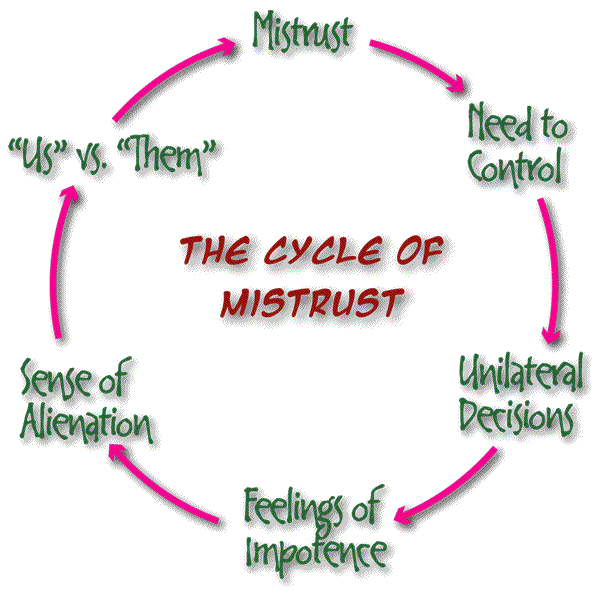
Secrecy has one simple cause: lack of trust in others. If you trust your colleagues and bosses, there is no need to be secretive. You probably know perfectly well what information they need—or ought to have—and it’s clear that you should make sure that they get it. This doesn’t happen because you don’t trust them. And you probably have good reason. We no longer see those in charge taking the common good as their guide. Greedy executives put themselves and their own enrichment first, regardless of all the cant that is written about the purpose of management being to increase shareholder value. the invention of payment by stock options is only one of the ways that “shareholder value” has been converted into “executive enrichment.”

Unnecessary secrecy increases costs, wastes time, and hands competitors a huge advantage.
If trust breeds trust, mistrust breeds mistrust even more quickly. Greedy, self-serving executives create mistrust on an organizational scale. that’s why they should be reomved from positions of power. What they do is so harmful to the future of the business—and the true interests of the shareholders—that any short-term profits increases that may produce are insignificant in comparison. When you create a culture of greed, you virtually ensure that the organization will be filled with secrecy, backstabbing, and a massive waste of resources as people and departments fight their colleagues for advantage, not their competitors for market share.

Creativity thrives on the free flow of information. You never know when someone will connect seemingly disparate pieces of data and come up with a new product or approach that no one has thought of before. By making data hard to access, you are stifling one of the major engines of innovation. In that way too, your organization is shooting itself in the foot, if it allows unnecessary secrecy to become widespread.


To deal with pointless secrecy, you should:
  1. Assume all information should be open to everyone, unless you have a powerful and logical reason to keep it secure.

  2. Make sure that data is easily accessible when you aren’t there. If it’s on a personal computer, tell others how to find it. If it’s on a server, don’t hide it behind passwords and barriers.

  3. Don’t keep important information only on a laptop that you carry around with you. Indeed, don’t keep it there at all. We’ve seen too many cases where genuinely confidential data, such as people’s personal details, has been put of a laptop and them left in a cab or restaurant for thieves to find.

  4. If you think someone needs data that you have, and isn’t asking for it, send them a simple note explaining what it is and why you think it would be useful to them.

  5. If you find that any of your subordinates are hoarding data for no purpose, sit them down and explain why this is a bad idea. If that doesn’t work, you may need to resort to discipline.

  6. Before you do this, make sure that your own conscience is clear. Many people hide data from the boss as a matter of routine. Don’t be one of them.
Trust has to start somewhere, so that somewhere might as well be you.
We need to break the cycle of mistrust and that means taking the risk of trusting people instead. You can’t wait for them to “earn” your trust, because until you trust them they never will. And it has to start somewhere, so that somewhere might as well be you.

Secrecy should be restricted to an absolute minimum. In many cases, that means virtually none at all. Your competitors are probably far more interested in their own internal battles than they are in what you are doing. Besides, the more information that you make available to everyone, the harder it will be to pick out the small amounts that are truly significant to a competitor.


Add to Technorati Favorites Stumble Upon Toolbar

Thursday, January 18, 2007

The Road Least Taken to Happiness at Work

“Living From the Inside Out” is the Best Path to Happiness and Success

Most people make decisions about their life and work based on what is generally considered “right” and “good.” This is living from the outside in: letting others people’s expectations rule your life. You do what you do because that’s what you have been told to do. It’s a good recipe for frustration and stress. Living from the inside out means finding your own innermost values and basing all choices on those. That’s the best way to increase your happiness with whatever you do for a living.
In writing about careers, especially in the professions, management, or leadership, it’s not unusual to find the advice that you should “follow your bliss” or “seek out your calling in life.” That’s all well and good, if you know clearly what your calling is and you feel it strongly. What if you don’t? What if you’re quite unsure about the kind of work or life that would be best for you?

Many people—perhaps the majority even—don’t have much, if any, sense of having a “calling” to their particular work, but they do the job just the same. They want the money, or the status, or the sense of achievement. Trouble is, they aren’t very happy doing it, so they get frustrated and sometimes take it out on the people who work for them.

Can you find a calling, even if you aren’t aware of having any such thing? Would it help you feel more satisfied with your life?

I believe the answer to both of these questions is “yes.”

The root of the problem is living from the outside in: letting the world and its expectations set your values and choices for you, instead of doing it for yourself. When that happens, you do things because that’s what’s expected, even if it makes you cringe. You make yourself unhappy and the unhappiness spills over onto others.

There’s more than enough unhappiness in the world. How about increasing the store of happiness instead? Here’s what to do about it.
  1. First of all, slow down and give yourself time to think. It’s tempting to give in to all the pressure simply to get on with life, without wasting time asking yourself awkward questions about what you might prefer to do instead. This is a mistake. You can suppress your inner doubts for a while, and substitute all the supposed certainties given to you from conventional thinking, but they won’t go away. They’ll lurk inside you, making you unhappy and increasing your stress.

  2. Next, make yourself a list of what you enjoy most. Think about whatever matters to you most. Ask some friends what they see about you that you might have missed for yourself. Think back to the things that you enjoyed most in the past and put them on the list. What you’re looking for are the values that are most important to you.

  3. Never show your list to anyone else. If you do, they’ll suggest things you have missed off and ones that you should drop. If that happens, it will become their list, not yours and you’re back with living from the outside in: basing your choices on what others think. Besides, if you know others will see your list, you’ll likely censor it to be more “respectable” and conventional.

  4. Take your list as a work in progress. People change. What matters to you today, may be less important in a few years time. Still, it’s a good start. Now it’s time for action.

  5. Then try living from the inside out. Start with your deepest values. Focus on what feels most important to you and ignore what others say. It’s your life, isn’t it? If you’re called to be a manager, that’s a great calling. But so is the calling to be a musician, or a baker, or a candlestick maker. Whatever your values point you towards, that’s what you should do. You’ll do it better, enjoy life more and have more satisfaction.
Your life’s true story and direction are written in the “language” called values. It’s there, right in front of you, so learning to read it should be your top priority if you want a life that’s true to who you are. Following other people’s values and expectations isn’t a recipe for happiness. Following your own is.

Oh . . . and along the way, you’ll be spreading some of your newfound happiness to others instead of adding to life’s little miseries. Wouldn’t that be worthwhile?


Add to Technorati Favorites Stumble Upon Toolbar

Wednesday, January 17, 2007

Thoughts About Success (Part 2)

Is True Success Non-Material?


Another way to ask this question is to consider whether “doing well” in life is the same as “living well.” In Part 1 of this series, I reviewed various definitions of material success—prosperity, recognition, status, and independence—and considered whether they offered a clear path to follow on a quest for a good life. It seemed that the answer had to be “no,” mostly because no definition of material success seems to offer a sound recipe for living well. It also became clear that deciding how to achieve a good life via any definition of material success was equally open to dispute.
Many people dismiss the whole notion of finding a path to a good life through purely material success as a sideshow. They argue that what produces a life well-lived, together with feelings of satisfaction and personal value, has little to do with conventional measures of prosperity. Success in life and work, they argue, is not material. Prosperity and advancement are pleasant—even desirable—but should not be seen as sufficient life goals. True success has to do with matters such as finding meaning, value, happiness, and personal satisfaction.

One way of coming to grips with this viewpoint is to recognize it’s underlying premise: that success is not an end in itself, but a means to arrive there. Non-material definitions of success see the true goal of life as existing apart from all aspects of visible achievement. Indeed, they may see conventional indicators of success as blockages on the path to life’s real goals.

Does Success Guarantee a Meaningful Life?


Living a meaningful life is an appealing approach to defining living well, but it does not really offer a clearer definition than more materialistic outlooks.
Large numbers of people share the belief that personal prosperity is not a reliable source of meaning or value. They cannot feel satisfied with life unless it gives them some assurance that what they do has value over and beyond any rewards that they may gain. In certain circumstances, gaining this sense of achieving something meaningful may actually conflict with what it will take to be successful in a material sense. That is why such people may well forgo wealth, fame, even comfort, in pursuit of what they believe to be a more important set of goals. Living a meaningful life is an appealing approach to defining living well, but it does not really offer a clearer definition than more materialistic outlooks.

The difficulty with all such value-based definitions of success in life (and the actions and choices that leads to it) is plain: each definition is individual and depends on the fundamental values behind it. Unless you accept those values, the subsequent choices rarely make much sense. For example, those who value ecological responsibility might judge success in terms of minimizing any negative impact on the planet. To anyone who does not share those values, that definition of success would be, at best, meaningless—even incomprehensible.

Enthusiasts for any cause often to want to impose their values on others, by persuasion or force. The results are nearly always unfortunate, since values are highly personal and the majority of people resist anyone else interfering with them. Living a meaningful life is an appealing approach to defining success, but it does not offer any clearer definition than more materialistic outlooks.

Will material success guarantee a life that includes a sense of meaning? No, it won’t. If living what you judge to be a meaningful life is important to you, you must subordinate prosperity to your primary goal of finding meaning—however much other people see your choice as eccentric or idealistic.

Is Success About How You Feel?


From this viewpoint, success is purely instrumental. What each of us is really seeking is this set of feelings; happiness, satisfaction, pleasure, contentment, excitement, or whatever else we desire.
Perhaps material success is a proxy. If so, any objective definition of success is doomed to fail because success itself is merely acting as a means for gaining something else—something entirely subjective and emotional. Whatever feelings achievement is expected to produce are the true goal. Maybe feelings of pride, or recognition, or power, or importance in the world.

From this viewpoint, success is purely instrumental. What each of us is really seeking in our lives is this set of feelings; happiness, satisfaction, pleasure, contentment, excitement, or whatever else we desire. Successful actions would thus be defined purely as those most likely to produce such feelings in a suitably reliable way. If praise brings you feelings of intense pleasure, any action that produces praise is a successful one. In such subjective territory, one person’s source of positive emotions may differ profoundly from another’s. Besides, such an instrumental view would allow any action to be judged successful that produced the desired feeling. If a criminal derived pleasure from killing people, murder would be accepted as successful for that person.

This is obvious nonsense. To be acceptable to society as a whole, actions that people use to produce a life based on achieving positive feelings must also be socially acceptable (or, at least, tolerable) ones — which takes us straight back to conventional definitions of success: the ones that that are built around society’s current norms.

There is also another problem with an instrumental view of success. While we want to experience positive feelings, we usually want to avoid negative ones even more. Absence of pain may be as important as pleasure; success and prosperity may be sought, not so much for itself, but to escape from poverty and want. There is a good deal of evidence that people are more likely to choose actions that promise to help them avoid negatives that they are to select those that offer positive outcomes. We’ve already seen that a meaningful life may be neither easy nor happy. Now it seems that seeking a good life that is based on achieving positive feelings might have as much, or more, to do with escaping from negative ones. In either case, such feelings are entirely personal , so it’s hard to use what works to produce them as the basis for a wider definition of success.

Besides, success usually requires others’ approval or co-operation. Pursuing an individual feeling of happiness in defiance of what others see as acceptable behavior quickly lands you in trouble. You may want the constituents of material success because they lead to emotions that you desire; but unless those success patterns are also generally approved they are unlikely to allow you to avoid pain or other negative results at the same time.

Does “Doing Well” Really Mean “Doing Better Than the Next Guy?”


Does “doing well” actually mean being more successful that those we see as our peers, even if we try to keep this element in the mix hidden?
We live in a highly competitive society, where almost all success—at least in conventional terms—includes some element of winning out over others. Is it really the case that we cannot feel successful unless we are somehow clearly beating our “competition?” Does “doing well” actually mean being more successful that those we see as our peers, even if we try to keep this element in the mix hidden?

“Doing Well” almost always carries some connotations of being more successful than others. Indeed, where success is open to all, with neither competition nor significant obstacles, it is often dismissed as insignificant and “too easy” to be worth pursuing. To succeed is almost always equated with being a winner; and winning is all about causing others to be seen to lose. The adulation accorded to sports stars, those who win TV talent shows, and film starts or singers who win Grammys, Emmys, or Oscars makes it obvious that most conventional ideas of success—material or non-material—include coming in first in a tough race.

Of course, many people are uneasy with such definitions of success precisely because they must always produce more losers than winners. In a large field, like a whole organization, very few can win the greatest indicators of success, but huge numbers can—and must—lose to allow it to happen. Are all these losers by definition also unsuccessful in living good lives? Can you establish relative measures of success that allow for ability and effort, even if the final goal was not achieved? Won’t all such measures be seen for what they are: merely consolation prizes?

Defining success as winning satisfies a few and leaves everyone else out in the cold. On a large scale, it produces an under-class of those who have given up hope and are therefore prey to feelings of revenge towards the winners. In an organization, it leads to a favored elite trying to keep a mass of more-or-less alienated employees in their place. While competition may be an acceptable enough basis for defining success in sport, it’s drawbacks in the workplace seem to outweigh any benefits. Of course, it is still widely used, which perhaps accounts for persistent problems of morale and turnover in the most competitive businesses.

Using competition as a basis for defining success also causes people to focus on simple, tangible, and easily measurable indicators of winning or losing: like money, percentage changes in output, or comparisons with industry norms. It has become obvious that some of the outrageous payments given to top executives are driven less by greed than a wish to keep score and indicate your placing amongst your peers. Similar reasons lie behind the urge to seek promotion—even if you suspect the higher-level job will bring only greater stress and a higher chance of failure.

Maybe Success Cannot be Defined in a Single Way?


All the definitions of success that we have examined have failed in one way or another to form a sound basis for living a good life. Perhaps there is no clear definition that can be agreed upon that can serve in this way. Maybe, like obscenity, a good life is something we cannot really define—yet everyone recognizes when they see it.

In the end, we must each make our own decision about what constitutes success in living a good life. It may be conventional, like winning or making lots of money. It may include a commitment to seeking some higher meaning or acting in the service of others. It may include following a dream, or chasing a vision of life based on purely subjective desires. Whatever it is, it is the only kind of life success that will be truly satisfying. Success is what we say it is, whether others agree or not. Following external definitions of success may bring wealth, power, or prestige, but it will never bring happiness if it runs counter to our own, internal values.

These values, and they impact they have on achieving any kind of life success that will bring satisfaction, are the subject of Part 3 of this series.

Add to Technorati Favorites Stumble Upon Toolbar

Tuesday, January 16, 2007

Knowing What is (Really) Good for You

The con