Saturday, June 30, 2020
News and Views: June 30th 2007
The Performance Review lottery
Are performance appraisals are either an unscientific lottery or just a measure of your popularity with the boss? It seem that there is new evidence to back either position. Research has revealed that the majority of employees who report to multiple bosses get completely inconsistent ratings. It seems that today’s obsession with “measuring” everything isn’t matched by an ability to get the measures right. [link]The arrogance of macho managers
One of the commonest characteristics of macho, grab-and-go managers is their unbelievable arrogance. In this thoughtful article, Daryl D. Green reflects on what happens when a leader gets side-tracked by his ego and personal pride. The list of companies and other organizations brought nearly to ruin by arrogant leaders is a long one. Personally, I can’t think of a single case where a leader’s arrogance has been other than harmful. [link]Getting away from it all
James Dale gives a long list of top leaders who sneak off to play golf, play in rock bands, go fishing, or “waste” their time in other ways. His point is that: “Sometimes you should do something that isn’t work, refreshes your mind and body, and gets you out from behind your desk, computer, car, or airport lounge.” Not only is it a great way to give yourself perspective, he argues. It’s a great way to get ahead at work too. [link]Is working less better for the world?
That’s the argument made by Dara Colwell. Her view is that Americans are working harder than ever before and at a greater cost to the environment, while research suggests that practicing a simpler lifestyle made people happier and used fewer resources. Maybe slowing down is the best way to go “green?” [link] [via]Mindlessness rules!
Robert Waterman, Jr., in his book Adhocracy , says that: “ Stress—the kind produced by rapid change—seems to make us revert to mindless, programmed behavior.” True enough. This post suggest four ways to deal with that. [link]
 Can technology reduce stress?
The Chicago Times thinks so. They say that technology is playing an increasing role in helping workers combat stress: everything from relaxation techniques perfected with a computer program to software that alerts office workers when their stress levels reach a certain threshold. Peter Buttrick, head of the cardiology division at the University of Colorado Health Sciences Center, doesn’t agree. He says making major lifestyle changes, such as exercising, moderating the foods you eat and eliminating things that are stressful, are key to producing long-term effects on stress levels. [link]Fired by your family?
Tom Stern, author of CEO Dad: How to Avoid Getting Fired by Your Family , believes that there can be many reasons for the fracture between your work and your family life. “In mine, it was both nature and nurture--a genetic high-drive component that I was born with and a family culture that overemphasized overachievement and underemphasized closeness and fun,” he explains. Try his website at www.tomsterncentral.com. [link]
 Busy Girls’ Guide
Did you know that there’s a site for women trying to handle a life and a career? That it dispenses advice on areas from organizing your life to dating and romance? You didn’t? Well check it out . Here’s a sample of Is your laptop wrecking your back? “The simplest rule to follow is: ‘do the opposite movement to the one that is causing the problem’. e.g. if your screen is to your right, move it to the left. This can be applied beyond just working practice - sleep on your other side, carry your bag on the other shoulder, hold your phone in the other hand.” [via]Is self-discipline the answer?
CIO Magazine offers “Five Sensible Tips for Achieving Work-Life Balance,’ including Maintain boundaries between work and home, Stick to a schedule, and Delegate. Not rocket science, eh? [link] [via]
Labels: News


Friday, June 29, 2020
What are you busy doing?
It’s not a trick question. Workplaces everywhere are full of people busy doing next to nothing . . . only they don’t realize it.
It’s one of the most prevalent, but least remarked upon, problems of our information-rich age. Today’s technology and management cultures allow anyone to work away busily with every appearance of being productive—even creative—when all they are really doing is treading water. Here’s how it works.What these people are doing is mostly shifting information around. They spend large parts of their days responding to e-mail and voice mail; they attend meeting after meeting after meeting; they watch scores of presentations and prepare still more. It all appears extremely important and productive, but when you look at it closely, what you see is an organization that spends nearly all its time swapping information from person to person, without having the time to consider fully what it contains, let alone act on it.
What is in all those e-mails, instant messages, and voice mails? Typically, requests for information or responses to such requests. You might have 100 e-mails in your in-box, of which roughly one quarter are requests to you for information, one quarter contain information that you have requested, while the remaining half contains copies of e-mails swapping information between other members of the organization.
Let’s start with the half that are cc’ed; you didn’t ask for those and probably don’t want them, but you still have to spend enough time reading them to be sure that there isn’t anything important hidden in them somewhere. They keep you busy for some time—genuinely busy—but none of that time is productive. The quarter that contain requests to you for information is going to take up another large chunk of time: getting the information, setting down in the right way, and passing it to the person who requested it.
Is that time productive? Generally speaking, you can’t know, because that will depend on what the person receiving the information does with it. In many cases, they spend time collating and combining it with information from other people, then passing the whole lot on to someone else. How useful is that? You have no idea; most organizations have computer discs and filing cabinets full of such collated data that no one has ever read or ever will read.
Surely the data that you asked for is going to allow you to do some productive work? Well, maybe. You may have asked for it because you have to produce a report, complete with tables of collated data, for your own boss. What will he or she do with that report? My guess is skim over it, pick out one or two bits of information, and add those to another report that he or she is doing for someone higher up the hierarchy.
Strangled by data?
The curse of information technology is that it is so very, very powerful. It can collect, collate, and analyze data on a scale people fifty years ago would have thought impossible. It can pull data from all around the world, seeking out sources that would have been totally invisible to people back then. It’s a wonderful tool, with almost limitless possibilities. The problem comes, not from the technology itself, but from the use people make of it.They overwhelm themselves in more data that their brains can handle, afraid that some missed or omitted piece might be the one that proves to be vital. They commission reports inches thick (far too much ever to read in the time left over from shuffling all that other data around), then base their choices on summaries of summaries of summaries: the one page of information that would have been all that their grandparents would have had available; all that the human mind can process in the five minutes or so allocated to making the decision.
And all those meetings? They mostly consist of people “sharing” information that they have spent hours collecting and preparing precisely to share in that meeting. Whom do they share it with? Those who will either ignore it as irrelevant, question it if it doesn’t show what they want, or use it to produce still more presentations for future meetings.
That’s how people can end up extremely busy, yet doing nothing more than moving information around for the sake of generating more information and more demands to move it somewhere else.
No time left for what really matters
I’m not saying information can’t be vital, but in this welter of data it’s hard to see that anyone is allowed the time to do the most important task of all: to sit and think carefully and deeply about what even a tiny fraction of all this data is revealing. We’re placing such demands on our brains that stress and mental are causing mental overload. We have all this wonderful data; but we are so confused, tired, and distracted that what we do with it is crippled.Today, everyone is running around, working their tails off, shifting information like never before, and imagining that they’re being productive. They’re really not. They’re busy, sure, but they no longer have time to be thoughtful or genuinely creative. They have become slaves to the information mill, grinding out more and more data to increase this overload and generate still more data requests.
Just because you can do something, it isn’t always something that you should do. We are all at the mercy of the limits of the human brain to absorb information and process it in useful ways.
Even the smallest of today’s personal computers can process more data in a few moments than most people can process mentally in a lifetime. For example, you can send a file containing the equivalent of all the words in the Bible and the plays of Shakespeare and War and Peace to someone anywhere in the world at the click of a mouse.
So what? It’s technologically marvelous, but is it really useful?
That’s the question we need to be asking ourselves. If a normal human being can’t use the data to produce some sensible outcome, why waste the time collecting, analyzing, summarizing, and sending it? It will make many people very busy, but it’s hardly the stuff of useful work.
Labels: management attitudes, priorities
Thursday, June 28, 2020
Counting the costs of compromise
What happens when you abandon your beliefs and dreams for the sake of fitting in and getting on?
Conventional management thinking places a large premium on being a “good team player.” That sounds harmless enough—even beneficial—but it’s worth considering more carefully what it means in practice, especially in workplace cultures based on macho styles of leadership.To be a good team player ought to imply nothing more than acting in ways that don’t cause needless problems for other people. Perhaps it might also suggest friendliness and co-operation. After all, someone who acts totally selfishly, always demanding that their needs are put first, is neither pleasant to be around nor a useful colleague.
This is the commonsense or natural picture of a good team player: friendly, co-operative, willing, when needed, to take a back seat for the sake of helping the team. Not too selfish, not too demanding, not too solitary or withdrawn to make a satisfactory colleague.
The new version—the macho manager’s team player
But that’s not what today’s macho leaders have in mind when they use the phrase. To them, a “good team player” is totally compliant at all times; never even thinks of rocking the boat; never questions long hours or causes problems by wanting to take vacation when it’s not convenient (which is almost always). When he or she is away from the workplace, supposedly relaxing on some beach or enjoying a break, the good team player is still 100% available: checking in constantly with those still at work, answering e-mails, talking on the telephone, dealing with problems.This kind of good team player isn’t purely the result of massive staff layoffs that have reduced manning to the level where anyone’s absence causes major problems. This kind of team player is also a large part of the cause. Organizations know that they can strip staffing to the bone, and beyond, precisely because those who are left will still cope—regardless of the crushing hours, the stress of being continually on-call, and the havoc it makes in the rest of their lives.
Why do people put up with it?
In large part, of course, organizations rely on people's feelings of loyalty. Not loyalty to the business, mostly, but loyalty to colleagues, who will be forced to take up any slack if someone refuses to give up vacation time or work a 60 or 70-hour week.Fear of being thought disloyal, however misplaced, does at least provide an explanation that shows most people in a good light. The other reasons behind people’s willingness to play the “good team player” are not so pleasant: greed, cowardice and ambition.
Compromising with unreasonable organizational demands to earn lots of cash, snag that promotion, or through fear of being excluded from the ranks of high-fliers and corporate favorites, suggests base and selfish motives: the complete opposite of the public persona of the good team player. Yet these reasons behind playing the “good team player” role are probably as common as the others. No one is truly coerced into staying compliant. It always takes some measure of personal acceptance. In some people, that acceptance is downright eager . . . provided the price is right.
Counting the cost of compliance
Here’s what happens as a result. The organization goes on reducing staffing and piling on fresh demands, since it has now created a culture in which anyone who refuses the extra, unpaid hours is marked down and ostracized. Managers continue to rely on a compliant workforce, who will do as they are told and even come to pat themselves on the back for being so loyal and helpful—ignoring the proofs, in the form of yet more pink slips or even higher demands, that this loyalty is a one-way street.Those with the most courage, the highest levels of self-confidence, the greatest commitment to ethical principles, and the strongest personal values leave. If they are replaced at all, their successors will be chosen to be less “difficult” (and will almost certainly earn less money too). Although this represents a shocking loss of talent, many organizations ignore that because the process gets rid of “troublemakers” and people who don’t match their twisted definition of the good team player.
The ones who stick it out are faced with an ongoing choice between fitting in or risking trouble by trying to achieve some kind of work/life balance. Every concession to the organization, however small, eats away at their ability to resist future expectations. What began as a willingness to do some extra work to see things through a bad patch becomes the norm.
High-fliers are often hardest hit
One of the differences between high levels of stress and actual burnout is the presence of depression. Someone suffering burnout has given up. He or she no longer has the power to fight, nor the self-esteem to put the blame on the organization, where it belongs. The burnout victim was, typically, an ambitious high-flier, a good team player who gave and gave until there was nothing left to give. Being a high-flier doesn’t buy you a free pass. Going along with crazy demands through ambition or greed can lead you beyond the point where it’s still possible to back out without harm.Facing the future
There should be no call to sacrifice the rest of life to work demands. Work is part of life, not the other way around. Civilized countries rightly outlawed once-common labor practices like employing children, paying in tokens that had to be redeemed at a company store, sweat-shop conditions, harassment, and sacking people without paying their outstanding wages. Did the leaders of the organizations of those times welcome such laws? Of course they didn't, since such practices benefited their profits. I don't say these are bad people (mostly). What they are is myopically focused on making money and able to convince themselves that the ends justify the means. Besides, the argument goes, it's a free society and plenty of workers are happy to accept the conditions offered.Is this so? In a way, it is. In the past, people were forced to accept wretched working conditions or starve. What is amazing today is that so many of their descendants embrace them willingly. Organizations long ago learned that coercion was far less effective than creating a widespread belief that working your butt off is somehow meritorious—the sign of respectability, social status, virtue, and the much-hyped “good team player.” We live with a generation in charge of the world—my own—who have mostly swallowed wholesale the idea of the value of a strong work ethic.
Instead of attributing our unprecedented increase in wealth over the last fifty years to the right reason—technology-created productivity—many people still go with the idea that it’s due mostly to individual hard work; the way that hard work always made you better off in the good old pre-technological past (only it didn’t, outside of fairy tales). We prefer to believe in the sunny myths of the Great American Dream than recognize the realities of the world we actually live in. Even in the past, the majority of poor immigrants didn’t make a wonderful life, however hard they worked. A very few did, and they became the stuff of stories. The rest stayed poor and made out the best that they could. Nothing much has changed.
The cost of compromising with macho leadership can be extremely high, even for those few who claw their way into the ruling elite. A hundred years ago and more, the ultra-rich were characterized by a lifestyle that generally avoided work altogether, in favor of lavish parties and a cadre of henchmen who dealt with the tedious business of making yet more money. Today, even the ultra-rich have bought into the belief that work is somehow a good thing in itself. And since the rich and powerful always want the largest share of whatever is seen as most valuable at the time, today those ultra-rich executives are likely to spend the most time at work of anyone—and have the most hectic and stressful lifestyles. Maybe that is their punishment. In creating a culture that puts a totally irrational premium on long hours and hard work for their own sake, they have become victims of the monster that they unleashed.
I can only hope that the new generations entering the workplace have better sense than to compress their lives and dreams to fit into a broken system of deeply-flawed values. It's time to take back our time and our lives; time to find new ways to organize how people work together that don't threaten to destroy us.
Labels: civilized work, corporate culture, enjoying work, management attitudes, thinking about management
Wednesday, June 27, 2020
Keeping your sanity and your cool
In today’s manic workplaces, personal boundaries require constant attention.
Boundaries are essential to effective organizational functioning. They’re just as important to individual functioning too, especially in the workplace. It’s dreadfully easy to allow organizational needs to swamp your personal space, reducing you to an automaton whose only direction is the one currently set by organizational policies and goals. Here’s how to stop that happening.Everyone knows the old saying that good fences make good neighbors. Nowhere is it more true than in the workplace, especially when it points to the need to establish and maintain personal boundaries in the face of continual pressures to lose your identity in the group.
Good fences make good neighbors because each side knows where the limits lie. This side is mine, where I can choose freely; that side is yours, where I can enter only with your permission. You don’t trespass on my side and I don’t try to eat into yours.
Where boundaries are poorly marked or uncertain, there will be a constant tendency to disputes, land grabs, turf wars, and the consequent resentments—even violence. No one is quite clear about their limits. Those who are—or feel themselves to be—stronger are tempted to encroach. Bullies can grab bits of someone else’s territory and hope to conceal their aggression behind a smokescreen of uncertainty. Such boundaries as remain are under continual threat.
Keeping your space clear
That’s not an uncommon situation in many organizations. The powerful (bosses, top executives, ambitious colleagues) stand on one side of each individual’s boundaries. On the other side are that person’s private needs, personal life, family obligations, career hopes, and health requirements. If the boundaries are unclear, weakly laid down, or easily breached, the strong will be tempted to encroach, nibbling away until little is left that is not under their direct control.Without good personal fences, your time, your energy, your achievements, and your dreams are more or less up for grabs. Those bullies, domineering bosses, uncaring executives, and even so-called friends out for a free ride can just walk in and take more or less whatever they want: your time, your energy, your self-esteem, your confidence. The result is wage slavery.
Here are some ways to establish sound personal boundaries without alienating the guys on the other side.
- Start as you mean to go on. Setting and maintaining good “fences” from the outset will always be easier and less contentious than trying to establish them when others have become used to walking all over your patch.
- Be firm. Your boundaries are going to be tested. Others will try to take more time, energy, and personal space than you are willing to give. It’s tempting to give in a little, if only for the sake of seeming flexible. Don’t do it. It will always be harder to eject a squatter than stop them entering in the first place.
- Be crystal clear where your boundaries are. You can’t really blame the organization or the boss for trespassing on your private time, or requiring unreasonable work out of working hours, if you haven’t made it clear what you will do willingly, what you will do only in a true emergency, and what is going too far at any time.
- Defend against incursions. However clearly you lay down your barriers, there will be times when others cross them. If you don’t defend yourself, they’ll assume the boundaries weren’t meant seriously.
- Set your boundaries carefully. It’s well worth taking the time to be absolutely certain of where your boundaries should lie. If you aren’t sure, how can anyone else be? Constantly shifting them won’t work either. It will tempt others to assume that your decisions on boundaries are weak and easily changed.
- Negotiate when there is no dispute. The worst time of all to try to resolve any boundary problems is when they are in dispute. Don’t wait until the boss expects something you aren’t prepared to give to talk about the whole issue. By then, emotions are aroused and firm positions taken. If you have the good sense to discuss boundaries when everyone is relaxed and can see one another’s needs rationally, it will give you a handsome pay-off. Later, all it will usually take is a polite reminder of what was agreed to get everyone back on their own side of the line.
- Don’t violate others’ boundaries yourself. You’ll be in a weak position to defend your own, if it’s known that you’re quite ready to step over the line with others whenever it suits you.
- Don’t be a sucker for hard-luck stories. Not every attempt to snatch something inside your boundaries will arrive as an obvious incursion. You’ll face a good many pleas and much wheedling based on claims that it will only happen just this once. Any time you give in sets a precedent and the next incursion will be harder to resist.
- Don’t be greedy. Other people also have legitimate claims. Colleagues may reasonably expect a helping hand in a crisis. The organization that pays you has a sound claim for value for its money. The boss can reasonably expect respect basic loyalty. If you push your boundaries out too far, they’ll never be respected, whatever you do.
Work and the rest of your life are neighbors. As with all neighbors, life is calmest and most pleasant if they co-exist with a minimum of friction. That’s why good fences—and open communication about mutual boundaries—are so important.
Labels: civilized work, enjoying work, self-preservation, work/life balance
Tuesday, June 26, 2020
The 7 worst habits of Hamburger Management
- Always taking the easy way out. Lots of people want simple answers to all of life’s problems, but Hamburger Management makes this into an art form. Because they’re always in a mad rush, rarely bothering to “waste” time in thinking or reflecting, these macho managers depend on a few simple and conventional ways for doing everything. They don’t want to hear about problems; all they want are quick and easy solutions, preferably ones that won’t increase costs or take any real effort to implement. Instead of using information to help them explore and understand, they pick on one or two “key ratios” and use them as mechanical ways to tell them what to do.
Running things in this way produces rigid, simplistic styles of management. The focus on simple outcomes, like quarterly profits, obscures the reality that events don’t fit into neat categories in that way. Short-term, quick “wins” easily turn into longer-term slow losses. The constant haste and pressure to deliver on rigid goals makes it impossible to stand back and see how superficial and limited this approach soon becomes. - Acting first and thinking afterwards. I’m tempted to say never thinking, but that is probably too harsh. The cult of “getting things done” and “delivering results” has been twisted into an obsession with instant action and constant busyness, regardless of whether or not such action has a sound sense of direction. Anyone can run around being busy all the time. That doesn’t make you effective, it just makes you tired and stressed.
Sitting and thinking is not doing nothing; it’s one of the most important activities of management: working out what to do next for the best results. Just because you cannot see mental activity doesn’t meant that it isn’t there. Some prior thought can help you avoid problems, save time and cost, and retain flexibility. Jumping into ill-considered action, just to show how busy you are, makes no sense at all. - Always being right. Hamburger Management is based on a combative, militaristic picture of the organization: business as warfare against competitive forces and a wide range of “enemies” from environmentalists and unions to tax authorities. This produces a macho image of the leader, free from weakness of purpose or too many scruples about how to achieve it.
If being wrong is seen as a weakness, there’s no space for humility. Nor is it possible to acknowledge mistakes or change course. All that is left is to show boundless determination to push ahead on the original track, regardless of problems or evidence that it isn’t gong to work. There’s a long history of organizations and executives persisting with projects long after everyone else could see that success was hopeless. Nobody is always right. In reality, some of the weakest people are the most stubborn, since their fragile self-esteem cannot cope with admitting that they have made mistakes. - Talking when they should be listening. This is another aspect of the macho style: a command-and-control approach that is big on issuing orders and shouting down the doubters. Many macho managers have inflated egos. They focus so much on their personal agendas that they have no time or attention for anything else. They confuse being domineering and autocratic with being decisive.
When you don’t listen, you deprive yourself of the life-blood of effective leadership: good, up-to-date information about what is going on, so that you can respond accordingly. You also stifle creativity and suppress problems until they become crises. One of the main reasons why macho managers are always up to their butts in crocodiles is that they never get any information about what’s going on in the swamp. Their mouths are wide open and their ears are tight shut. Spending more time listening would help them head off more problems, instead of having to deal with them after they’ve grown to a dangerous size. - Not knowing when to give up and do something else. Hamburger Management has created a cult of dogged determination. The macho manager’s self-image is something like John Wayne, pistol in hand, facing down overwhelming odds. There’s nothing wrong with being determined—it can be essential to achieve results—but when it is taken to excess it becomes pig-headedness.
There’s an old saying that, if the only tool that you have is a hammer, every problem looks like a nail. If all you have to offer is being a tough guy, every goal will demand grim determination; every plan will call for overcoming problems by sheer force. You’ll distrust cleverness, since that threatens to make your bull-headed style look useless. - Believing that might makes right. Tough guys value being tough. Those who believe that their success depends on hard fighting to overcome the other guy value fighting ability. Domineering people value being number one. Management gun slingers value being quick on the draw. None of them can admit to any doubt about the excellence of their chosen approach.
The court cases of recent years involving top executives have shown the prevalence of the belief that might makes right: that winning is everything, pretty much regardless of how you do it. The history of civilization is the story of people doing away with the automatic assumption that the biggest bully should rule over everyone else. Sadly, that idea is alive and well in organizations afflicted with Hamburger Management. Whether it’s beating competitors with various dirty tricks, crushing internal dissent, or using shameless lobbying to prevent lawmakers from curbing your activities, might is the answer to every issue. - Focusing on the negative. Hamburger managers are constantly stressed. Partly as the natural result of all the haste, harassment, and obsessive activity they load into their lives; partly due to their constant focus on the negative. Whatever results they achieve, they are never enough. There’s always a gap between what has been gained and what can still be imagined. The performance of subordinates is never good enough. They can always find “gaps” between performance and some theoretical ideal. The continual emphasis on “more, more, more” makes everything done so far appear inadequate.
It’s one thing to have strong aspirations; quite another to be obsessed with the gaps between what you can imagine and what can be achieved in this imperfect universe. It’s said that the optimist sees the glass as half full, the pessimist as half empty, and the realist points out that the glass is twice the size it ought to be. The macho manager imagines an even bigger glass, dreams of the glory he or she would reap if it was filled, and announces that they will make sure it is done by the end of the next quarter. With no real idea how to make this happen, he or she hands this crazy goal to the team, who are told to do it—or else. If results fall short, they are the ones to blame. Never mind that the goal was ill thought out and quixotic, designed purely to glorify the manager. Do this a few times and everyone will become thoroughly demoralized.
Labels: civilized work, Hamburger Management, management attitudes, short-termism
Monday, June 25, 2020
How to work less and accomplish more
A simple way to increase your productivity without spending another minute working
There’s an easy way to get more done in the same total time. It doesn’t require fancy software, special organizational tools, or even understanding anything new. All it takes is to slow down and understand the realities of how you spend your time; then apply what you will learn.Let’s begin with a simple picture of spending 20 minutes working on a single task. It will take you a little while to get into the work, say 5 minutes. That’s for getting things together, settling down, and starting your mind working in the right direction. Before you leave the task, you’ll need maybe another 5 minutes to wind down, put things away, tidy up, and shift your thoughts to what you’ll need to be doing next.
Simple arithmetic shows that, of the 20 minutes total time elapsed, 10 minutes in total was available for productive work, with two sets of 5 minutes allowed for starting up and winding down. That gives a productivity ratio (productive to non-productive time) of exactly 50%. It look like this:
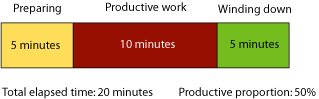
However, if you increase the total period of uninterrupted, focused time on that task to 30 minutes, your productivity ratio immediately increases to 67%, since it takes no more time to start up and wind down. You now have 20 minutes of fully productive time out of 30 minutes total time elapsed, like this:
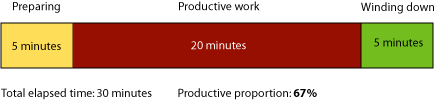
If you can increase the uninterrupted time to 40 minutes (and the task will take at least that long to complete), your productivity ratio will rise to 75%. With one hour spent like this, productivity rises to 83%. And if you could set aside two hours free from interruption, your productivity ratio would be 92%.
Now see what happens if you have uninterrupted time, as before, but decide to multi-task: that curse of much management thinking. We’ll go back to a period of 30 minutes in total, since that makes a chart that will fit on this page, and assume only two tasks for the sake of simplicity.
Because research has shown that it takes time to swap between tasks—the human brain can’t just jump fully-effective from one to the other—and you still have to allow start up time and wind down at the end, your total effective working time is sharply reduced. You still spent exactly 30 minutes, split between the two tasks, but your productivity ratio has fallen to 33% from the 50% in the first case in this article.
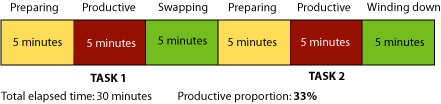
Being interrupted is the very worst thief of productivity, as this chart shows. With no multi-tasking and only two interruptions, 40 minutes being “busy” gives only 10 minutes of truly productive time: a productivity ratio of only 25%. Imagine how low that ratio will fall with more interruptions and a vain attempt at multi=tasking as well. Is it any wonder that people reach the end of a hectic day and cannot see any results for all that effort?

The lesson is simply this. To get the most done in the least time, focus on only one task, remove all possible interruptions, and never multi-task. And try to allocate as long a period to the task as you can, before you have to stop or change to something else. The longer the focused period, the higher the productive ratio of useful time to time spent in starting up, winding down, and the like. That’s why “chunking” time, thought much better than multi-tasking, still isn’t much of a help unless the “chunks” are good, big ones.
Labels: civilized work, enjoying work, priorities, stress, work/life balance
Saturday, June 23, 2020
News and Views: June 23rd 2007
Injustice is bad for your heart
A report in The Guardian newspaper, published in London, shows that feelings of injustice are enough to cause stress and heart attacks. According to the UK Government’s Health and Safety Executive, five million employees describe themselves as “extremely stressed”. The article goes on to point out that stress-related health problems include high blood pressure, obesity, and cardiovascular disease; and that some doctors suggest that an increase in people experiencing strokes at a younger age may also be related to work stress, especially if a person feels a slave to their work and not the master of it. What’s even more interesting is that research shows a heightened sense of injustice in the workplace corresponds directly to the risk of heart attack or angina. [link]Unmasking serial killers in the workplace
According to Dr. Ellen Weber: “The problem with stress is that it masks as diligence or self-righteousness—so we miss its warning signals as people fail to spot signs before a serial killer’s strike.” People find that stressors can stir up their cortisol hormones in ways that leave them angry, stressed or anxious, and unable to sleep well. All are potential precursors of illness and premature death. It hardly seems worth risking a fall into the clutches of a serial killer just to improve an organization’s bottom-line, but that’s what tens of thousands are doing right now. [link]Take that vacation . . . now!
According to the Center for Economic and Policy Research, the U.S. is “the only advanced economy in the world that does not guarantee its workers paid vacation.” Worse, according to this posting: “US workers gave back close to 574 million vacation days in 2006, depriving themselves of much-needed breaks, according to Expedia’s annual vacation deprivation survey. On average, Americans leave at least four days unclaimed annually.” Why do people accept this craziness? Maybe everyone has been reduced to such an abject state of fear by lay-offs and threats of outsourcing that they are ready to work unpaid when they should be on vacation (that’s what not taking vacation days amounts to). I suspect it also has a lot to do with organizations taking advantage of people’s wish to seem important and irreplaceable. Whatever the reason, it’s an irrational way to behave. [link]Appreciate life’s journey
If these statistics about stress and vacation deprivation are getting you down, try this upbeat idea from Brian Kim: “If there’s one thing that I wish to impart to those who have started down the path toward the fulfillment of their dreams, it is this: appreciate the journey. “ Brian suggests that you sit down and think about what you’ve done so far: “The rich cornucopia of knowledge, contacts, skills, opportunities to test your resolve, experiences of triumphing over obstacles, etc., that you never would have got before had you not undertaken this journey of yours” He reckons that you’ll be surprised at how far along you’ve come. Good advice. [link]Think twice before you ask for that promotion.
According to Penelope Trunk, promotions are more stressful than divorce. She says that things get more political; there is more ambiguity and uncertainty; and you don’t have as much personal control and you have to get things done through other people. Therefore, if you don’t want to deal with office politics and delegation, then you should say no to the promotion. She concludes: “So forget about that promotion. Don’t let someone else define your career path for you and then promote you through it as if their vision for your life is your vision. Instead, figure out what work you are best suited for, and request it. This is the best path for you.” See if you agree. [link]Is your boss a crazy boss?
Fortune magazine’s Stanley Bing has an tongue-in-cheek online quiz to help you find out. It’s all part of a marketing push for this book: Crazy Bosses: Fully Revised and Updated He also offers stories from readers about the bullies, narcissists and other crazy bosses they spend their working days with. [link]Are business units a con?
According to The Corporate Cynic, they are. He sees them as creating the perfect breeding conditions for more executives and their assorted hangers-on and cronies and creating endless turf wars: "The Business Unit Leaders and their minions started getting into the pants of the purchasing and operating functions claiming that these functional areas were really there to support them and therefore their property. The functional VP’s fought back because they had overall responsibility and were held accountable for the functions. Then the BUL’s began to argue amongst themselves as to what product lines or customers belonged to each unit." Pretty provocative stuff, but worth thinking about. [link] [via]An article in Management Issues asks whether: “. . . having a tyrannical boss leave any kind of lasting imprint on the employee—or are employees just fond of complaining?” The article refers to a posting on JobSchmob.com that suggests the mental fallout can have lasting effects. The writer of this article says: “I finally was able to leave the place of torture recently but I am still very affected by what they did to me. . . I was subject to malicious outright lies, ethical questions lobbied, public demeanings, and quite frankly abusive behavior to the extent every written, spoken word or look was a case for negative feedback.” Check out the comments too. [link]
Labels: News
Friday, June 22, 2020
Why changing your self-talk could lower your stress
Cutting your stress level and increasing your pleasure in life and work could require little more than shutting your mental “ears” to phantom voices from your past.
Most of us, at one time or another, hear that depressing whine inside our heads that tells us nothing we do is ever good enough, successful enough, or creative enough to be of any real account; that we’ll never amount to anything and other people are probably sniggering at our feeble efforts anyway. This kind of self-talk is responsible for many people simply giving up and settling for mediocrity. Yet all that your mind is doing is trying to help you avoid future pain by scaring you away from taking risks. It’s time to ignore such tainted advice and forget the past upsets that caused the whining to start in the first place.People who give advice on personal development or coping with workplace problems usually concentrate on what you might do to make things better. Recently, I came across an article on a British web site that takes a different tack. It looks at how you might need to think differently too: specifically, what beliefs you could have picked up in the past which are now holding you back.
The article is titled: “10 beliefs that could hold you back in life.“
Beliefs are tricky things. We often use the word to describe a fundamental outlook on the world, like a religious, ethical, or philosophical belief. That’s not what this is about, though some of these outlooks come complete with a set of supporting beliefs that apply to many other aspects of life. The type of belief that can raise your stress levels, block your career, and produce misery and frustration is the untested, unchallenged assumption about yourself that goes like this: “I’m a failure. I’ve always been a failure. I’ll never amount to anything. People just laugh at me when I try to do any better. I might as well accept it and give up.”
Understanding the self-talk monster
One useful way of thinking about this type of belief is to recognize it as merely negative self-talk: the monologue that plays continually inside your head, criticizing everything you do and dismissing your results as never good enough to help. Some people label it the Inner Critic, but I think that sounds too much like a theater reviewer or a grouchy panelist on American Idol. It also implies that this voice comes from something separate from you, whereas it’s nothing more than the output from a habitual set of beliefs and assumptions that you’ve picked up at various places and times along life’s path.Self-talk is based on recollections of hurtful and negative things that others said to you—and that somehow were close enough to your own fears and misgivings to be taken up by your mind and treated as . . . well, not quite true, but near enough to one possible truth to be scary. Now your mind uses them as a means to prevent you from running into more hurt. In its own twisted way, this self-talk is trying to protect you from future pain. That’s why it grabs your attention, just as a reflex to jump back from a snake might do.
The easiest way to understand how to move away from this thought pattern is through an example.
Success has always been desirable, but in today’s world it can seem like the only thing that matters. Yet everyone is fallible, so we all make mistakes and feel bad as a result. In your pain at a poor outcome, you’re very likely to be rather sensitive to negative comments from others. A sly look, a half-suppressed giggle, an overheard comment can all convince you that the mere fact of failing has made you into a failure. That really hurts, so your mind decides to save you from more pain by accepting that label. After all, if you’re a failure, no one will have any future expectations of you, so it will be impossible to fail again.
With this belief in place, appropriately negative self-talk kicks into gear. As soon as you seem to be in danger of trying something difficult, you mind starts warning you off. Of course, you’ll fail again sometime—everyone does, without exception—so the mind takes this as confirmation that trying anything new and risky is simply going to result in more pain. The belief has been reinforced and the self-talk steps up to a higher gear as a result.
A protective response?
There are many, many variations on this “protective” response. You might tell yourself that you’re too stupid to be able to grasp anything tough; or too awkward ever to make friends; or too cowardly to be able to face down some bully in the workplace. Others include: “I’m too old to learn new tricks;” “I’m a nobody, so no one will listen to my ideas;” “It’s too risky to change;” “There’s nothing I can do to change anything;” and “Nobody would believe me if I told them.”As a protective strategy, all this negative self-talk sucks. It may appear to save you from more hurt, but it does nothing to change the situation you’re already in. In essence, it says: “Stand still right here. I know it hurts—badly—but moving could make it hurt even worse.” So nothing changes for the better, and now you’re as frustrated as all Hell too.
The only answer to negative self-talk is to ignore it. Don’t argue with yourself, because what the self-talk says is, quite truthfully, based on certain facts from your past. But that’s just it; they are past. Over. Gone. Of no further account. No longer relevant.
How to fight back
Failing doesn’t make you a failure, because everyone fails at one time or another. Not instantly understanding something complicated doesn’t make you stupid; even the greatest genius has to find his or her way through hundreds of things not immediately understood on the way to some creative insight. No one is ever too old to learn. All these claims by your self-talk are complete garbage. They’re monsters made from smoke and mirrors to frighten you out of putting yourself at risk. Push ahead and they’ll disappear.I suspect that the majority of stress people feel in difficult and negative workplace situations is self-inflicted. It’s not that the situation isn’t bad. It is, but listening to continual negative self-talk makes it many times worse and raises stress to unnecessary levels.
Like all techniques to lower stress, ignoring negative self-talk isn’t free or easy. It takes effort and it takes time. But the simple truth is that anyone can do it, and the results are more likely to add to your well-being and happiness than just about anything else. That alone should be sufficient incentive to start. And before your self-talk gets to you . . . no, it isn’t going to be a waste of time or another self-help fad that you’ll soon forget. It’s going to change your life.
Labels: burnout, enjoying work, self-preservation, stress
Thursday, June 21, 2020
Should you learn not to care — or just not to care so much?
Is being emotional the same as being passionate? Should you allow the jerks and weasels out there to keep on stressing you out?
I’ve been moved to write this piece after being soundly abused—with ample use of obscenities and expletives—by one or two people because I wrote in an article elsewhere: “Stop paying so much attention to how you feel. No one can control their emotions, good or bad. If you spend your attention on how you feel, you’ll be in a constant state of anxiety. If you feel good, you’ll start worrying about how to keep that feeling. If you feel bad, you’ll fret over how to feel better. You feel whatever you feel. Get over it. Just go on doing what you need to do, regardless of your emotions.” The abusers started me wondering why such simple words made them so angry. This article is the result.I have two principal aims with this blog: to help people to overcome the problems of stress and anxiety caused by modern working practices, and to try to look as objectively and honestly as possible at some of the situations that lead to most upset and frustration.
Should you try to check your emotions?
In various postings, here and as a guest blogger elsewhere (like this recent post at Lifehack.org), I have tried to consider calmly the emotions raised by the difficulties and annoyances most people face in a typical working week. In essence, what I have seen is that allowing your emotions to run unchecked can add to your upset.I don’t criticize anyone for what they feel. That would be silly, since none of us can stop our emotions from being aroused any more that we can stop ourselves from thinking by an effort of willpower. Nor do I suggest that there is anything “bad” about emotions. They are a natural part of being human, as is the capacity for rational thought. It's just that allowing negative emotions to take complete charge is likely to hurt you more than it does anyone else—which seems a poor strategy.
My suggestion has always been the same: that you can lessen your stress and frustration by simply getting on with things and letting time pass, so that you can stand back and look at the situation more objectively; and that to do so stops you from adding further fuel to already inflamed and stressful feelings.
It’s not a new idea either. The Buddha suggested it more than 2000 years ago. Whether you call it objectivity, detachment, or keeping things in perspective, it comes to much the same thing. It means accepting your emotions as natural, but refraining if you can from whipping them up into greater turmoil. Once you have allowed them to subside a little, you may see things differently. That is why it can be worth trying to put off saying or doing anything too drastic at a time when you’re likely not thinking as clearly as you could.
I find it incomprehensible, therefore, that whenever I have suggested this it results in abusive, often foul-mouthed, expletive-filled comments from people clearly in the grip of turbulent emotions.
Detachment, not disdain
I may be wrong in what I say (I don’t think so, but anyone has a right to differ with me on that), but I cannot understand why articles containing this set of ideas should provoke such a violent reaction. That’s why I was cheered to read a piece by Bob Sutton for HuffingtonPost.com called: “The Virtues of Emotional Detachment.” In it, he goes a little further than I do, saying:I have argued for years that learning when not [to] care, what not [to] care about, and how to not care is just as important to career success and personal well-being as being passionate. I especially think that it is an essential skill for people who are trapped in asshole-infested workplaces and can’t get out — at least for now.It’s interesting that Tom Peters takes quite violent exception to what Bob has written on this topic, quoting George Bernard Shaw to support his case:
“The reasonable man adapts himself to the world. The unreasonable one persists in trying to adapt the world to himself. Therefore, all progress depends upon the unreasonable man.”—George Bernard Shaw, Man and Superman: The Revolutionists’ Handbook.I’m far from sure that Tom Peters and Bob Sutton are talking about the same thing. What I hear Tom Peters supporting is being passionate about what you believe. What I hear Bob Sutton saying is that you shouldn’t let the weasels get you down. Not the same thing at all. (It’s also worth pointing out, gently, that George Bernard Shaw, like many of us born and raised in the British Isles, was certainly not a person who wore his heart on his sleeve. What he was protesting about in this quotation was pragmatism: the tendency to “go with the flow” and compromise your principles away for the purpose of fitting in. He was not trying to promote being emotional, or even passionate. It can be misleading to take quotations out of context.)
Bob points to an exceptionally interesting post on Kitetail called:”Effective Strategies For Surviving Culture Tax"—“culture tax” being a way of describing “dealing with organizational cultures where the process of getting things done is draining and demotivating.“ In that piece, the author seems to me to sum up pretty well the case for lessening stress by trying to maintain some emotional detachment from the bad things of working life:
Once you recognize and accept the negative styles of the people you are working with, you are no longer the victim. With that, you can focus and direct your energy on how to effectively achieve your goal. [ . . .] I recommend practicing the Zen discipline of emotional detachment. Unfortunately, this is often misinterpreted as not caring and being disengaged. However, emotional detachment merely directs you not to be attached to an outcome or to an expectation. This practice will help you objectively evaluate the situation and recognize new opportunities as they arrive. After all, when one door closes another will open, but only if you are listening.
Caring . . . yet not hurting yourself
I suppose you might be able to so anesthetize your emotions that you no longer cared about anything much. Stress and burnout does that to some unfortunate people, whether they want it to happen or not. But I wouldn’t recommend it as a way of handling the frustrations, the anxieties, and the jerks in your workplace. It’s pretty much what is meant by the old saying about cutting off your nose to spite your face: doing yourself more damage as a human being through the “cure” than the disease did in the first place.Despite Bob Sutton’s misgivings on the topic, I think that you can detach from a situation (in the Buddhist sense) and still care about it. You do it by looking at the situation as objectively as you can and reaching the best decision open to you about what action to take in the light of your overall goals. If passionate and deeply-felt involvement seems to you to be the best option to meet your objectives and make yourself feel good, go for it! If, however, you decide to “keep your powder dry” this time and be ready to fight another day, that’s fine too. And if, on mature reflection, you reach the decision that whatever it is isn’t worth your concern after all, why should that be somehow “wrong?”
“Attachment,” in the sense these authors are using it, means to cling to something—hope or hurt or expectation—long after reality has shown that it is hopeless to do so. It’s demanding that the universe reverse course to suit your requirements. That may be understandable, but it does cause a great deal of misery. What the Buddhists, as I understand them, suggest is that it’s better to avoid this: to “detach” and accept that the world is the way it is; then decide what to do next on that basis, as free from stress and emotional turmoil as any of us can ever be.
It’s possible I will be abused again for writing this. If that is in your mind, please stop for a moment and consider whether doing so is likely to change anything for the better. Disagree with me by all means, but don’t add to your stress or mine by getting so angry about it.
Labels: burnout, self-preservation, stress
Wednesday, June 20, 2020
Interruptions and choice
Taking away people's freedom of choice through constant, compulsory interruptions is a poor strategy.
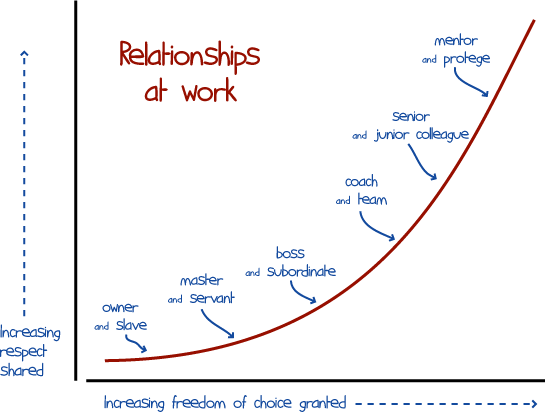
It’s the demands from others to meet their schedules that really messes up your day. And yes, sometimes you have no option save to go along. But what makes the most difference in the “frustration power” of these interruptions is denial of choice. If you can choose what to pay attention to and when to do it—focusing for as long as you need to and taking a break some other time to catch up on all the rest—most interruptions aren’t much of a problem. Unless, of course, your boss is a total jerk and wastes most of your time with pointless deamnds to pay attention to him.We all know that continual distractions are bad for concentration and increase stress. What makes them even more frustrating is when you are denied the option to ignore them. When someone—the boss, an insensitive colleague, a boorish customer—grabs your attention and refuses to let go.
There is nothing worse than being deeply immersed in a piece of work—right in the “flow”—when somebody or something comes along and demands your attention—now!—completely distracting you. “This won’t take a moment,” they say. Of course, it takes far more than a moment. And by the time you get back to the piece of work that you were doing, you’ve lost your place, you’ve lost your flow, and it takes you maybe an hour or more to get back into the swing of things—if you ever do.
When someone’s days are so fragmented with meetings, e-mails, telephone calls, and other interruptions that they never have the time to get anything useful completed, it’s bound to cause them frustration and stress. It’s a rare person who doesn’t get angry. After all, you have your own work to do—important work that others will judge you on—and important work takes time and concentration.
If your time is broken up into little pieces and sandwiched between other activities, especially those that you cannot choose to reschedule or set aside, it’s made next to useless. It’s not just the total amount of time that matters (though that is important enough), it’s the amount of continuous, uninterrupted time that makes all the difference between feeling happy and satisfied with what you have done, and feeling frustrated, uncertain, and embarrassed over a job that you’ve thrown together in what few moments were left to you after everyone else had had their demands met.
Creativity is virtually impossible under such conditions. If you’re interrupted and distracted right at the moment when some truly important idea has just occurred to you, there’s the strong possibility that you will forget it well before you can write it down or capture the thought some other way. Research has proved that the single, most significant difference between people noted for their creativity and the rest of us is that the creative ones always note their ideas down straightaway . . . if they are allowed the time.
It’s hard to understand why organizations cannot see how counterproductive and morale-sapping it is to force people to work like this. Maybe it’s because of today’s unprecedented ease of communication that the expectation has grown that, because you can contact someone virtually instantly, they should deal with whatever you want instantly as well. No time for thought. No ability to set time aside, free of interruptions, to complete important tasks. No freedom to schedule their own work. And it’s bosses—the very ones who claim to be most concerned about driving up productivity—who are nearly always the very worst offenders, driving productivity down again and again by interrupting their subordinates or dragging them away to pointless meetings.
If you want an easy way to increase productivity for everyone, declare war on interruptions of every kind. Make it a capital offense to schedule more than one meeting during the day. Make sure no meeting lasts for a minute more than two hours. Urge everyone to establish set times for sending and reading e-mails. Ban lengthy circulation lists and outlaw the practice of cc-ing the whole organization on every e-mail. Then make it abundantly clear that anyone who sets aside important work simply to deal with an interruption (unless it’s a matter of life and death) is guilty of significant time wasting and will be dealt with accordingly. Most of the things that interrupt you at work are neither urgent nor important. They should be ignored. Most of the important ones are not urgent, so you should set them aside until a more convenient time. If you only do that, it will totally transform your day.
And, as the drawing at the head of this article shows, an essential element of being a free agent is the power to make your own choices most of the time. If that power of choice is denied, most people find it extremely stressful—likely intolerable for any long period. It reduces you to the status of a slave: a person of no account who must jump to deal with his or her master’s slightest whim. Being a wage slave is still being a slave. It diminishes you as a human being and destroys your dignity as a person with your own responsibilities and choices to make.
Your freedom to exercise the power of choice in scheduling your work, giving the most attention to what needs it most, is too important to lose. Demanding that others drop whatever they are doing to pay attention to you—even if you are the boss—is selfish, childish, and unprofessional. Those who do it merely show the world what jerks they are. Make sure that you are never one of them.
Labels: leadership, management, priorities, working relationships
Tuesday, June 19, 2020
Remarkable company

I’m very flattered that Kevin Eikenberry has included this blog in his short-list for the title of “Best Leadership Blog 2007.”
Kevin is asking his readers to vote for the final choice, with a prize draw for all who vote. The winner gets Kevin’s “Remarkable Leadership Volume 1 - CD Set” valued at over $550 and including 6 teleseminars with Kevin, 6 interviews with other leadership experts and quite a lot more.
All this is part of the pre-publication activity for Kevin new book: Remarkable Leadership: Unleashing Your Leadership Potential One Skill at a Time.
When you look at the others who are in the shortlist, just getting to that stage is a high honor.
So if you would like to vote for this site, or just check out the ten contenders, as of June 2007, for the Best Leadership Blog, hop on over there now.
Why slowing down is the best way to get there faster
It may seem counter-intuitive, but it works just about every time.
Going too fast denies you the opportunity to exercise life’s choices in a deliberate and conscious way. The result is a series of decisions made mostly by a mixture of short-cuts, snap choices, and rules of thumb. Bad decisions too, since there was no time to consider alternatives or delve into the detail. Like someone driving down an unfamiliar road, in the dark, and the rain, and without lights, the result is pretty predictable. Take your foot off the gas and try slowing down enough to think about where you’re going and what might lie ahead. You’ll likely get there faster . . . and in one piece too.Rushing denies you the power of choice. When you’re going as fast as you can, there’s no time to think about options or consider alternatives. You have to make all decisions at high speed and that means relying on what you already know or what has worked in the past. It means using rules of thumb and quick-fixes. It means ignoring the subtleties and complexities of a situation, because you simply don’t have the time to take them into account.
Rushing also simplifies—but not in a positive way. It simplifies the way that looking at something as you drive past at 70 miles an hour simplifies it. You see that it’s a person, or an animal, or a vehicle, but there isn’t time for your mind to register any of the details. All you get is a quick impression. So that’s all you can work with.
For example, say that you want to improve customer relations. If you’re in a rush, there won’t be time to check through any of the data available in any depth. The best you’ll be able to do is to grab the headlines and work with those, likely missing some of what really matters. You make a snap choice and set off in broadly the right direction, but without sifting through the options for the best path to take. As a result, you run into problems—then assume you are headed in the wrong direction. So now you go off some other way and throw yourself totally off track.
One of the worst aspects of today’s macho management is that it encourages decision makers to operate with a minimum of input. Haste forces them to work with summaries and headlines prepared by others. They rarely have the chance to explore the options for themselves. Even choices that might involve massive costs and huge potential profits or losses are taken on the basis of headline figures summarized on a single sheet of paper or a few PowerPoint slides.
Why should this matter?
It matters because the power of choice is immensely powerful. In fact, it’s one of the most powerful tools that we have for changing ourselves and our world in positive (or negative) ways.Every time you make a choice—even a simple one—you alter direction and put yourself on a new path towards encountering something you would not have met had your choice gone the other way.
Imagine trying to find your way to a set point in an unfamiliar city. Each choice—left turn, right turn, go straight ahead—sends you on a slightly different track. It might be the right one, or the wrong one, or one in between: neither right nor wrong in itself, but sending you towards your destination more or less directly. Every single choice has an effect. Individually, none is probably irreversible or bound to stop you from reaching where you want to go. But cumulatively, a series even of marginally poor choices will send you miles off course, while a series of sound choices will get you to your destination quickly and without stress.
That’s what I mean when I say that slowing down is the best way to go faster. By slowing down enough to make every choice a conscious and careful one, you avoid snap decisions that might take you miles out of your way.
The cost of speed
Our modern obsession with speed not only robs us of our choices. In many cases, we’re going so fast that we don’t even notice that they were choices to make until it’s too late. The choices were there though—and they were made, perhaps by default or even unconsciously. All because you failed to slow down enough to notice all those forks in the road and concealed turnings. That’s what Hamburger Management does to you. It substitutes speed and thoughtlessness for choice. It bases decisions on slogans (Quicker! Cheaper! More! More!) instead of careful, rational analysis. Everything is short-term because, at that speed, trying to look ahead to the longer-term means you have to take your eyes of the road immediately ahead for a moment . . . so you smash into the car right in front of you.
Why are so many people so stressed? Because they’re being forced to go along at a pace that makes them feel permanently out of control. Just a little faster and they’ll be certain to crash. It’s enough to make anyone feel tense and afraid.
Don’t join in the mad rush to do everything faster and faster. That crowd’s composed mostly of lemmings—and we all know where they end up. By slowing down, you’ll be safer, waste less time on wrong turnings and the subsequent corrections, and lower your stress levels into the bargain.
Labels: Hamburger Management, leadership, management, short-termism, slow leadership, stress, work choice
Monday, June 18, 2020
Where does your allegiance lie?
Why do we persist with an approach to organization devised during the Dark Ages?
Variations on the medieval Feudal System have been the basis of virtually all organizations, from nations to corporations and clubs, for the past 1000 years. In all that time, the constant conflicts of allegiance inherent in feudal arrangements have produced countless wars, rebellions, heresies, and conflicts of every kind. Today’s organizations are still suffering the negative effects of an approach that tries to stifle dissent and enforce conformity from top to bottom. Can’t we find a better way?Wars between corporate barons and ambitious underlings are probably more common today than ever before. It’s inherent in the system we use. As the old saying goes: “Big fleas have little fleas upon their back to bite ’em. And little fleas have smaller fleas—and so ad infinitum.” How do you keep everyone in line? More than a thousand years ago people in Europe created the Feudal System to deal with this problem. It’s still the basis of a great deal of organizational practice today.
Ruling a nation and running an organization are quite similar in some respects. In both cases, those in charge cannot control or supervise everything personally. They have to rely on others to do much of the work of ruling for them.
Under the Feudal System, the king (read CEO) is the ultimate authority. He ruled through a group of top nobles (read Board Members and Division Heads) who owed him their allegiance. That is, they swore to serve him, obey his commands, and be loyal to his position as ultimate ruler. In turn, these nobles worked through lesser nobles (read middle managers) who swore allegiance to them—and so on, down to the lowest of the low at the bottom. Everyone had his or her place, defined by the person to whom they owed their allegiance.
In theory, this produced an orderly society based on a fixed hierarchy—just like today’s organizations. The glue that held it all together was allegiance. That’s why breaking that allegiance was seen as such a terrible crime, usually punished by an especially nasty death.
So far, so good. But allegiance is a tricky thing. It’s claimed by many other sources besides whoever is above you in the hierarchy. In medieval times, for example, the church claimed the allegiance of all believers (which was pretty much everyone), and continually tried to set allegiance to its commands as “higher” than any earthly claims. That caused continual friction between kings and the church (which is why King Henry VIII in England finally broke with the pope and declared himself to be both king and head of the English church).
Then those pesky barons and nobles, just like many executives today, couldn’t see why the king (CEO) was any better than them. Many decided to break their allegiance and rebel—taking along those who swore allegiance to them—and attempt to become kings in their turn. For their followers, the choice was them a hard one: either to stick with the baron (and risk being punished as traitors to the king), or stick with allegiance to the king (and face immediate punishment from the baron). Since the king was usually far away and the baron’s executioners local, most went with avoiding the most local threat. Nothing much has changed there either.
When today’s organizations abandon strict hierarchies, they unwittingly create even more conflicting allegiances. To bypass awkward division heads, some CEOs have created business units or profit centers, whose heads report (give allegiance) directly to them. Then there are distinct professional groups (such as HR, finance, IT) who have patterns of allegiance within their own function, thus provoking still more conflict with the wider allegiances laid down by the overall hierarchy.
To complete this picture of clashing allegiances, we need to add the allegiance to people hold to friends, family, ideals, career aims, and—most subversive to hierarchy of all—allegiance to themselves and their own needs. If the people who see major generational differences in today's workplaces are correct, younger people also have quite different patterns of allegiance than their elders: more personal, less based on convention,duty, or ambition.
Conflicting allegiances are common sources of problems and stress in organizations and they aren’t resolved easily. As I’ve already noted, well-meaning attempts to remove the rigid hierarchical patterns common in the past have created more conflicts, not fewer. All these so-called dotted-line reporting arrangements, the shifting allegiances due to membership of various teams, the personal allegiances, and the inner allegiances to ideas and beliefs produce clashes that no one can reconcile.
It would be easier if everyone shared the same ultimate set of goals. They don’t. Name any size of organizational unit, from a division to an individual, and each one will have at least some goals that differ from those held by the other units.
Maybe the only answer is to let go of the remnants of the Feudal System at last and forget all about allegiances. They aren’t the only possible kind of organizational “glue.” Some fundamentalist religions use strict dogma instead, but I don’t think that is much better. Others, like Buddhism, rely more on a shared set of ideals and values. That seems more promising to me.
How could this work in an organization? You would begin with a clear set of ideals—such as superb quality or outstanding customer service—and make sure that everyone was working towards these goals within their individual jobs. Then you would reward actions that served these ideals well and discourage those that did not. You would not specify exactly how each person should achieve the shared goals. Instead, they would be trusted to find their own way, within the overall demands of their job. Continual improvement would be required of everyone, since the goal would always be to do better, not to follow the boss’s orders or replicate wherever you are today.
I’ve never worked for Toyota, but their approach sounds a lot like this. In contrast, their US and European competitors mostly continue to use variants of the Feudal System, rewarding loyalty and hierarchical allegiances. Might that explain why Toyota has been so successful in such a short time?
History shows us that focusing on allegiances quickly produces an unending stream of conflicts, generates stress, and promotes command-and-control and rule by fear. It also stifles dissent and the emergence of new ways of thinking. Even the control it allows those at the top of the hierarchy isn’t too strong—especially in today’s world of open Internet communications and global mobility.
I think it’s probably time we gave the Feudal System a decent burial and looked for another, better way to organize.
Labels: corporate culture, executives, management attitudes, trust
Saturday, June 16, 2020
News and Views: June 16th 2007
Finally seeing the light?
Here are some interesting snippets from The Standard, a Hong Kong newspaper, reporting on a seminar for corporate executives held there last week. [link]- “We believe long working hours are a sign of loss of productivity and efficiency," said Ambrose Linn, Hong Kong manager at Dutch mail company TNT, which enforces a maximum 48-hour week on its employees with no more than 12 hours’ overtime.
- . . . a survey by local nonprofit organization Community Business found that employees work an average 51 hours a week - 25 percent higher than the maximum working hours set by the International Labour Organization. A third of respondents said their productivity was being affected by long hours while 31 percent said long hours were causing health problems.
- “Senior management has to change its mind-set, especially with the new graduates coming out of university. They don’t want to work 60 hours a week, and companies won’t attract the talent,” Shalini Thakur, associate director of diversity at investment bank UBS, told the seminar.
- BP says it has stopped making it mandatory for senior management to be supplied with smart phones and e-mail devices because constantly checking and responding to messages goes against the company’s philosophy of promoting work-life balance.
Bullying grows as a workplace issue
That’s the title of an article in the New Hampshire Business Review. According to the article, a national poll conducted by the Employment Law Alliance found that 44 percent of American workers reported having worked for an abusive supervisor. Psychologist Gary Namie, co-founder of the Workplace Bullying Institute and co-author of “The Bully at Work: What You Can Do to Stop the Hurt and Reclaim Your Dignity on the Job,” says that decreased job performance, depression, feelings of helplessness and isolation, anxiety, and fear are among the emotional affects of workplace abuse; while such self-destructive habits as alcoholism and thoughts of violence or suicide are not unheard of. It seems that state legislators are considering addressing the issue in several states in the northeast of the US. [link]Developing trust
Some good ideas on this topic in an article on a site associated with a medical journal in the UK. The author is given as “Mark Griffiths, professor of gambling studies, Psychology Division, Nottingham Trent University.” I checked him out and this isn’t a joke. Dr. Griffiths is Director of the International Gaming Research Unit at the university, with an impressive list of awards and prizes to his credit. I liked this point very much; “No quick fixes for broken trust—If you think broken trust can be put right with a little charm or good humor, then think again. While wit and humor are constructive in a trusting relationship, they have the potential to exacerbate damaged trust.” Too right! [link]Work/life balance is shot
Will McInnes, a blogger from the UK, says: “. . . wherever I look I see hardcore old fashioned macho business working . . .” I do too, Will. He mentions: “. . . two e-mails, one sent at 11 p.m. last night, the other at 01.58 a.m. this morning. Business emails. Work.” He also has a link to an article about a VP in Google who regularly works 12+ hour days, has “marathon e-mail catch-up sessions” at weekends, and attends around 70 meetings a week. As will says: “Sorry, all due respect and other cop-out caveats, but that is just insane.” [link]Stress and tragedy
Also from the UK, The Independent had a report on a tragic situation caused by excessive working. The article starts by noting: “Stress or depression forces more people to take time off than any other ailment save for bad backs. No fewer than 10.5 million working days are lost to stress in Britain every year, costing the economy an estimated £4bn. Most of those absentees are at least facing up to their problem, and, in the main, are seeking help. In the macho confines of the City, where sexism, racist discrimination and homophobia are rampant enough, it is a different story.” It seems that a senior executive in an insurance company beat his two-year-old daughter to death, probably as a result of mental collapse brought on by overwork. There have also been several suicides recently of so-called high-fliers in London’s financial district. The same district has, it seems, more Alcoholics Anonymous, Narcotics Anonymous, and Gamblers Anonymous meetings than anywhere else. Isn’t it time that people put two and two together? [link]19 Battlefield Tips to Survive Stress at Work
Comparing work to the battlefield is commonplace, but it usually means little more than various leaders trying to find links between what they do at work and what generals do at war (other than strut around wearing fancy uniforms and shouting orders). This article tries to find ideas for combating workplace stress from the methods developed to deal with Post-traumatic Stress Disorder and similar problems caused by the stresses of warfare. I’m not sure about all of them, but some might help. [link]Kill Meetings to Get More Done
Good ideas from Lifehack.org on how to get out of all those useless meetings. What it doesn’t address is why the meetings are there in the first place. Usually it’s all about covering your butt by involving as many other people as possible in anything that might go wrong. If someone needs a lot of meetings on a project, my guess would be that they don’t believe in it and aren’t sure it will work. People rarely do anything that might lessen their personal share of the credit for something they truly think will be a great success. [link]Why meetings make us mad
Still on the subject of meetings, this survey found, unsurprisingly, that: “. . . the number one business meeting frustration, it seems, is disorganization . . . more than a quarter (27 percent) of the 1,037 people polled said that disorganized, rambling meetings were their biggest bugbear, followed by 17 percent who said they were annoyed by colleagues who interrupted and tried to dominate meetings.” If so many meetings are disorganized and dominated by loud-mouths, why do people go on holding them? [link]Greed goes international
Does this statement ring a bell? “Indian executives could be in danger of pricing themselves out of the market with salary demands that are so high they are forcing Indian companies to look to cheaper expatriates to fill senior roles.” It didn’t take long, did it? Part of the problem is the silly practice of setting executive salaries by comparisons with other executives. That’s a sure recipe for constant leap-frogging. This will also be very familiar. “Sunil Mittal, head of the Confederation of Indian Industry, (whose salary as head of the Bhati Group doubled last year) said that ‘Salaries cannot be legislated. There is shortage of skill at the top level, and more specifically in the service sector, which is why pay packages of senior executives are high,’ he insisted.” What that probably means is that there is a shortage of people prepared to forget about earning more than the next guy and accept only what the job is worth. In the USA, there are almost no executives like that, it seems. [link]Labels: News
Friday, June 15, 2020
Too much leadership?
When it comes to the ratio between “do-ers” and “supervisors,” many organizations are hopelessly out of whack.
Would you plan to win a boat race by reducing the number of people rowing the boat and replacing them with extra people steering? I didn’t think so. Yet that is pretty much what many of our corporations have done over the years. And while they’ve been cutting costs by removing rowers, they’ve been ignoring the costs caused by all those highly-paid steerers. In all the hype about a “war for talent,” it’s worth wondering what the impact has been from the massive loss of positions in the lower and middle parts of the organization in recent years.I was amused by a management fable that popped up recently on a blog called “Cenek Report.” I won’t spoil it by reproducing bits and pieces. You should go read it for yourself *.
It’s kind of parable of competitiveness about two corporations, one Japanese and one American, who have a boat race. Each uses their own approach to organize their racing boat. The Japanese boat has eight rowers and one person steering. The American boat has one rower and eight people steering.
The rest of the parable charts the attempts by the American corporation to win the following year, using all the paraphernalia of “modern” management.
When they lose the next race by an even wider margin, they give up the idea entirely and distribute the money “saved” by abandoning the program as bonuses to their executives.
Sadly, there’s quite a bit of truth lurking behind the farce.
There’s far too much emphasis today on management theory and leadership prescriptions, while commonsense ideas about what produces good service, good operations, and good working conditions are ignored. It’s as if, in the rush to “professionalize” the workplace, everyone shies away from obvious questions, such as
- Do we have enough people to do the work required?
- Do they all know, clearly, what they are expected to do?
- Do they have the time, the tools, and the skills to do it?
- Are they paid enough to make what they do seem attractive?
- Do they enjoy what they do and give it their best efforts?
- Are the working conditions suitable to a civilized community?
After many years of cost cutting, a lot of companies now resemble the American boat in the parable. There are very few rowers left—most have been removed through downsizing, outsourcing, and cutbacks requiring “voluntary” overtime. The number of those steering the corporate boat hasn’t fallen much at all. People still cling to nonsensical ideas like “span of control” that stipulate a fixed allocation of supervisors to set numbers of employees. And that’s without the vast inflation in “support functions” such as human resources, legal, and finance. We're becoming a nation of more bosses and advisers than people to boss around or advise.
Logically, the best place to look for cost reductions nowadays must be in the executive suite and those support functions. Forget about head count. Lots of low-paid “heads” cost rather little, compared to even a few “heads” taking home multi-million-dollar packages. Unnecessary people? Try any support function you care to nominate.
If we want to have a business community that can be competitive in a global economy, as well as providing enough jobs and enjoyable working lives to enrich our society, we need to get back to commonsense observations. Instead of asking whether an organization “needs” yet another layer of management, or an additional specialist advisory function, how about asking how few leaders and advisers it could manage with? I suspect that the loss of many of these positions would scarcely be noticed—except through the subsequent increase in profits.
More rowers and fewer people steering (or advising from the riverbank) sounds like a sound recipe for better business and lower costs all round.
* The Cenek Report site must be the least readable site I have ever come across. I hesitate to speak of design, since it is minimalist to the point of being almost invisible to tired old eyes like mine. Be warned!
Labels: corporate culture, executives, leadership, thinking about management
Thursday, June 14, 2020
When you’re up to your ass in crocodiles, why not get out of the swamp?
Linking modern management and TV reality shows

Have you noticed how narrow the gap is between Hamburger Management and some of the more extreme TV reality shows? Both encourage and reward all-out competition driven by raging self-interest. Both consist of people encouraged to behave in ways that are competitive, underhand, rude, and aggressive in contrived and highly stressful situations. Both see winning as the only acceptable outcome, regardless of what it takes to win. Can you survive competition like this? Is it even sensible to take part?How and when did it become entertainment to watch a rich guy with a seriously awful hairstyle fire people on camera? Is it just the ultimate fusion between sport and business: corporate life as a spectator event? Do people simply enjoy seeing previously successful people kicked in the teeth? To me, that’s a symptom of an insane society. But while the nice people who write blogs are talking about co-operation, values-based leadership, and lifelong learning, the guys with the money are out there pushing the message that all’s fair in love, war and business.
Thanks to the prevailing cult of macho, “winner takes all” management, only survival matters—with excellence, service, and ethics lost behind or out of sight. Worst of all, colleagues have become simply rivals in the game of who can avoid being thrown off the island by the others. Am I alone in wondering what kind of managers and leaders this is breeding? Do we want to live in a world where the first, and most important, rule of corporate life is always to watch your back?
What can you do to cope with such a situation?
- Ability and talent still count. Look at American Idol (okay, I know it’s not a reality show, but it provides the best example of what I’m talking about). It’s not always the winner who has the best subsequent career. Several losers have done as well or better. The one who wins the short-term contest doesn’t always win over the longer haul.
- Dealing with others fairly can be more important that it seems. Getting to the top by climbing over the bodies of others makes plenty of enemies. In the competitive game, winners can turn into losers at any time. When they do—and nearly all will at some time or another—it helps not to have too many people around who have been waiting their chance for revenge. The guys you kicked on the way up will probably love to kick you even harder on your way down.
- Friends are always good to have. Life is a pretty uncertain business. There are plenty of times when a piece of information, a friendly warning, a helping hand, or just someone to talk to openly can make all the difference. Jerks and assholes don’t have friends, only hangers-on looking for their own chances to claw their way up. If you don’t trust anyone, you won’t find anyone is willing to trust you. That means you’ll have to pay—one way or another—for every piece of information or moment of support. And it will have to be cash on the nail, since everyone will have learned not to trust promises (at least, not twice).
- Choose your currency. There are two currencies in business. One is patronage: the ability to do someone a favor, advance their career, or appoint them to a plum job. That’s the currency that comes from having power. The other currency is being liked. It has nothing to do with power and everything to do with the kind of person that you are. The currency of patronage is limited. There’s only so much available, and the guys at the top grab most of it. The currency of being liked is available to everyone. It won’t win you direct power, or even promotion in every case, but it will protect you from many of the crocodiles. You have to be a real bastard to screw over a popular person. And you have to be really lucky to get away with it without others ganging up on you as a result.
- Compete only for what is truly worthwhile and lasting. Power, status, riches, fame. All are, I’m sure, great to have. But all of them take some hanging on to. All come with plenty of stress and fear attached. For many people, that blissful moment on the winner’s rostrum—that 15 minutes of fame—is all they will ever receive. It will be followed by years of struggle to get back to that point, coupled with misery, frustration, and anger. But friendship, peace of mind, happiness, and contentment can last for many years—maybe a whole lifetime.
Before you start wrestling with the crocodiles, be very sure what it is that you want and are willing to pay for. Coming out on top may cost you more than you bargained for. Managing to wade out of the swamp—even if the cost is giving up your heedless dreams of making it into the big league—could turn out to be a great bargain in the context of your life as a whole.
If you’re offered a place in some reality-show-type competition to rise to the top, remember to count the cost before you start. There may just be a very large and wily crocodile sitting somewhere on the bank, waiting for all the others to wear themselves out fighting, before he or she slides into the water and calmly demolishes the supposed winner. Reality shows may be fun to watch (though it’s hard for me to imagine why), but I doubt that they’re fun to take part in.
Labels: corporate culture, executives, Hamburger Management, thinking about management
Wednesday, June 13, 2020
Thoughts about honesty
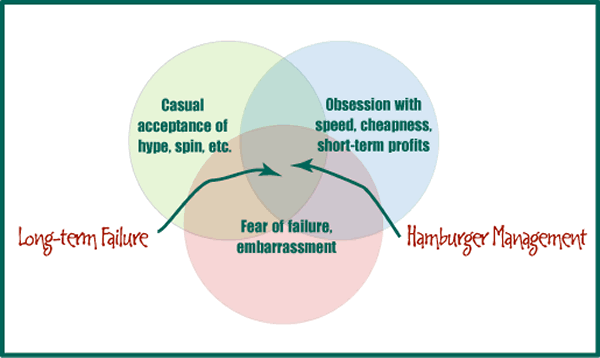
I don’t agree with everything in this article (it’s too kind to conventional management ideas, for a start), but it’s still an interesting read (See clips below). But I do agree that honesty has a power and a credibility that lying, hype, and spin can never match.Why has honesty become so endangered? Mostly because so much in today’s world of management is not working well, but no one wants to own up to the fact and face changes.
There are maybe a few people who lie for the fun of it, but I don’t honestly think that’s a common trait. Most people who lie do so because they think that it’s the best option: the only way they can imagine out of a situation that’s going to be worse if people discover the truth. They lie to save themselves time, trouble, or embarrassment. By doing so, they often store up even greater problems for the future. But, given most people’s constant short-term viewpoint, they don’t consider that.
Without honesty, there cannot be trust. Without trust, everything in the corporate world is harder to accomplish. Sadly, Hamburger Managers have been induced to believe that you can replace trust (which takes time, honesty, and openness), with instant answers, such as money incentives, threats, bullying, and constant harassment. Honesty doesn’t figure in macho management styles because those styles nearly always have too much to hide.
Hamburger Management is putting style before substance, in the hope that doing so will lead to quick results that cost little or nothing. Take all the mania about lowering costs. Sure, doing so will hike profits (for a time), but only so long as sales remain the same. If cutting costs lowers quality and usefulness, and sales fall, you’ve just shot yourself in the foot. Making a better product, providing a better service, even if it costs more, may well drive sales up by much more that the extra cost. Those profits are much more secure and long-term ones.
One of the most tarnished rituals of the corporate year is the performance appraisal. It ought to be about honest, two-way feedback. It’s more often about fudging problems, concealing screw-ups, finding ways to avoid paying a salary increase, or producing “evidence” to justify firing people. Everyone hates it and nobody trusts it. So why do it? Because having some kind of “justification” for subsequent management action will, hopefully, ward off legal reprisals. Because it allows central management to control costs (especially salary costs) by fixing “standards” that limit increases, regardless of actual performance. Just about everyone knows that the results are fixed in advance. How would you feel about elections that were rigged? That’s about the amount of honesty and credibility many people attach to performance appraisal results.
We live in a world where hype, spin, and other euphemisms for lying have become accepted. Is this a sign of civilization? You won’t ever stamp out dishonesty and lying, but I see no reason to encourage either by dignifying it with the status of a management technique. Lying is lying, whether politicians, marketers, HR professionals, or senior executives do it.
One of the truest is honesty is not just the right thing to do, but the perhaps the most potent weapon in business. Honesty has become an endangered species. Yet it’s incredibly potent, whether the news is good or bad. “We cannot meet the deadline.” “That is my best offer.” “You’re hired.” “You’re fired.” Honesty isn’t just the right thing. It’s effective. But rare.
Conversely, witness the spate of tarred executives from once-respected companies, who massaged, inflated, and drastically altered financial statements to make things seem better than they were, or hide their own personal excesses. Enron, Tyco, Adelphia Cable, HealthSouth, WorldCom, and others still in court.
The fact is, there’s no such thing as a good liar. Just think of how many lies have you been told today? “He’s in a meeting.” “ That’s our best price.” “It’s guaranteed for life.” “ You have my word on it.” “That stock is sure-thing.” “This won’t hurt a bit.” “ Your call is very important to us.”
 |
Labels: business ethics
Tuesday, June 12, 2020
Lighten up
Don’t add to your own anxieties by obsessing about work.

Many of the problems that we face we cause ourselves by a combination of overwork, unrealistic expectations, and imaginary anxieties. Sometimes, it seems as if the whole world is losing its sense of humor and proportion in favor of chasing ever less realistic expectations and more magical beliefs about constant progress. Does life offer nothing better than making more money profit in less time by working all hours? Lighten up! That way you get to enjoy all parts of your life, not just one or two.Most of us take our lives and our work far too seriously. We fret and fume over every setback, lash ourselves with harsh words when we screw up, and set ourselves such ludicrously excessive targets it’s a miracle we aren’t more anxious than we are. We live in tiny, cramped, “me-centered” worlds, where everything that happens is, we believe, directed at us. Problems at work are put there to drive you mad. It rains when you’d planned to spend time outdoors; therefore the rain fell specially to ruin your day. Someone passes you by in the corridor, ignoring your greeting; that means they’re mad at you, or stuck-up, or deliberating snubbing your attempts to be friendly, or plotting against you. Why couldn’t they simply be preoccupied, unobservant, or even slightly deaf? Why does it have to be about you?
Any sane person would surely laugh at such childish egocentrism. But then, even sane people fall into the trap of attributing results to the wrong causes. Most of our successes are due as much to luck as anything else. So are most of our failures. The people around us spend ninety percent of their waking hours thinking about themselves and their own concerns—just as you and I do—but we act as if they spend at least that amount of time worrying about us.
When do people perform best at any task, from sport to nuclear physics? When they’re relaxed, intent on what they’re doing, find pleasure in the activity, and are more or less oblivious of everything else. When they’re having fun. So loosen up, forget what others are thinking about you (mostly, they aren’t concerned with you at all), and enjoy your life. It’s the only one you have (so far as we know).
Try something new
I’m a strong advocate of thinking what most people would do in a given situation, then trying the opposite. In this case, most people will assume their inner doubts and worries reflect reality. So try the opposite. Tell yourself your doubts and fears are simply an over-active imagination and some temporary digestive problems. Instead, make the assumption that your performance can obviously be improved with a little effort, some practice, and fewer emotional tantrums. See if it works. My guess is that it will. Even if it doesn’t—and why wouldn’t it?—you’ll feel better without all that pandering to your fears and anxieties.Sure, work is important. But so are many other things. When all that you focus on is one aspect of your life—working—all the other aspects are ignored. However much achievement you get from your work, it won’t make up for all that you’ve given up elsewhere. A one-sided life is bound to be limited and narrow. It’s like only ever eating pasta at every meal: neither sufficiently nutritious nor very interesting.
Don’t fall crank up your expectations to stratospheric levels
Don’t fall for the glib talk about being able to do anything, if only you set yourself some sufficiently demanding goals. There’s no magical force of intention and affirmation. Doing this will encourage you to create foolish hopes that you can do anything (no, you cannot) or reach the heights in no time (wrong again, it’ll take many years). Worst of all, thinking like that encourages people to believe in the power of “if only.”If only you can get that next promotion. If only you can get a raise. If only you can buy a new house or a new car, everything in your life will be wonderful. It’s a fallacy. Nothing is that simple and excessive hopes are very likely to end in equally excessive despair. If you want to have some realistic expectation of success, try taking steady, patient action. It’s not spectacular, nor will it deliver without effort, but you’ll be far less likely to end up disappointed and depressed.
Life has many sides
A good life is doing the best that you can with what you have been given—and that means all of it, not just the parts that you take to your place of work. Grim determination and excessive work may produce material benefits (though even that isn’t assured). They will also destroy any chance of others (and that’s much more certain). Do alcoholics drink for the pleasure it brings them, regardless of the terrible effect is has on the rest of their lives? Surely not. They do it because it has become a compulsion that they cannot fight, and they endure the misery and shame as best they can. Do they have a carefree glass of wine once in a while with good friends?Workaholics are the same. They do what they do because they are obsessed and gripped by a compulsion they have brought on themselves. Do they enjoy it even? I suspect few do. They simply fear the alternatives so much that they cannot do anything else. They wreck most of their lives to satisfy only a part.
Relax. Lighten up. The world will go on much the same, whether you’re around or not. You might as well enjoy as much of it as you can.
Labels: enjoying work, priorities, stress, work/life balance
Monday, June 11, 2020
Leaders all the way down
Why imitation may be flattery, but isn’t a good path to leadership.
When you look around at many organizational leaders today, it’s hard not to come to the conclusion that they aren’t truly being leaders—they’re just acting. They’re doing what it is they think leaders do. So how did the the leaders they so busily copy choose their actions? The same way. There’s an endless cycle of imitation going on. And, when you think about it, leadership that imitates what others do is no leadership at all.Most people have heard the old story about the guru who explains that the earth travels through space supported on the back of four gigantic elephants. One of his pupils, trying to be cute, asks what could possibly be holding the elephants up.
“A gigantic turtle,” replies the guru.
The pupil can’t wait to ask the next question.
“So what is holding up the turtle, Master?”
“Another turtle,” the guru replies.
“And what holds that turtle up?” the pupil asks.
The guru regards his pupil wearily and holds up a hand. “Before you ask,” he says, “It’s turtles all the way down.”
Leadership can be like that. Every week, scores of people take up leadership positions for the first time. Not being sure what to do, they look around at the leaders who have gone before them and copy what they do. If they look for books to help them, they find that most of those books are filled with stories about the exploits of famous leaders of the past. Their message too is that to be a leader you have only to copy what these former paragons of leadership did. Even the hundreds of leadership training events each week are mostly taken up with recycling ideas from the past.
Is it any wonder, then, that most organizations are filled with people walking around acting the part of a leader—doing all the things that they’ve been told leaders should do—while almost no one is actually attempting to be a leader?
Acting the part
If you look up the word “leader” in a dictionary, you’ll find a range of definitions. Those that seem most relevant to organizations include “being the person in charge of a group or organization,” “being the person that others follow,” and “being the most successful or advanced person in some defined field.” Only two of these definitions of a leader, it seems to me, can be filled by someone whose way of being a leader is to act in a “leaderly” way by following what past leaders have done.You can certainly be the person in charge of a group or organization if you’re only acting the part. You can fill such a role even if you’re incompetent, confused, or plain terrified—all states that are far more common amongst actual leaders than you might believe. Being in charge is a purely hierarchical statement. It says nothing about the quality or usefulness of what you do as a result of being in a leadership position.
You can also be the person that others follow, even if you’re merely acting a part. Indeed that’s pretty much the current state of affairs. The joke about the turtles that go all the way down hinges on what’s called an infinite regression: a question answered by the same statement every time, no matter how often you ask it. Management today is mostly based on a similar infinite regression. People learn to be leaders by acting the part, based on repeating what they see existing leaders doing. How did those leaders choose what to do? By imitating the leaders before them. And so it goes, in a potentially infinite series, with everyone acting a part based on imitating those before them.
That’s why many myths about leadership and management are so resistant to change. The actions that they produce aren’t there because they make sense or because people have though about them long and carefully. They remain because each generation of new leaders simply copies them from the generation before. (Generations of leaders come around much more often than generations of people, since leaders are appointed, not born to the role. Each time a leader moves on, or a new leadership role is created, a new generation is produced somewhere.)
True leadership
Only my last definition of a leader, “being the most successful or advanced person in some defined field,” defies production by imitation. Unfortunately for all those who still cling to the hope that leadership can be taught by means of principles derived from the actions of past leaders, this is the only definition that really makes a difference.You can fill a hierarchical position labeled “leader” regardless of your competence or ability, as is proved every week. Other people will follow you if you look the part, but heaven knows where you will lead them. But being the most advanced and successful person in your field—however large or small that field may be—will not happen as a result of imitation. Only those who grapple with problems anew and find fresh answers, relevant to current circumstances, can meet that definition.
Many of our problems today are caused directly by so-called leaders acting the part and repeating the past, instead of making the time and effort needed to think through problems afresh, maybe finding better ones in the process—or at least ones that are better suited to today’s particular circumstances. Faux-leadership is little more than following a script written by someone else. Often that’s someone who has never been the leader of anything at all, but merely writes about it on a theoretical basis.
If you must copy, never copy what someone else does. Look for someone who has found their own answers to leadership’s challenges and copy how they found them: by continually thinking, exploring, testing, and revising. That’s the only way you’ll ever become a true leader—at least according to the only definition that matters.
Labels: leadership, thinking about management
Saturday, June 09, 2020
News and Views: June 9th 2007
Bad business to come?
Margaret Heffernan is in gloomy prognostication mode: “ . . . the biggest undergraduate major by far in the U.S. today is business. Twenty-two percent of B.A.s are awarded in business, compared with a paltry eight percent in education, five percent in health professions, less than four percent in English and a tragic two percent in history. No wonder, as a nation, we’re stupid, sick, inarticulate and prone to repeating bad mistakes.” I’m very much inclined to agree. As she says: “When I was running companies, I didn’t want kids with B.A.s in business. I wanted kids who could speak, write, think about the world, who even had some sense of context. They were like gold dust. My best employees were invariably Russian, Chinese, Indian, gay, Jewish, female. Being outsiders, they’d had to struggle and struggling, they’d learned about the world. I wanted—and still want—people who pay attention, reflect, and can handle complexity. But almost everything about current career structures militates against this.” When I read this, I wanted to cheer: “ . . . they’re mostly learning outdated, macho rubbish that replaces creativity and commonsense with doctrinaire, slick mumbo jumbo.” Absolutely right! [link] Suggested reading: Hard Facts, Dangerous Half-Truths And Total Nonsense: Profiting From Evidence-Based Management .
.When it’s time to quit a bad job
Alexander Kejrulf posted this typically thoughtful piece this week, thinking about when it’s right to quit a job and when it isn’t. Should you quit at the first sign of trouble? Or do you only quit when all hope is gone. His conclusion is this: “If your job does not make you happy you should first try to fix it. If there’s no realistic hope that you ever will, it’s time to get out of Dodge.” Check out his six tips for finding your quitting point. [link]When it isn’t
On a similar theme, Penelope truck thinks that there are 5 situations when it’s wrong to quit. What are they? You hate your boss. You want more prestige. You want to meet new people. You want more meaning in life. You want more happiness. See whether you agree with her. [link] Penelope trunk's book: Brazen Careerist: The New Rules for SuccessHow you shouldn’t check your email while working
Sound advice from Craig Childs. E-mail is a great time-waster, if you allow it to be. The trick is to be disciplined about it. And here’s another reason to think before you click on that e-mail “send” button. You might just end up in court. A University of Arkansas law professor is suggesting that the U.S. Federal Copyright Act does not protect someone from copying and distributing another person’s private expression. Which means that forwarding any e-mail without permission of the sender may even be against the law. Then there's another piece about wasting time gossiping by email while at work. This claims that: “Staff who ping those “humorous” emails around the office with funny attachments are not just distinctly irritating, they are also a significant drain on a company’s productivity and can even put the whole business at risk.” Heavy stuff! [link]Ethical decision-making
More ethical decisions would undoubtedly make the world a better place, so you might just want to check out this "quick guide to ethical decision-making" from the St. James Centre in Australia, whose slogan is: "Think . . . to create a better world." The contents list includes:- would I be happy for this to be on the public record?
- what would happen if everybody did this?
- how would I like it if someone did this to me?
- will the proposed course of action bring about a good result?
- what will the proposed course of action do to my character or my organization's character? and
- is the proposed course of action consistent with my espoused values and principles?
“I wish you enough”
Here’s a neat little story that will appeal to many people, I think. A tad sentimental, but with some definite things to think about embedded in it. I’m not going to reveal any more. You’ll have to read it for yourself. [link]Get a life!
This article from Fast Company contains lots of good things. Here are a few excerpts to whet your appetite: "If you're so 'successful,' why aren't you having more fun? If you're so 'together,' why are your days so chaotic?" "As long as our work is so vital that we can't slow down, we don't have to look at our own lives: a marriage that isn't working, a career that isn't satisfying, children we're out of touch with, friendships we've outgrown. There's nothing more 'dangerous' than having a little time on your hands." [link] [via]The curse of macho management
According to The Scotsman newspaper, the glass ceiling still intact, due mostly to a macho ethos in professional firms in accounting. Professor Elizabeth Gammie unveiled her statistical research, which began in 2003, and paints a gloomy picture of the reality in major accounting businesses. In response, says the article, “[Frank] Blin, Scottish leader of the UK’s largest firm [PricewaterhouseCoopers] with a fee income of about £1.8 billion, said there is an acceptance of a macho culture and long working hours, but there was also an urgent business imperative for change.” I wonder if they will act on that “imperative” if it threatens to lessen billable hours? [link]Report on happiness at work
You can download a report on happiness at work which contains some interesting points, such as there:- Happiness declines the longer people stay with an organization.
- A similar pattern emerges in relation to the number of years people have spent in their current roles.
- 85 per cent of senior managers and those at board level are happy, making them the happiest employee group. (Since they’re the richest, most powerful, and benefit most from up-ticks in stock values, that’s hardly surprising.)
- People who work part-time are happier than those working full-time. This suggests that those who work part-time feel happier due to a healthy work-life balance and perhaps since their work plays a less significant role in their lives they require less to be happy.
- Women feel more job satisfaction than men.
- Those aged 55+ are the happiest employees. [And nearest the end of their working “sentence?”]
“Talkin 'bout 4 generations”
Are there really major differences between current generations? This article suggest that the oldest current generation was brought up on strong ideas about duty and public service, the baby boomers were raised ambitious and hard-working, Generation X has more interest in work/life balance, and young people of Generation Y “. . . have come of age in a largely prosperous society and who, let’s face it, are easily seen as overconfident,somewhat entitled and unrealistic in their expectations of the workplace.” I’m not at all sure such stereotyping is either useful or valid, myself, but you can make up your own mind. What’s more interesting is that these are all expressions of distinct value-sets, and values pretty much define how people react to events, people, and expectations. [link]Labels: News
Friday, June 08, 2020
Another kind of inflation threat
We seem to be turning into a society based on narcissism and egotism, if recent survey results are correct.
Narcissism—defined as a positive and inflated view of the self—is on the increase, especially amongst people born after 1982. That’s the conclusion of a recent survey. And narcissism and egotism aren’t just a problem for individuals. These mental states fuel greater selfishness, materialism, lack of concern for others, and, it is claimed, violence and substance abuse. In the workplace, the effects of increasing egotism and narcissism are plain to see in bullying bosses and arrogant executives. Narcissism is also a major supporter of Hamburger Management, that cheap and shoddy imitation of leadership that defiles so many corporations today. It’s time to call a halt.The current (July/August 2007) edition of The Atlantic magazine reports a survey of more than 16,000 students pointing to a continuing rise in narcissism since 1982. I posted an article (Who is the highest flier of them all?) a little while ago on the negative impact of individual narcissism amongst managers, but it’s worth reminding ourselves of the problems it causes, even to whole organizations (The Narcissistic Organization).
Sadly, narcissism isn’t only found in a few people at the top of organizations. It is an affliction of many bosses. When it strikes, it causes them to claim ideas their subordinates dreamed up, belittle other people’s achievements, and demand unquestioning “loyalty” and adulation from all around them.That’s why I couldn’t resist sharing a few quotes from this post on Flying Solo, an Australian site. The article is called “Is your ego taking over?,” It fits so well with the post I put up here yesterday (Beware! Ever more egotists are at large . . . and they're dangerous). Here is just a flavor of an interesting article that you should read in full:
Sure, it’s perfectly natural to feel somewhat disappointed when such situations [ . . . feelings of inadequacy when you’re being challenged or when a client or colleague has rejected an idea you’ve proposed. . . ] arise. But what if you’re feeling this way the majority of the time? What if the feelings derived from such situations consume your thoughts to the point where you feel deflated, vulnerable or even depressed?Check out their list of signs that egotism may be creeping up on you. These particular ones seem to me to be classic symptoms of macho, Hamburger Management:
Now, be honest with me here: does it feel like your ego is taking a constant beating?
If yes is your honest answer, it just might be likely that you possess an inflated ego. Unlike being naturally confident and believing in yourself, an inflated ego is over-believing in yourself to the point where it can actually hold you back.
- You consider being “right” as the most important thing. Hamburger Managers can’t admit to being wrong, since that would involve both slowing down for long enough to find what they should have done instead, and listening to others. Besides, denting their own self-image isn’t part of the deal. Image is extremely important to such people—mostly because they haven’t got too much else going for them. Billions of dollars of corporate cash is expended (and lost) every year by executives determined to prove that they are right and all the rest of the world is out of step.
- You feel the world owes you something. Another typical Hamburger Manager thought. Always being quickest, easiest, and above all cheapest ought to count for something, right?
- You honestly believe you’re above everyone else. Why do Hamburger Managers believe this? Because their bosses are always telling them it’s true. How else can they be kept at full stretch all the time, working obscene hours and forcing everyone underneath them to do the same? But do those same bosses believe it? Of course not. They’re the truly superior ones, obviously. Those so-called high-fliers underneath them are mostly being duped with empty promises.
- You often walk around feeling very proud. Pride isn’t always so bad in itself. Like ambition, it can be a powerful driver towards some very worthwhile achievements. What matters is the subject: what you are feeling proud of. If it’s cutting corners, driving costs down regardless of the effect on others, finding ways to con people into doing extra work for no reward, getting rid of “awkward” people who ask too many questions, or screwing your customers to inflate your profits, you aren’t just an egotist and a Hamburger Manager. You’re a Certified Asshole too.
- You are never a beginner at anything! Of course, most Hamburger Managers believe this because it’s nearly true. They’re never beginners because they never begin anything new. All their actions, thoughts, and attitudes are copied from the standard play-book of conventional management myths and reach-me-down answers.
- You justify and defend absolutely everything. Macho types can never accept any changes from what they have decreed. That would be to admit to weaknesses. Nor can they recognize personal mistakes—particularly those produced by their constant, habit of making “intuitive” (read “instant and ill-considered”) decisions. Everyone else’s carefully prepared arguments are ignored, because their personal gut-feel is infallible. Everyone else has to compromise or step down, so they never have to lose a point.
Only today’s habitual emphasis on short-termism and hype over substance keeps the whole sorry mess alive. When you bring it into the open, there’s no justification for continuing to pander to so many hyper-inflated egos.
It’s past time to call a halt and get back to something like sanity. Freedom doesn’t mean allowing anyone and everyone to do whatever they like. That’s anarchy, and it’s what we have more and more of in upper reaches of the corporate world today. Of course business dislikes rules and regulations. That doesn’t mean some aren’t needed to cool an over-heated corporate world. Being civilized means restraining those urges that are not consistent with an ethical and compassionate way of living. Unbridled freedom soon becomes no freedom at all. Unrestrained corporate activity is already well along the way to producing an uncivilized workplace culture for all save a very few.
Why not slow down and think carefully, before it’s too late?
Labels: civilized work, corporate culture, Hamburger Management, management attitudes
Thursday, June 07, 2020
Beware! Ever more egotists are at large . . . and they're dangerous
Egotism has always been common amongst leaders. Now, thanks largely to growing acceptance, it’s becoming an epidemic.
One of the the more malign impacts of today’s macho, fast-paced leadership style is the spread of unchecked egotism. Thanks to the media, with their sanctification of people such as Donald Trump and Martha Stewart, egotism is in danger of becoming not just acceptable but even “cool.” Does that matter? Yes, it does, because being involved with others, and interested in their welfare as well as your own, is the basis for both an ethical outlook and a commitment to honesty. More egotists mean less concern for anyone else, and that makes exploitation, dishonesty, and callousness more common.Macho types have no time to get involved with people, save as useful “networking contacts,” to be exploited for their own benefit. Exploiting others to serve their own advancement seems quite logical and is done with no sense of shame. Indeed, like all egotists, they have no real interest in dealing with most other people at all, beyond the minimum needed to get the job done. They aren’t interested in anyone else’s problems, because they aren’t involved. Nothing is important, save what relates to them personally, and the people they want to impress or use in some way.
Of course, we are all guilty of egotism at times. It’s natural to be more interested in your own needs than the needs of others, at least for some of the time. What becomes unnatural—even dangerous—is the viewpoint that dismisses anything and anyone as important only insofar as it conveys some direct benefit to you.
How do many of today’s executives sleep easy, having deprived others of their jobs to boost short-term profits (and their own stock options)? How do they find it so easy to justify cost-cutting decisions that have no other purpose than to please Wall Street? They are mostly dedicated egotists, and as such they aren’t much involved in anyone else’s world. So it’s easy to minimize or disregard those consequences of their actions that fall on others. They don’t feel for the people whom they use or misuse, because they’ve forgotten that they’re dealing with fellow human beings. In the rush and hurry to satisfy their own needs and ambitions, other people seem more like machines or objects—sometimes useful, more often an irritant or a distraction.
Speed, macho beliefs, and egotism are incompatible with empathy. Egotists have no time or interest in recalling what it feels like to have someone dump their frustration and annoyance on you, just because you didn’t do exactly what they wanted when and how they wanted it. No time to remember that the other guy wants a stable job and a good income, just as they do. The higher and faster the high-fliers go, the more the world gets split into them (the important part, with so many things to do) and others (the unimportant elements that get in the way and have to be pushed, cajoled, or coerced into doing whatever they want for as little outlay of time, money, or attention as possible). As a non-participant in anything but their own concerns, these Hamburger Managers have no need for courtesy, politeness, ethics, or patience—and no time for anyone save themselves.
Human life—real, valuable, joyful human life—is all about participation. We are all part of the same world, intimately connected, however much some people want to keep others out. If you have no time to participate in this shared world, you have no time to live. If you cannot spare the time to help or empathize with others, why should they give you support and understanding when you need it most? You’re the person who ruined their day with your imperious demands, or walked right past them with your mind fixed on the next item on your agenda, or sent them the pink slip.
All our joys and triumphs are greater when shared. Our griefs are lessened by others’ sympathy and understanding. We cannot opt out of links with others and remain fully human. Those who do, even just mentally, lose their humanity and become capable of every kind of cruelty and dishonesty. Look at just about any dictator you care to mention, past or present.
Without any sense of obligation to our fellows, there’s no basis for behaving ethically or honestly. Sure, you might get caught, but it’s easy to ignore that possibility when the rewards of screwing over everyone else for your own ends are so obvious. When you divide other people into two simple classes, those who matter because they can help you advance, and all the rest, you will have no shortage of supposedly unimportant people whom you can cheat, exploit, harass, or bully at will. If the behavior of some bosses is little short of disgusting, it’s mostly because they feel neither shame nor concern at what they do—and nor, it seems, do many of their superiors.
Do we want to live in a world where politeness, gratitude, understanding, honesty, ethical dealing, and patience have become extinct? Where everyone is locked into their own bubble of petty concerns and nobody cares about anything else? Where rising to the top in career and financial terms means opting out of involvement in “unproductive” activities like friendship, helping others, and just taking time to appreciate the beauty and wonder of the world itself?
Slow Leadership isn’t just about creating civilized workplaces. It’s part of a wider need to create a more civilized world for everyone, free from the jerks and assholes whose egos are bigger than their brains.
Recommended reading: The No Asshole Rule: Building a Civilized Workplace and Surviving One That Isn't
 , by Bob Sutton.
Labels: business ethics, civilized work, corporate culture, Hamburger Management
Wednesday, June 06, 2020
Making it past the “Law of Small Numbers”
Why haste impairs your judgment . . . and what to do about it.
The Law of Small Numbers is at work everywhere in business today. Put simply, it’s the tendency to jump to important conclusions on the basis of very small samples: letting a very little data drive some very big decisions. Why is it so prevalent? Haste, mostly. No one is willing to wait long enough to see whether the immediate outcome is confirmed by long-term results. But you don’t have to be one of them.
Any limited sample of data can be misleading. The smaller the sample, the more the effects of pure chance can skew the results. A few good results, one or two spectacular-seeming successes, can lead to the idea that they represent the basic truth on a project or a person’s ability. It’s the same with setbacks and errors. If things don’t go well immediately, people assume that they never will. So they cut their losses and bail out—perhaps right before the point when those chance-caused setbacks were about to end and the good times start.
Another common outcome of the Law of Small Numbers is a tendency to see patterns where none really exist. What may seem to be an obvious pattern can disappear entirely when a larger sample of data becomes available.
Suppose that you watched someone toss a coin 10 times and it came up heads every time. How sure could you be that he or she had a double-headed coin? Well, not very sure. It seems like a highly significant pattern, but it could quite easily arise by chance. There’s a 50:50 chance of heads coming up on every toss. That chance isn’t affected at all by previous tosses. The probability of getting heads on the next toss is exactly 50%, regardless of whether heads has come up once, ten, or a hundred times in a row.
Most people grossly underestimated how great a part luck, context, and specific circumstances play in our lives. They attribute a series of outcomes to a stable pattern after only a few examples. I’m not saying that everything is down to chance. That’s clearly not the case. Some choices and actions have a greater likelihood of success than others. But which ones? To decide which actions do indeed have the better track-record takes time and large samples of data. Only when you have tracked results for a significant period can you be fairly certain that the effects of chance can be isolated and removed from your judgment.
The more people work under pressure—the more that they feel they are judged purely by short-term outcomes—the harder it becomes to sort out what is truly beneficial or harmful from what merely seems so for a short time.
Many executives today stay in their jobs for less than two years. That might be enough time to discover whether someone in a job requiring limited skills is competent, but it’s not nearly long enough to see whether significant department- or corporation-wide decisions are soundly based. Worse, it encourages the executives to focus purely on “quick wins,” since they know that anything long-term won’t yield results until after they have departed for greener fields elsewhere; and very few people are willing to work hard to chalk up an achievement for their successor.
Life is not a short-term gamble
You may not be able to change the corporate culture right away (that takes time too!), nor affect how long you are kept in the same role, but you can surely avoid taking short-term, overly-risky gambles on inadequate data in your own life and work choices.The key is always allowing enough time, and collecting enough data, to allow for the ever-present element of chance. It’s possible to develop a wonderful reputation for ability on the basis of a single result, much of which was due to luck. If that happens—and you gratefully accept it and join in the assumption that you are, indeed, brilliant—you’re creating a set of expectations that you may come to regret. Living up to a result that wasn’t really down to you is a recipe for extreme stress.
Bear this truth in mind too when you’re called upon to make judgments on others. The myth that anyone can make some kind of near-infallible judgment of character and ability on the basis of a single meeting is just that—a myth. Prejudice can definitely be near-instant. Just don’t kid yourself that some kind of magical intuition operates on first meeting.
And if you claim to have proof of the power of instant judgments based on intuition from instances in your own life, remember the ten coins that came up heads in a row. Chance demands that there will be some occasions when a snap judgment turns out to be correct. A bet on odds of many millions to one against will turn out positive sometimes (like winning the lottery). You could buy a lottery ticket tomorrow—just one—and win the jackpot. But that has no effect on the odds for the millions of people who spend tens of dollars on lottery tickets every week, often for decades, and never win a bean. How many successful instances of your intuition are needed to establish that it should be trusted? Many hundreds probably. How many can you recall? How many unsuccessful intuitions have you forgotten?
The less time that you give to any decision, the more of the outcome that you are leaving to chance. Slowing down is the best way to lower the risks in your life; hurrying the best way to increase them.
If you're really in a rush, you could always flip a coin.
Labels: Hamburger Management, leadership, management attitudes, thinking about management
Tuesday, June 05, 2020
Do you dare to be different?
A “slow” way to make long-term, positive change
People come to blogs like this one seeking to make change. But because most have been conditioned by our “I want it all and I want it now“ society, they are tempted to look for quick and easy ways to become whatever they want to be, or achieve whatever they want to achieve. That’s not a very sensible way to look at things. After all, it’s taken you 20, 30, 40, 50, or more years to get the way you are. What makes you think that you can change that in days or weeks?
If you want to be different, there are three essential steps. Missing out even on one of them will most likely keep you pretty much where you are today. That’s because every time you push hard in the new direction that you want to go, you’ll find that your old habits and ways of thinking push right back. Every action produces an equal and opposite reaction. The harder you push and the faster you try to go, the stronger the reaction you’ll encounter. Try these steps instead. The key to making quicker process is a paradox: slow down more.
Slow down
You won’t break out of your old habits by rushing. When people are under pressure, they don’t have energy to try anything new. They’re afraid of risks. They can’t face the idea of stirring up opposition. So they reach for whatever they’ve done before, or for some supposedly “tried-and-true” answer. As a result, they rush headlong down the same old paths into the same old messes. If you refuse to be hurried, surprising ideas and opportunities may present themselves. Think of a garden. You can try to force the plants to grow quickly by pouring on the fertilizer, but it rarely produces much beyond quick, lush growth that soon becomes weak and collapses under the first strong wind or heavy rain. Like many of today’s whiz-kid managers, things look great until tough times come along. Then all the weaknesses show and you can see there are no strong roots to provide long-term survival.Give yourself time and space. Never be in a hurry. Allow time for thinking, musing, just noodling around in your head with no apparent purpose. Give space in your thinking for ideas you haven’t had yet; allow openings for sniffing out the ideas of others. Haste is the enemy of creativity. Being busy all the time is a great way to stop any possibility of significant change.
Rushing means that you have to tackle all problems head-on. That stirs up the maximum amount of opposition and push-back. So just at the time when you want to make fastest progress, you are making sure that you meet the most problems. By slowing down, you will make fewer waves and cause less upset. You will also be able to creep up on blockages and find ways around them, instead of throwing yourself at them in a frontal attack.
Let go
Let growth happen. New ideas usually arrive unexpectedly. Whenever they do, allow them to be heard. Learn to be alert always for good ideas and opportunities for breakthrough. Be flexible and grab opportunities when they come. Don’t sit back and expect another one to be along in a moment. The universe isn’t like that. The idea or opportunity you just ignored may have been the best one you’ll ever have.Keep learning and moving. If something works, there’s a natural tendency to stop right there and think you’ve reached Nirvana. We all have a tendency to hang on to our successes and go on repeating them as long as we can. Resist. Say “thanks” and move on. Don’t cling to your achievements. Let them go to make way for more failures and new ideas. The achievements you cling to and repeat are the ones that are most likely to turn into your greatest failures, if you persist in them past their "sell by" date. Plus you’ll have spoiled the recollection of them for all time.
Open up
Shut down the critic inside your head. Ignore it. Tell it to go pester someone else. Allow yourself to wander aimlessly. Explore ideas and possibilities that your inner critic tells you are useless. Constant judgment and criticism are enemies of change. Listening to your inner critic will convince you every idea you have, every opportunity that you consider, every change you plan or make are worthless. The truly worthless element is that nagging inner voice. Sometimes the best way to deal with it is just to laugh.If something is becoming habitual, dump it. Habits are the iron bands that hold you in your current ways of thinking and behaving. No one ever made a breakthrough without letting go of whatever has become habitual and automatic. Breaking those tough old habits won’t be easy. You may have to endure some “cold turkey.” It will be well worth it.
Keep a wide open mind. Real growth often happens well away from where we intend it to. You never know when an idea will hit you, or you’ll meet someone, completely by chance, who will have a profound and wonderful impact on your life. Don’t create your own artificial boundaries by deciding in advance what you will learn from and what you will ignore. Life doesn’t come in neat packages, clearly labeled “learning opportunity.”
Despise dogma. Dogma is the product of closed minds. It’s an idea with a threat attached. If you suffer from dogma, get it out of your life. Let it go. Kick it out. Try thinking the opposite. Treat it like a crazy joke. Do anything you can to get rid of it. It’s the greatest source of all of barriers to change.
Labels: enjoying work, learning, slow leadership
Monday, June 04, 2020
In the dark? Here’s how to get better information
The basic laws of office communication
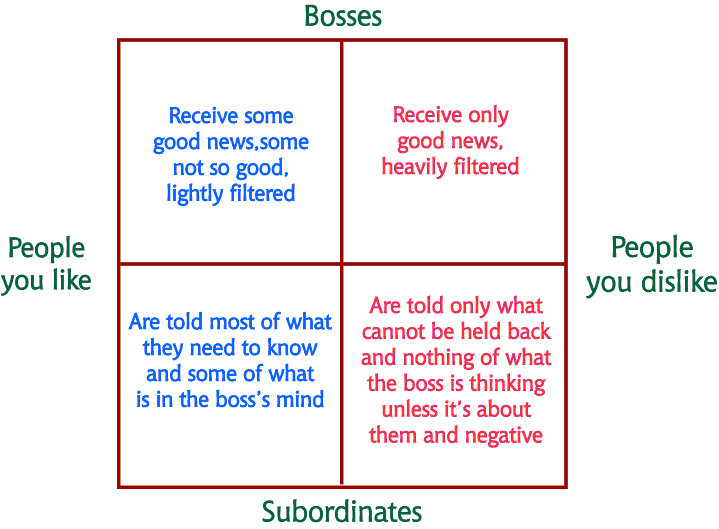
What’s most often blamed for organizational problems? You guessed. It’s poor communication. And what probably claims most attention from consultants, writers, gurus and trainers? Same answer. Yet it never appears to improve significantly. Since modern organizations began to emerge, people have been complaining about communication problems. All the training and consulting should have solved the problem long ago, but they haven’t. Why should that be?
The answer lies in human nature: that endless source of difficulties for anyone wanting to make life tidy and predictable. Information in organizations flows upwards, downwards, and sideways according to four natural laws that are caused by some very human responses to the requirement to pass information along. Knowing these laws is essential if you want to save yourself endless trouble and frustration. Using them wisely will make you seem to be a born communicator. It’s the combination of the three laws that decides how much information each person will get and how heavily filtered it will be.
First Law: Upward flows will contain only good news
Bad news doesn’t move upwards in organizations easily. Typically, it doesn’t flow upwards at all. People’s immediate response to bad news is to bury it and hope it’s never found. Bosses encourage this by their tendency to kill the messenger. Being the bearer of bad news to those above you in the hierarchy isn’t good for your career or your job security.In contrast, good news not only moves upwards easily, it’s often enriched and added to along the way. If there isn’t enough, more can be invented. Telling the boss what he or she wants to hear is commonplace, as is exaggerating every small success and forgetting all failures.
Second Law: Downward flows will be limited unless they are negative
In most organizations, information is only passed down the hierarchy on a “need to know” basis. Since bosses, especially those with large egos (that is most of them—and all Hamburger Managers) and a love of power (ditto), assume their subordinates need to know little, the downward flow of information is niggardly at best. Being “in the know” makes people feel important, so those who get information rarely feel much urge to pass it on.“Need to know” may be important in communities of spies, but it’s hard to see why it applies so widely in other organizations, apart from the reasons given above. There are likely to be few topics where secrecy is genuinely needed, and a great many where it harms progress. But humans are human and most of them love a good secret.
The exception to the limit on information flowing downwards is blame. Blame flows downwards at great speed, since those above want to make sure none of it stays with them. Indeed, it keeps flowing downward until it reaches those who can’t manage to pass it on fast enough, or have no one to pass it to. There it sticks, even if they had nothing whatever to do with the original issue.
Third Law: Sideways flows will depend on trust and liking
Do people share information with their peers? Only if they like them. That means those closest together, physically and emotionally, share information most readily, but those further away on either count are left out. Where information has to cross departmental boundaries, it rarely makes it. Other departments are demonized, so based on being disliked and distrusted, they get next to nothing. Indeed, there’s often a tacit agreement to block information to them, or even falsify it.This law works in combination with the other two like this:
- Bosses who are well-liked get more and better information from their subordinates. It’s less heavily filtered and may even contain some of the bad news.
- Disliked bosses get only unalloyed good news, much of it fabricated. All negative data is suppressed.
- Trusted subordinates are told most of what they need to know, and are usually told rather more as well—including what the boss is still thinking about.
- Disliked and distrusted subordinates are told as little as possible, even if they really need to know. The only exception is anything negative about them, which is relayed promptly and in great detail.
Fourth Law: Bad news travels farther and faster than good
It’s human nature to pass on bad news quickly. You only have to watch the professional news media to realize that. Good news has to be very good to make the headlines. Bad news only has to be intriguing, odd-ball, or sexy.The effect of this is a continual skewing of data towards the negative, especially over the short term. If a new initiative is launched, the quickest feedback will be the most extreme, whether positive or (especially) negative. That sometimes leads to organizations and people making bad judgments. Ideas are dropped on the basis of quick feedback that suggests problems. The good news takes its time to filter through and by then it’s too late.
If you want to get good information, make yourself liked and trusted, whether you’re in a boss or a subordinate relationship with the person who has the data. That’s why organizations that foster distrust through macho, Hamburger Management, constant cost-cutting, and treating staff like expendable widgets quickly get what they deserve: a virtual information blackout.
If you want the complete and accurate picture, give it time. Don’t get too despondent if the first news looks bleak. Don’t get too excited if the next wave of reports filtering up the hierarchy sound extremely rosy. All news is filtered somehow. Sometimes the only way to get anything like the truth is to go and see for yourself.
Labels: corporate culture, leadership, short-termism, trust, working relationships
Saturday, June 02, 2020
News and Views: June 2nd 2007
The end of the 40-hour week?
According to a Gartner research report released on May 30th, by 2015, people will be working a whole lot less hours each week. Gartner argues that: “ . . . three of the four traditional pillars of work—the living wage, long-term relationships with loyal employers, and government- or company-provided pensions—have already gone the way of the dinosaurs, leaving only the 40-hour workweek.” Wonderful news, if it turns out to be true, but I’ve seen predictions like this in the past. None of them proved accurate. Ah well, we can still hope. [link]But maybe it will happen . . .
According to Penelope Trunk: “. . . a great generational shift taking place in America since Generation X became adults. The shift is in the definition of the American Dream. Our dream is about time, not money. No generation wants to live with financial instability. And we are no exception. But finances alone do not define someone’s American Dream. Especially when our dream is about how we spend our time.” [link]Try a “Travel Sabbatical”
That’s the suggestion of Tara Russel, writing in Bay Area Business Woman. “In an age when we are hearing more and more about work /life balance, it seems increasingly difficult to truly ‘unplug.’ Nonetheless, many people today are doing just that. Eschewing their daily routine and stepping out to travel for months or even years at a time, busy professionals are rediscovering life on their own terms and you can, too.” She offers five tips for planning your next travel sabbatical. I think it sounds like a great idea. And if you can’t (yet) get away, how about using her tips right in your home area? You can still learn to know and reframe yourself, without ever leaving your home. [link] (Suggested reading: “Stopping: How to Be Still When You Have to Keep Going.”)Good news for BlackBerry owners
It seems that all our latest electronic wizardry isn’t increasing workaholic tendencies. Statistics Canada, in a study, entitled Time Escapes Me: Workaholics and Time Perception, “. . . found 31 per cent of Canadian workers aged 19 to 64 identified themselves as workaholics in 2005. That was unchanged from 15 years ago, despite the proliferation of cellphones, BlackBerrys and home computers that keep people connected. “ This isn’t so surprising. Workaholism, like all addictions, is a human sickness. Drug addicts make use of the latest drugs. Workaholics use the latest ways of continuing the “work fix,” whether they are electronic or not. [link] (Suggested reading: “The Overwork Trap: How We Get Caught and How We Escape.”)Gender differences on work/life balance
According to Cindy Krischer Goodman, who writes “The Balancing Act” column for The Miami Herald: “A 2007 DayTimers Life Satisfaction survey reveals men and women have different measures for living a satisfied life.More women have a clear purpose and sense of meaning in their lives. They tend to find satisfaction doing things that help others and they tend to be more organized, prioritizing weekly goals. More men get satisfaction from personal success. More men also feel they have succeeded more than most people.” Hmmm. Sounds a little too stereotypical to me. [link]
What relaxation type are you?
Here’s an idea: fitting your chosen approach to relaxation to your personality. Are you vision, sound, or body-oriented when it comes to relaxing? I think sound does it best for me.[link] [via] Or perhaps power napping will improve your performance? It seems that: “. . . taking the recommended nap time of 20 to 30 minutes during the day. . . is far more effective than sleeping an extra 20 to 30 minutes in the morning. ”The need for resolution
Steve Roesler writes that: “. . . we literally terrorize ourselves when we pile on mental burdens that need to be released. Managers add stress to their lives by postponing important conversations and letting them build up until their heads start to feel like a balloon waiting to burst.” I’m sure that’s true. His solution is proper feedback. Why? “Trust comes from a series of interactions where people have made agreements, talked about how things were going, and then lived up to what they said they would do.” [link]Venting or ranting?
Management Issues reports on: “. . . Workrant.com, a site that claims to be the place to ‘rant away all your work related stress.’” It seems that lots of young, Generation-Y types go there and rant (with extremely colorful language) about their bosses. “Most ranters, of course, are complaining about micro-managing supervisors. And most posters are rather young. So Generation Y seems particularly upset with the way managers do their managing.” On one visit, I found rants against bosses who hate women (or homophobes who hate gays), one with disgusting personal habits (and I mean disgusting), someone who talks too much about supposedly-ideal husband, and more incompetent bosses than I ever imagined existed. I’m tempted to say it’s all good, clean fun, but it isn’t at all clean. [link] (Suggested reading: “When You Work for a Bully: Assessing Your Options and Taking Action.”)Dealing with interruptions
Lorie Marrero writes at Lifehack.org on the “Top Ten Sources of Interruptions,” with ideas on how to deal with each of them. Here are two of my favorites: “5. E-mailTurn off the “new e-mail has arrived” notification sounds and pop-up windows. . . Force yourself to stop pressing the Send/Receive button all day long as if you were a lab rat about to get a treat!” and “10. Saying YES when you should say NO
If someone asks you for help, stop and consider the request carefully before answering. Use the very effective phrase “not available” when declining a request. People tend to not question this phrase and instead will go on to the next choice.“ [link]
When to leave a job that sucks
Here's an interesting set of suggestions on when it's right to call it a day and walk. Troy Hadley offers “ 10 important signs that your job sucks.” he also offers a “health warning” first: “Some of my advice here involves big ideas . . . that should not be undertaken lightly. Research tactics first before acting.” Here's one that appealed to me: “Ask yourself if you are putting energy into the right areas. Are you spending all of your time arranging meetings and conference calls and not able to put your all into the actual work? Unless you are a project manager, arranging people-to-people face time can take up lot precious work time. Can someone else handle that for you? If your company can't provide reasonable support, you might want to look for one that can.” [link] There's also the opposite point of view at: “10 important signs your job might be worth staying at.” [via]Labels: News
Friday, June 01, 2020
Want a trouble-free day?
Here's how to get one almost every time.

One of the best ways to be able to slow down and lower your stress is to save yourself trouble, especially the kind that others so often cause you. And the best way to save yourself from that kind of trouble is to avoid causing trouble to others first. Really. You may want to believe that other people are natural assholes (some, sadly, are), but most are behaving that way because they think they have to deal with an asshole . . . you!
We all spend time and attention—usually plenty of both—focusing on the trouble and difficulties we think other people cause us. But how often do you stop to consider what trouble you cause others? Maybe someone cut you up in traffic today, or spoke to you rudely. Perhaps your boss chewed you out for some minor problem or one of your subordinates was surly and inattentive. What’s your immediate inclination? To dwell on your hurt . . . or wonder whether you might have done something to cause their response?
Mostly people don’t even notice times when they cause others discomfort or extra work. If they do, they probably excuses themselves by saying “that wasn’t what I meant” or “that was just an accident.” Push them further, and they’ll likely say, “It wasn’t such a big deal. They’re making a fuss about nothing,” or “That’s life, I guess.”
The purpose of self-reflection shouldn’t be to find excuses or indulge in sentimental navel-gazing. Our problem as humans is that we’re so often out of touch with reality. What we do, think and say is based on fantasies from our minds. We don’t deal with the real world. We’re wrapped in our flawed perceptions of what’s there. Reflection is the first step towards seeing the world as it truly is—and that includes seeing our part in the problems and difficulties others face.
Looking carefully at what you and how people around you respond do will give you more insight into how and why other people do what they do. You can never get inside their heads to understand the real balance between inner drives and outer circumstances that triggered their behavior. But you can certainly do that with your own actions.
Here’s a simple exercise taken from Gregg Krech’s book Naikan: Gratitude, Grace, and the Japanese Art of Self-Reflection
Sit quietly and ask yourself three questions:
- What have I received from others today?
- What have I contributed to others today?
- What troubles and difficulties have I caused people?
People nearly always respond as best they can to the situations in which they find themselves. Some of the response is down to them and their personalities. Most is due to the circumstances and how they understand them. Yet our human tendency is to focus on the circumstances that caused us to act badly—and so rationalize away our own thoughtless or cruel behavior—yet attribute poor behavior in others entirely to the person themselves, ignoring the circumstances—which may include, of course, our behavior which triggered their outburst. Psychologists call this Attribution Error and it’s behind many kinds of human conflict, from Road Rage (that driver cut in front of me deliberately, because he or she’s an idiot and an asshole) to war (those people have to be crushed because they’re inherently evil).
Of course, people who think that kind of thing about you or me are misguided or plain stupid. Right?
Labels: stress, trust, work/life balance

This work is licensed under a Creative Commons Attribution-NonCommercial-NoDerivs 2.5 License.