Wednesday, February 28, 2007

The Critical Importance of NOT Doing Things

Why a “don’t do” list is vital to good working habits

Most gurus and teachers spend their time telling people what to do. But if you’re already over-stretched and facing an unending future of still more pressure, that’s not likely to appear palatable. Here’s how NOT doing things can help even the most stressed person find ways to improve their working life.
I’m always a little uneasy about all the websites and blots devoted to Getting Things Done and avoiding procrastination. I see the attraction—especially to those who feel frustrated and harassed—but it seems to me that getting things done is less than half of the problem. The greatest part is stopping yourself from spending time on all those unnecessary activities that clutter the working day, force people into staying late to catch up on essential tasks, and provide an enormous workload with almost nothing to show for it.

Stopping unnecessary meetings would boost available working time, lower frustration, cut costs, and free up time for essentials during the normal working day.

Take meetings. My own experience has been that as many as 75% of meetings are unnecessary. They’re mostly called to provide either an illusion of team consensus; to pass information that could be passed in one hundredth of the time by other means; to allow the self-important to have a forum to enjoy hearing their own voices; or to engage in the widespread game of synchronized cover-your-ass. Of the remaining 25% of meetings, close to 100% take too long, are ill-prepared, have poorly coordinated outcomes, or involve far longer in travel time than the meeting itself. Stopping unnecessary meetings would boost available working time, lower frustration, cut costs, and free up time for essentials during the normal working day. Not doing them would get far more done than any fancy scheduling and prioritizing system.

Unnecessary communication is another sinkhole for time and effort. All those copied e-mails, circulated memos and minutes, papers marked “FYI,” and constant demands to “keep me in the loop” and make sure this, that, or the other person is “on side.” The culprit here is a deadly combination of fear and ambition: fear that something will happen behind your back that might harm you; and ambition to become so essential that nothing—and I mean nothing—can happen without your implicit approval. All nonsense, of course, but still accepted as normal.

Cutting out all useless communication, and trusting people instead to get on with their jobs and do what they are paid for, could transform productivity overnight. All it would take is the determination to stop behaving in ways that even clinically-diagnosed paranoid schizophrenics would see as crazy.

Another great way to save time and cut waste would be to stop rushing into action before you’ve spent enough time thinking about what you are going to do. Our society places such a ridiculous premium on action over thought that a great deal of activity goes to waste because it was ill-conceived, badly prepared, poorly focused, or simply unnecessary, right from the start. The workplace equivalent of the old saying, “marry in haste, repent at leisure” should be posted in a prominent position on every boss’s desk.

Our society places such a ridiculous premium on action over thought that a great deal of activity goes to waste because it was ill-conceived, badly prepared, poorly focused, or simply unnecessary, right from the start.

An hour’s quiet thought might save a month’s wasted work. A few days of reflection and consideration might prevent 20 people being given a project that they will work on for a year, before it’s finally abandoned as unfeasible. Holding back on angry words, until you can understand clearly what is going on, could save you weeks of trying to repair a shattered relationship.

We are action-mad, reactive idiots for much of our working days, and pay a heavy price for the luxury of feeling that we’ve done something instead of merely thinking about what we ought to do.

Each time you’re distracted, it takes extra time to get back to where you were before.

Don’t add to your own distractions. That latest electronic gizmo, that neat computer software, the fashionable cell phone, or the device to check e-mails fifteen times every minute is only going to make your level of distraction greater. Each time you’re distracted, it takes extra time to get back to where you were before. Enough distractions in a day can leave you exhausted from constant effort, but with nothing actually accomplished—which is pretty much what may people experience as routine.

If you want to make a serious impact on all those activities which consume time with an inadequate—or non-existent—return for the energy expended, try these:
  • Take time to make a list of those activities that consume most of your time.

  • Sort out all the ones that you can stop doing with little or no real effect. Cal this List A.

  • Make a second list of all the ones you can reduce in frequency or delegate. Call this List B.

  • Make a daily “Do not do” list alongside any “to do” list. Make sure that you stop all items on the “ do not do” list. Keep this up until you are no longer even tempted to consider doing them.

  • Delegate everything on List B right away.

  • Spend the time that you’ve freed up thinking, completing essential tasks, and being creative. Defend it like your life.

  • Repeat on a regular basis.


Email Newsletter icon, E-mail Newsletter icon, Email List icon, E-mail List icon
Sign up for our Email Newsletter


Labels: , ,

Add to Technorati Favorites Stumble Upon Toolbar

Monday, February 26, 2007

Are you having fun yet?

Try these nine ideas and start making your work fun again

I just came across a web site dedicated to “The Eight Irresistible Principles of Fun.” It’s not specifically about the workplace, but the principles it suggests would work really well there. Most of them fit closely with the basic principles of Slow Leadership, so I’ve taken the liberty of listing them here, with my own, workplace-oriented comments. I also added a ninth principle of my own:
  1. Stop hiding who you really are. So many people do this. They pretend to be someone else: someone more acceptable to the boss; someone more serious and determined; someone who might appear to be a high-flier; someone who “fits in.” Even professional actors need to take a break sometimes and just be themselves. Can you imagine the stress that you’re putting on yourself, trying to be someone that you aren’t, every hour of every working day? And what’s the point anyway? You are who you are. Totally unique in space and time. Who says you aren’t good enough? Don’t fall for that rubbish. All that matters for a satisfying life is to be the best possible version of whoever and whatever you are: to develop your unique talents, express your special personality, and contribute all that you can to the life and people around you. Never, never, accept that you aren’t “worthy.” That’s crazy talk. Being yourself, openly and with joy, is essential to having fun anywhere—and especially at work.

  2. Start being intensely selfish. I’m not quite sure about “intensely selfish,” but I see what they are getting at. I would rephrase this as: “Start standing up for yourself and what you believe in.” No one will ever have the same degree of interest and investment in your life and future as you. No one will ever care as much as you do. No one will ever understand your needs as well, or know what it is like to be you and do what you do. People are always trying to make us into the kind of people they want us to be; to make us fit the mold and conform to their views. Do they do this for our benefit? No way! It’s for them: to stop us causing them trouble, messing up their neat lives, asking for things they don’t want us to have. This isn’t the same as people who give us good advice or share their experiences to stop us making bad mistakes. I’m talking about those who will compel us to fit in, if they are able. Focus on yourself and your own needs. At work, it’s likely that no one else will.

  3. Stop following the rules. Yea! Those rules are there to force you into conformity. The more you follow them, the less creative, individual, interesting, and open-minded you will become. There are two kinds of workplace rules: necessary ones (like rules for safety) and the rest. The first account for probably less than 10% of all the rules around. You’ll never have fun by following the rules. You’ll just become a grey, boring, wage slave, with not a single difference from all the other wage slaves around you. You won’t even advance your career much. No one ever promoted someone who didn’t stand out from the crowd in at least some way.

  4. Start scaring yourself. To learn, to grow, to develop who you are, to find excitement and fun, you have to take risks. If it doesn’t scare you, it isn’t a risk. Fun is all about taking risks—look at all the theme parks with their scary rides. Look at all the people who go surfing, or snow-boarding, or climb scary mountains, or challenge their minds with reading and listening to great music. Don’t wait for the universe to start scaring you. It may well do so in ways you really don’t want. Start scaring yourself. At work, this means taking on new and scary challenges, volunteering for jobs that you aren’t sure that you can do, taking on learning opportunities that scare you. Dare to do what you’ve never done before. Practice “conscious incompetence.” Just do it!

  5. Stop taking it all so damn seriously. Especially yourself. The most boring, least fun people around are all those who take themselves so seriously it hurts. They drone on and on about whatever tedious things they are involved in. They get hung up with never losing face or admitting they are wrong. They demand constant reassurance about their inflated sense of self-importance. There’s one life. It’s far from perfect, but it’s all there is. Crap happens—often. The more seriously you take it, they more it will worry you, and the more pain you’ll suffer as a result. Most of the misery in the world that humans cause (and that’s an awful lot of it) comes from people trying to control their lives down to the most minute details. They think they’re so damned important that everyone, and everything, else has to be lined up for their convenience. It will never happen. Give it up, sit back, and enjoy your ride around the sun. You might as well, since there’s usually damn all you can do about it anyway.

  6. Start getting rid of the crap. I am constantly amazed at how much crap people collect around them, especially in the workplace. Pack rats look tidy by comparison. All those electronic gizmos to stay in touch, all the “to do” lists, the constant meetings, the endless e-mails and memos. How much of it ever accomplishes anything? My guess is that 80% of it is simply distraction and a waste of time. People complain that they have no time to do their jobs, yet waste most of the time that they have reading e-mails, attending pointless meetings, and contributing to the tide of organizational crap engulfing them by producing e-mails and calling meetings of their own. Give it up. You’ll be amazed how much time you have suddenly; and how much fun you can pack into it, in place of all the “stuff” that was there before.

  7. Stop being busy. Constant busyness is the curse of our generation. People believe that if you aren’t constantly busy, you’re not pulling your weight. The curse of the Puritan Work Ethic hangs over us, like a cloud full of misery and drizzle. Busy is not the same as productive. Busy doesn’t mean “good” or “worthy.” Mostly it means “doing things for the sake of convincing others that I am worth keeping on here.” When lay-offs started becoming commonplace, people began extreme efforts to appear busy every moment of the day. As Hamburger Management became conventional, bosses starting measuring activity, because they had no idea how to measure effectiveness, and they thought they should measure something. The result is people who are too busy to have fun, too busy to live their lives, too busy to enjoy anything. Don’t join them. Life has enough misery without adding to it.

  8. Start something. I can’t do better than quote a comment from an earlier post: “Trying something new is like catnip—irresistible fun. Getting better and better at something that I initially did badly—THAT breeds enthusiasm.” Don’t wait for others, or you’ll wait for ever. Start it yourself.

  9. Don’t worry what others will think about you. This is my “extra” principle. All too many people are stuck because they’re worried what others may think. The truth of the matter is that others are mostly doing what we all do most of the time—thinking about themselves. They aren’t concerned with you at all. A lot of the time, they aren’t even aware of your existence. So if, from time to time, they drag themselves away from self-absorption just long enough to disapprove of whatever you’re doing, ignore them. It’s your life, not theirs. Self-doubt and fear of embarrassment are major dampeners on any kind of fun. Throw them away. They aren’t worth the time of day.
When do people perform best at any task, from sport to nuclear physics? When they’re relaxed, intent on what they’re doing and more of less oblivious of everything else. When they’re having fun. So loosen up and enjoy your life.


Email Newsletter icon, E-mail Newsletter icon, Email List icon, E-mail List icon
Sign up for our Email Newsletter


Labels: ,

Add to Technorati Favorites Stumble Upon Toolbar

Friday, February 23, 2007

Stepping through the looking glass

It’s long past time to try something new in management

Management today is mostly based on standard responses to problems. But like Alice, stepping through the looking glass into a wonderland on the other side, it’s always open to us to consider what might happen if we didn’t follow the set path, but broke out into fresh ideas and opportunities.

Suppose that we implemented the opposite of today’s standard management responses? What kind of business world might lie on the other side of the looking glass? Would it be a wonderland of untapped potential, or a wasteland of risk and problems? Let’s take a look.

Gone would be the cramping over-emphasis on instant results and avoidance of risk. No one was ever inspired to great ideas or endeavors by thinking only about immediate or short-term practicality. Only idealism ever inspires. That’s why corporations that favor idealism over pragmatism produce more innovative, more inspiring, and more motivating ideas. Pragmatism is fine for second-rate businesses handling commodity products, but that route will never win long-term market leadership. Visionary companies, and leaders with a fierce resolve to implement those visions, consistently win over the long haul.

If we want people to look to the long-term for their returns, we have to offer the kind of security and support that warrant their trust.

On the other side of the looking glass, organizations would retain key employees with long-term rewards, such as development, security, and opportunities for personal growth; not just short-term ones like bonuses and stock options. Where employees have learned to distrust the long-term security of their employment, they will always demand large rewards now as insurance against future lay-offs. If we want people to look to the long-term for their returns, we have to offer the kind of security and support that warrant their trust. The corollary of this must be that consistent, long-term performance would be seen as more valuable than quick wins (and long-term losses).

The more the demand grows for quick, measurable results, the more our aims become distorted to give only these—even if it hurts the organization’s interests in the longer term. Creativity and long-term potential is worth so much more than merely current performance. Instead of paying reluctantly to try to deal with any present performance shortfalls, which are only the symptoms of some underlying malaise, through-the-looking-glass organizations would go straight to the fundamental drivers of excellence: being trusted to do your job, set in the right role, given the right support, and allowed the freedom to contribute freely whatever gifts you can bring to your work. A group of free people, having fun and acting together out of choice and shared beliefs, will always outperform pressed labor and those whose loyalty and interest goes no further than the salary check.

Most management is still based on the underlying assumption of a “master” stipulating what the “servants” must do and judging them according to their performance against his or her imperious standards.

This is not the way to promote creativity, learning, or fun in the workplace—let alone real productivity. Leadership of this kind is always ‘us’ versus ‘them’: the expert leader instructing the ignorant subordinate and demanding compliance. Yet compliance never produces better than mediocre performance. None of us can do anything well if our hearts are not in it. Real achievement only comes about when people engage in an act of free will—an act with joy and passion—by choosing to thown themselves wholeheartedly into their work and seeking to understand what will improve their output, knowledge, or skill the most. Our public schools should have shown us all that when alienated pupils withdraw their consent to work and learn, no amount of discipline or teaching produces any result at all.

Our organizations and its leaders, like our society, have a long history of trying to deal with problems by coercion of one kind or another—legislating against them, or trying to drive them out of existence, instead of exploring to understand what produced the problems in the first place and continues to sustain them. At best, this drives problems underground; at worst, it gives them something to push against to build up their muscles. We need at long last to understand the total futility of this kind of behavior.

I shall be away until early March, so posting will be more intermittent than usual, as my access to the Internet will be sporadic at best. Please be patient and things will return to normal in about 10 days or so.


Email Newsletter icon, E-mail Newsletter icon, Email List icon, E-mail List icon
Sign up for our Email Newsletter


Labels: , , ,

Add to Technorati Favorites Stumble Upon Toolbar

Thursday, February 22, 2007

Russell Ackoff: a wise and subversive thinker

How flawed, out-of-date, and misplaced teachings are crippling management

Professor Russell Ackoff has recently published a new book about the f-Laws, uncomfortable truths about the (mistaken) way most organizations are run, and how this approach is embedded in decades of repeated management mistakes and conventional business teaching. If you don't already know about Professor Ackoff, this article will introduce you to a grand old man of management non-conformity.

Here's a fascinating short piece from the BBC in London about Russell Ackoff and his f-Laws: the view that business is riddled with “flaws . . . from decades of repeated management mistakes and conventional business teaching.”

According to Professor Ackoff:
f-Laws are truths about organizations that we might wish to deny or ignore—simple and more reliable guides to managers’ everyday behavior than the complex truths proposed by scientists, economists and philosophers.
Here are a few examples:
  • The lower the rank of managers, the more they know about fewer things. The higher the rank of managers, the less they know about many things.

  • Executives make mountains out of molehills; subordinates make molehills out of mountains.

  • The relationship between executives and subordinates is complementary: neither knows why the other does what they do, nor cares about it. This leaves a large black hole between them into which most important issues and communications fall, lost and, like Clementine, gone forever.
This one I really love, because it seems to me to speak exactly to the current idiocy about measuring activities: “Managers who don’t know how to measure what they want settle for wanting what they can measure.” As Ackoff says:
In the workplace it’s also true that managers will measure anything that can be quantified in order to be able to set targets.
Then there is this piece of wisdom from Sally Bibb, Professor Ackoff’s collaborator, that speaks directly to Slow Leadership and the current craze for over-ambition and Hamburger Management:
Managers don’t know what they want because they never think about it. One executive told his psychotherapist he was depressed because he felt he wasn’t successful. To the therapist he looked successful: good job, great salary, lovely family and beautiful home. She asked how he would know when he was successful. He couldn’t answer. He just kept on striving without knowing what he was striving for.
Ackoff's books on the f-Laws are published in Great Britain, and you can get a free “taster” from the publishers. His latest book is Management f-Laws: How organizations really work and it’s definitely worth reading, The publishers are offering readers of this post a 10% discount on the book. Order from them here and type “triarchy-ten” into the Promotional Code box (which you’ll find when you get to the checkout).

I’ve said in many posts that I believe traditional organizational ideas are out-of-date and badly flawed. We still owe far too much to methods dreamed up in the days of Henry Ford and the Model-T. Despite great books like Hard Facts, Dangerous Half-Truths And Total Nonsense: Profiting From Evidence-Based Management by Jeffrey Pfeffer and Bob Sutton, business schools seem happy to go on trotting out half-truths and out-of-date nonsense and calling it management theory. I’m looking forward to the next piece by Peter Day of the BBC, in which Professor Ackoff promises to tell the truth about business schools!


Email Newsletter icon, E-mail Newsletter icon, Email List icon, E-mail List icon
Sign up for our Email Newsletter


Labels: , ,

Add to Technorati Favorites Stumble Upon Toolbar

Wednesday, February 21, 2007

You Are Not John Wayne

He may have been a great action hero, but Hollywood is still not like the real world.

Today’s media-driven, action-obsessed organizations are losing sight of the reality that sheer effort often goes unrewarded, unless it’s directed by some careful, complex, and time-consuming thought. Busyness and thoughtfulness are poor companions. Until organizations stop assuming greater effort is the simple answer to every problem, people will continue to work harder and harder for the same meager results—or none at all.

We live in a culture where action is highly prized and thought is seen as either pointless or suspicious. I’m not sure why this should be so. Of course, powerful rulers have always been suspicious of those whose motives and actions they can neither quite understand nor easily control. The bluff man of action was relatively easy to deal with. The quiet schemer was always the greatest threat. That’s why it paid to keep the cleverest people where you could see them, and deny education, and the leisure to think, to as many people as possible.

Maybe we also have Hollywood and our media-based beliefs to blame. It’s easy to display action on screen. It’s exciting, full of grand visual effect and opportunities for loud music and terrific over-acting. Displaying thought is tricky. Nothing much appears to happen, and complex thoughts can be hard for an audience to follow. It’s not impossible—William Shakespeare did it pretty well—but few screenwriters manage to reach his standard. Besides, pitting the brave, honest action hero against the skulking, devious, too-clever-by-half villain is such an easy driver of plots that few can resist it.

Whatever the causes, we are left with a culture where action—preferably lots of it and the more assertive the better—is assumed to be the answer to every problem.

Whenever people feel uncertain or doubtful, greater effort—more action—is called for at once. Do next quarter’s, or next year’s business prospects look shaky? Work harder, cut costs, increase everyone’s efforts. Is a project sliding off track? Stay at your desk until 10:00 p.m. every day, then take work home.

Never mind stopping to discover the real reason for the problem. These future sales projections may look bad because the product is falling out of fashion, or an unexpected competitor has brought out a superior alternative. The project that’s causing you to work 16-hour days may be doomed because it was badly conceived from the start. In neither case will extra effort alone make any difference to the outcome. It’s as if people feel that, in a just universe, all that determination and hard work deserves to be successful. The honest, perspiring hero, (or gallant, open-hearted heroine) should prevail, even if she or he hasn’t a clue about the problem or its causes.

That might be the case in a just universe. I wouldn’t know, because neither I nor anyone else has ever inhabited one. In the real world, effort very often goes unrewarded—especially if it, too, is misdirected, poorly conceived, or based on a total misunderstanding of the real nature of the problem.

No one ever produced a smart idea, an imaginative concept, a competitive edge, or a compelling vision without thought —typically a great deal of it.

No one ever produced a smart idea, an imaginative concept, a competitive edge, or a compelling vision without thought —typically a great deal of it. Hollywood may prefer simple plots that can be easily written and acted, but the universe rarely agrees with the neatness needed to make a one-hour TV show, with 20 minutes of commercial breaks. I recently heard on the radio that military personnel are copying what they see on TV as battle tactics. Rush in, shoot a few villains, and those who survive will immediately tell all they know. Works on TV. Sadly, in the real world, the survivors do inconvenient things such as lying, making up any old story to save their lives, or refusing to talk even under prolonged interrogation.

A corporate culture where thoughtfulness is seen as a waste of time, and intelligent reflection a probable basis for disloyalty and plotting, is going to discourage any spark of creativity or exploration that remains.

Constant busyness is practically guaranteed to drive any thoughts away, and leave no spaces where they might return. A determined focus on short-term actions destroys all chance of creating long-term advantage. And a corporate culture where thoughtfulness is seen as a waste of time, and intelligent reflection a probable basis for disloyalty and plotting, is going to discourage any spark of creativity or exploration that remains.

Relying on effort nearly always means doing what you are doing already—only harder. It’s very often taking a doomed idea and continuing to feed it with effort and resources, long after it should have been abandoned in favor of something better. It’s running about in a frenzy of action, when slowing down and giving yourself time to think up an alternative approach is the only likely path to success.

Stop shooting from the hip. John Wayne may have got the bad guy with every draw of his six-shooter, but he had considerable help from special effects, the director, and the script. In a 19th century gunfight in Phoenix, Arizona, two people stood on opposite sides of the street and blasted away at one another until both ran out of bullets. Neither suffered a scratch.

The only things that frantic busyness is guaranteed to produce are exhaustion, stress, and numbed resignation—exactly what many feel in today’s workplaces. Slow down and think instead. Then there’s at least a chance you’ll discover a way to succeed—and probably with about a quarter of the effort.


Email Newsletter icon, E-mail Newsletter icon, Email List icon, E-mail List icon
Sign up for our Email Newsletter


Labels: , , ,

Add to Technorati Favorites Stumble Upon Toolbar

Tuesday, February 20, 2007

Extra News and Views: February 20th 2007

My regular Saturday “News and Views” posting hasn’t been able to keep up with all the items I have collected over the past few weeks. I shall also miss two Saturdays, since I am away from this Friday and will have only very limited Internet access. I have therefore decided to add an extra posting of interesting items, most of which I have been holding for one or more weeks.

Staff don’t trust senior executives

[link] Yet another survey lamenting the poor levels of trust in the workplace. Sadly, the consulting firm that commissioned it trotted out the old platitudes about “communications problems.” Maybe it will eventually sink in that problems with trust usually mean that someone isn’t actually behaving in trustworthy ways. No amount of “better communications” will deal with that. And, while I’m on that topic, here’s another survey blaming communications for what is much more likely to be good, old-fashioned mistrust.

The downside of office politics

[link] There’s evidence to suggest that office politics have “grown from being a peripheral issue ten years ago to the single biggest cause of stress in the workplace today, according to British researchers. Unfortunately, they seem to have few ideas what to do about it.

Ideas on happiness at work

[link] Alexander Kjerulf offers some thoughts from various well-known people. Interesting to see the founder of Honda saying that people will not sacrifice themselves for the company. I’d be even happier if he said should not . . .

Are you obsessed with your cellphone?

[link] It seems that some Australians are. According to Management Blog, the average Australian spends over an hour on their mobile phone each day (this time consists of 35 minutes of texting and 25 minutes of talking) and lots freely admit to being addicted to them. Sadly, the research quoted gives no idea how much of the up to A$500 some people spend on cellphone calls each month is really necessary. I suspect the answer is “very little.”

Scary Co-Workers?

[link] [via] Business Week lists the colleagues people can’t get away from fast enough, and how to deal with them. The pictures in the accompanying slide show are scary in themselves. Unfortunately, the advice is mostly based on journalistic platitudes.

Is a good company like a good user interface?

[link] Kathy Sierra thinks so. She thinks they should support people in doing what they’re trying to do, and stay the hell out of their way. Seems like very good advice to me. The post is a good read, as always with Ms. Sierra, and the comments are fascinating as well.

Too apathetic to write about apathy?

[link] Max McKeown explains that a quick search on Amazon reveals not one single business book or pamphlet about overcoming apathy. Yet getting people to do things is, he believes, the essence of leadership. I quite like the part where he says: “Stress can cause apathy—and here the competent leader can help (and other slacker incompetents can learn) by giving back control of the situation to the person who has learned to be helpless at work, or doing a certain task, or simply in your presence.” Not so sure, though, about his continued emphasis on the idea that it’s all caused by learned helplessness. To my mind, many more people have learned that doing anything other than agreeing and trying to do their jobs as best they can is a recipe for being blasted by some ambitious Hamburger Manager eager to blame everyone else for his or her own shortcomings.

One bad apple is enough

[link] William Felps and Professor Terence Mitchell from the University of Washington’s School of Business analyzed some two dozen published studies that focused on how teams and groups of employees interact, and specifically how having bad team mates can destroy a good team. They found that teams that had a member who was disagreeable or irresponsible were much more likely to perform badly. Hardly a surprise, but it’s good to see intuitive ideas born out by research. Sadly, they also found that negative behavior outweighs positive behavior—that is, a bad apple can spoil the barrel but one or two good workers can’t unspoil it.

A warning for top dogs

[link] Janet Dowd explains the origin of the terms “top dog” and “underdog” and suggests that until the underdogs of the business world are properly acknowledged and valued, the top dogs will always be in danger of being caught off balance by the uncertain force of the thrust from below. Good advice.

Don’t let life “happen” to you

[link] Craig Harper from Down Under believes that most people have never really defined success. They want to be “different” and “better” and have more, but they don’t know what any of that is. He says: “we need to step back from the busy-ness and mayhem of our life, be still for a moment . . . and get some perspective, space and clarity . . . We need to stop looking for the convenient, easy, comfortable path and look for the rewarding, challenging, exciting, amazing and fulfilling path.” Good on yer, mate!


Email Newsletter icon, E-mail Newsletter icon, Email List icon, E-mail List icon
Sign up for our Email Newsletter


Labels:

Add to Technorati Favorites Stumble Upon Toolbar

Monday, February 19, 2007

Lies, Damned Lies, and Executive Platitudes

Why pretending to value people and acting otherwise is a corporate crime.

That handy platitude about our people being our greatest asset is trotted out in everything from press releases to annual reports to executive speeches. But does it mean anything? Is there ever any real intention to act on it? And if there is not, as so often appears, what are the implications for the businesses and organizations involved?
Recently, one of the regular readers of this blog, Dan, mentioned in a comment that the business platitude about our people being our greatest asset didn’t often appear to translate into action. Corporations, and the executives who run them, may claim that “our people are our greatest asset,” but their actions certainly suggest some very different assumptions. Staff are habitually accounted for as a cost, to be limited and minimized wherever possible, along with all other costs. Aside from the obvious ethical implications of such casual dishonesty, what are the true implications for an organization that fails to treat people as an asset at all?

A good place to start is to explore what actions might we expect to see, if this phrase about people being assets (let alone the organization’s greatest asset) was acted on in good faith. Any business’s assets are carefully protected and nurtured&mdashit’s greatest asset most of all. And that asset would obviously be the central focus of most business strategy. Not only would it be used as carefully and effectively as possible to build and develop the business, it also surely be enhanced and added to whenever circumstances allowed. If someone says that their home, or their 401(K) pension plan, is their greatest asset, you would expect to see them invest time, money, and effort in adding to its value whenever they could.

On this basis, the action that prove something is believed to be a critical asset include:
  • Protecting and nurturing it.

  • Making its use and development central to any strategy.

  • Using it as well and as carefully as possible.

  • Making it the central point around which other activities revolve.

  • Working to increase its value whenever circumstances allow.
Does that sound like the way most businesses treat their people? Not to me. What I see is almost an opposite range of actions:
  • People are treated as expendable and often subjected to rough and stressful treatment.

  • They are rarely seen as central to any kind of business strategy.

  • Far from using existing people to generate fresh ideas or come up with new projects, this is increasingly outsourced to consultants -- as if it is automatically assumed that internal resources are inadequate for handling anything other than routine.

  • People are expected to fit themselves around financial and technical demands, not the other way around.

  • Expenditure on increasing the value of employees (training, development, benefits) is seen as the first and most obvious target for cost reductions.
Does it matter if it appears that in this case, as in so many others, organizations and executives say one thing and do another? I believe that it does.

This type of casual reliance on platitudes that no one intends to take seriously represents a serious ethical lapse: an automatic and institutionalized level of dishonesty.

Politicians regularly try to deceive the electorate with “spin” and lies, and more and more business leaders seem to be using similar tactics. In both cases, the result is widespread distrust, anger, and resentment. Taken too far, such actions undermine the basic respect for authority on which all countries and organizations depend for stability.

If business leaders fasten on the use of meaningless platitudes and “spin” as a way to sugar-coat their true intentions, they will wreck such trust as they still enjoy and create instead an atmosphere of continual suspicion. People are not compelled to work for a particular employer. They can refuse to join, leave, or (worst of all) stay to collect a paycheck, but give as little of themselves as possible in return. Destroying trust is both foolish and economically wasteful.

What would an organization look like if its people really were treated as its greatest asset?

Maybe it would be something like this:
  • Expenditure on people would be classed as a natural and laudable investment, not a cost. It would be among the last things to be cut in bad times.

  • Staffing cuts and lay-offs would become so rare that their use would signal the very worst kind of crisis. Instead, an organization’s people would be seen as its most obvious source of ways to survive bad times, and the most value asset available to top executives in fighting off competition.

  • Concert for the welfare and development of staff would automatically be number one on every manager’s list of priorities.

  • As many staff as practicable would be involved in proposing more effective business practices and helping to develop strategy.

  • There would be an automatic zero-tolerance policy for anything that undermined the value of the organization’s principal asset—its people—such as bullying, discrimination, dishonesty, cruelty, imposition of stress and overwork, or simply behaving like a total jerk. Bob Sutton has traced research suggesting that the presence of even a single asshole in a business has grave consequences on overall productivity.

  • Each person would be seen as a source of unique value, so it would become mandatory to discover what they do best -- then help them do it.

  • Executives would be expected to be leaders and mentors, working for the benefit of all, not autocrats and egotists focused mostly on their own aggrandizement and profit.
Imagine the impact a mindset like that could have on a business. I wrote earlier that I thought it really mattered if organizations talked about valuing people, but acted in the opposite way. This is why: they are ignoring or wrecking what could be a genuine asset of huge value to the business, if only they treated it as such.

To my mind, that is close to being a corporate “crime.” It is certainly a gross dereliction of the duty of any executive to the owners or shareholders. Suppose some executive neglected maintenance and allowed expensive machinery to be ruined. Wouldn’t you expect them to be disciplined, or even fired? So what should happen if a boss treats people in ways that ruin their effectiveness through increased stress, lowered morale, limited creativity, or increased turnover?

Actions, it is said, speak louder than words. In the Christian Bible, it is written that you can know people’s true nature by their “fruits,” meaning the visible results of what they do. If many of today’s organizations were trees, their fruits would range from bitterly unpalatable to downright poisonous. It that any way for a civilized society to organize how it deals with work?


Email Newsletter icon, E-mail Newsletter icon, Email List icon, E-mail List icon
Sign up for our Email Newsletter


Labels: , , ,

Add to Technorati Favorites Stumble Upon Toolbar

Saturday, February 17, 2007

News and Views: February 17th 2007

More about stress and disease

Link to studies showing that workplace stress can lead to an increase in rates of heart disease, flu virus, metabolic syndrome, and can negate the heart-healthy aspects of a physically active job. There’s so much scientific evidence about the negative impact of job stress, I cannot quite see why the authorities haven’t stepped in with preventative legislation as they have with, say, seat belts in cars. [link]

Even government watchdogs can be caught out spoiling their own patch

Great Britain’s Health and Safety Executive (the government body charged with monitoring how employers deal with work-related stress) has been strongly criticized after one of its senior employees claimed he was forced into early retirement by work-related stress. [link]

Regular napping may reduce risk of heart disease

Researchers from the University of Athens Medical School in Greece found that those who took regular, mid-day naps lowered their chances of heart disease by more than a third. I think I’ll look into that as soon as I’ve had my next nap. [link]

When you feel that surge of blood to the head . . .

How to curb your primitive instincts and save yourself from wrecking your environment, your possessions, and your relationships. [link]

Accountants still don't get it

A study by Arizona State University suggests bosses at large public accounting firms don't like people who try to achieve work/life balance. Employees who worked part-time or flextime hours were less likely to get plum assignments going forward, and their career prospects took a hit, and (surprise) the negative impact of part-time and flextime work schedules packed more wallop against men than women. Seems the top bean-counters can't count the benefits of a happier workforce. [link]

A vigorous attack on “the market and its workaholic ways”

Oliver James, writing in The Times (London, UK), is unhappy that Britain came bottom of Unicef’s league table of the happiness and welfare of children in industrialized nations (one place below the USA. Holland was top). He blames Margaret Thatcher, who he claims began a trend towards what he calls “affluenza virus” values—placing too high a value on money, possessions, appearances (physical and social) and fame, plus what he calls a “men in skirts” version of feminism that is, he believes, vigorously hostile to parents being at home when their children are small. Worth a look, whatever side of the argument you’re on. [link]

Aussie professor also targets “affluenza”

Professor Niki Ellis says that highly skilled workers are putting in 50 hours per week, not because they love their jobs but because they’re trapped by their lifestyles. She also claims there’s an “attitude of denial” towards workplace stress in Australia. 50 hours a week is mild, compared with what is sometimes the norm in the USA, but I applaud her point. [link]

Transatlantic comparisons

Brian Lee compares Americans and Europeans and notes that what Americans lack in leisure time, we tend to make up for in work ethic. In his view, Europeans tend to place a much greater emphasis on the arts, spending time with family, and relaxation. I know which I prefer . . . but I’m a European, even if I now live in the USA. [link]

Motivation run amok?

Is ambition is a good trait to hold? Here’s a carefully argued view that says that it isn’t. The anonymous writer also has an interesting turn of phrase: “You don’t have to murder to be ambitious though. You can also tweak your accounting. The leaders of Enron and MCI didn’t kill anyone, but their ambition devastated thousands. I’d call them gentleman despots.” Worth a look for the passion alone. [link]


Email Newsletter icon, E-mail Newsletter icon, Email List icon, E-mail List icon
Sign up for our Email Newsletter


Labels:

Add to Technorati Favorites Stumble Upon Toolbar

Friday, February 16, 2007

Workplace Karma

Do unto others, and they will make sure they do unto you


A thought floated across my mind recently, when I was reading something about the ideas of “karmic law.” I’m not an expert in Buddhist or Eastern thought, but what I understand of the idea of karma is that it’s a refined version of cause and effect: what you do affects what happens to you, or “what you give out is what you get back.”

It seems to me that you don’t need to have any kind of belief in either the supernatural or Eastern religion to see that “what you give out is what you get back” represents simple realism.

Suppose that you’re a typical “Hamburger Manager.” You’re tough, assertive, macho, obsessed with short-term results, and tireless in your pursuit of your own ambition. What you “put out” in terms of behaviors will likely include:
  • Constantly talking tough—then complaining that no one likes you, though you’re really a nice person.

  • Hounding subordinates to do more and more with less and less—until everyone is so tired that they produce less and less, however hard they work.

  • Demanding longer and longer hours of unpaid overtime—and expecting bigger bonuses for yourself as a result.

  • Claiming that money is the only incentive—while cutting back wherever you can on salary payments.

  • Refusing to consider anything other than “meeting the numbers”—even if those numbers are based only on wishful thinking.

  • Accepting bad behavior from anyone who “brings home the bacon”—and sneering at the “impractical idealism” of those who suggest that this is unacceptable.

  • Thoughtlessly copying the cult of disdain for anything “soft,” “liberal,” or “impractical”—which is pretty much everything that doesn’t fit with the opinions of your bosses.

  • Maintining rigidity of outlook—because true believers never even consider the tiniest doubt about orthodoxy.
What will likely come back to you as a result?
  • Tough talk and macho behavior provokes the same kind of response. Aggression breeds aggression in return, so life becomes a constant battle of wills. All the aggression that you encounter will then likely make you more aggressive, and so on, round and round, in a never-ending process of escalation.

  • Hounding subordinates and forcing them into longer and longer working days will produce stress, tiredness, frustration, and burnout. Hourly productivity and creativity will fall—so the only way to catch up on targets will be still to demand still longer hours and exert yet more pressure. You’ll constantly have to do more and more hounding. It won’t end until there’s some kind of collapse.

  • Whenever money is used as the sole incentive, people quickly discover that any amount that you give soon becomes accepted as the “going rate” and loses its incentive effect. If you raise pay to bring back an incentive, you need to make still more profit to cover the extra cost. It turns into a continual, fruitless game of “catch up.” If you hold out and refuse to drive up salary costs, you have no further incentive availave—and you incur higher costs elsewhere as you are forced to replace those who leave. This is (politely) known as a lose:lose strategy.

  • Accepting any kind of behavior from jerks and bullies, so long as they meet the numbers and get results, creates an atmosphere so toxic that few people will stay in it for long—especially anyone with talent and intelligence. You’ll get the staff that you deserve—along with the high turnover, constant hassles, and looming law suits. Besides, anyone who tolerates jerks is, by definition, a jerk themselves. He or she who tolerates most jerks is the jerk-in-chief.

  • A rigid, numbers-based, macho outlook is a great way to destroy any sparks of creativity in yourself and others. Your competitors will have the ideas, and you will be driven back to competing on low costs and desperately trying to mimic what others have produced before you.
What the universe will give you back from giving out Hamburger Management is all the worst, most stressful, and least fulfilling aspects of the business environment. And if that tempts you to respond with even more rigorous Hamburger Management thinking, you’ll get still more of the same. If you pay peanuts, you get monkeys. If you lead like an idiot, you’ll be surrounded by idiocy. If you act like a bullying, aggressive bastard, you’ll be amazed at how many other nasty, callous bastards you will encounter every day; and how keen they will be to screw you over on every possible occasion.

The other reality of this faux-karmic law is that it multiplies. There’s one of you (one manager, one organization), but thousands upon thousands of other people to return what you send out. Act aggressively and thoughtlessly and all these thousands will return the same behavior, often with interest. So, if you act like a jerk, what you’ll get back is the same behavior, multiplied by the number of people who suffer from what you do.

There it is: behave like the stereotypical, bullying manager and that’s exactly what you’ll encounter in return. Do it consistently, and your return will be multiplied by several orders of magnitude. Give out honesty, trust, creativity, and sensitivity to others and that’s what the universe will most likely play back to you, also enhanced and extended.

It’s your choice. If your daily experience at work is that the world is full of people throwing sh*t around, the chances are extremely high that you are a major contributor to the process that put all that brown stuff there for them to throw back at you. Maybe, if you stop dishing it out, you’ll begin to find that less comes back. If everyone did that, very soon there would be none to throw around any more. Think about it.


Email Newsletter icon, E-mail Newsletter icon, Email List icon, E-mail List icon
Sign up for our Email Newsletter


Labels: , , ,

Add to Technorati Favorites Stumble Upon Toolbar

Thursday, February 15, 2007

Do you recognize today’s biggest business killer?

Audit mentality puts efficiency first, but innovation is what sells


Today’s standard responses business issues are limited and uninspiring, even as we stand in serious need of a steady flow of creative ideas and fresh innovations just to keep our high-tech, high-earning, and high-expenditure lifestyles in place—let alone to add still greater prosperity for more people. Cost cutting, increasing working hours, and driving employees harder and harder are all based on doing what you do today more cheaply and efficiently. But what if doing what you’re doing now, only better, isn’t enough? What is you need to offer the world something altogether new? No one ever stimulated creativity by staying longer at the office, cutting benefits, or driving people to the edge of exhaustion and beyond. If the audit mentality takes over, the future will be bleak.

Many of today’s businesses are too focused on the present and the past. Their futures are extremely short-term, usually bounded by the next reporting cycle and Wall Street’s immediate expectations. They talk about change and innovation, yet act almost entirely on making current activities less costly. It’s a kind of corporate schizophrenia: one personality jabbers away about taking on global competition through innovation and new technology; the other—the one actually in charge—assumes that the only way to succeed is by doing what is being done already, only more cheaply.

Today I read that DaimlerChrysler will cut 13,000 jobs in an attempt to return to profitability. Their sales have fallen drastically and they are running out of money. Why has this happened? Because, like the rest of Detroit’s automakers, they bet the farm on huge, gas-guzzling SUVs. Now, like their competitors in that market, the only way out seems to be to cut back hard and hope for the best.

But, wait a moment. Their product line isn’t selling and they are losing market share. How will drastic cutbacks address those issues? It may buy them time before Chapter 11 bankruptcy is the only alternative, but surely what they need most is a new, more attractive, more innovative product line?

If Americans are buying from foreign car manufacturers like never before, especially brands like Toyota, becoming more efficient as manufacturers will only help after you have a product line that more people want to buy.

That’s the wrong way around, it seems to me. Toyota aren’t successful just because they’re more efficient. First and foremost, they have products that people want to buy.

That’s the wrong way around, it seems to me. Toyota aren’t successful just because they’re more efficient. First and foremost, they have products that people want to buy. Then—and only then—they work to produce those products as effectively as they can. Can you buy an MP3 player more cheaply than the cost of an iPod? Sure. So why do Apple sell so many iPods?

The audit mentality in many companies is hopelessly inward looking. It sees only costs, efficiencies, and margins. Of course, the consumer has no interest in any of these. Unless you operate in a commodity market where every version of a product is identical, save in price, people don’t buy the cheapest product, whatever economists claim. They certainly don’t buy the one that yields the highest return to its producer. They buy what they like most, what will win them the admiration of their friends, what provides the most features that they want (not the ones the technical geeks get most excited about), and what will make them feel good about their purchase.

People want what they want—and then they want to get it at a good price. Low cost comes after desire, not before. It’s not what drives sales.

Efficiency is nowhere on this list. Nor is price. Of course, some people like to boast about getting a bargain, but few, if any, will buy what they don’t want, just because the price is good. They want what they want—and then they want to get it at a good price. Low cost comes after desire, not before. It’s not what drives sales. The corporation that can produce desirable, exciting products first—then do so in a way that prices them competitively and yields a good margin second—is the one that is going to dominate the market.

In any business, you need first of all to have a product or service that people want to buy. Then, and only then, you need to be able to provide it in a way that renders you a good profit. Today’s conventional approaches to management have it the wrong way around. That’s why we see once proud corporations reduced to survival mode: they concentrated on being the “lowest cost producer” and ignored what they were producing.

Creativity needs time, relaxation, the willingness to take risks, and the long-term vision to see something from concept to reality. When corporations truly take risks in the cause of producing ever more innovative and exciting products, no one begrudges them the profits needed to support that endeavor. We all benefit. When those same corporations try to drive up profits by scrimping and cutting back, stifling innovation and damping down every avoidable risk, with the intention primarily of rewarding financial institutions and top executives, almost any profit they make appears self-serving and excessive.

Business is risky. Investment in the future is never certain. The pay-off may take many years. But capitalism, as a system, exists precisely to provide the money businesses need to take those risks, hopefully to increase everyone’s prosperity and the range of goods and services available in the market. It is not there to wring the last few dollars from dying products to enrich a few, while allowing those with more imagination, a longer-term focus, and less obsessive interest in short-term share-price movements to take over the market.

Get together an offering that excites people. Then, when it’s out there and selling, focus just enough on keeping down the costs to maintain a solid margin.

Slow down. Take the time needed to be creative. Drive innovation, not still more stress. Get together an offering that excites people. Then, when it’s out there and selling, focus just enough on keeping down the costs to maintain a solid margin. But, whatever you do, never allow concern with efficiency to limit creative thinking about the next new thing.

The past is gone; whatever money you made then cannot be changed. The present is fleeting; it’s usually too late to change what you’re already doing, good or bad. The future is wide open; only there can change alter how things will happen. The audit mentality is a business killer. Have nothing to do with it, or it will slowly choke the life out of whatever future is open to you.


Email Newsletter icon, E-mail Newsletter icon, Email List icon, E-mail List icon
Sign up for our Email Newsletter


Labels: ,

Add to Technorati Favorites Stumble Upon Toolbar

Wednesday, February 14, 2007

Accepting the unacceptable : a thought for Valentine's Day

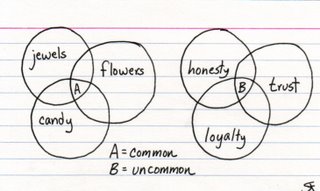
Here’s a simple yet profound thought from Jessica at indexed about gifts for Valentine's Day. [link]

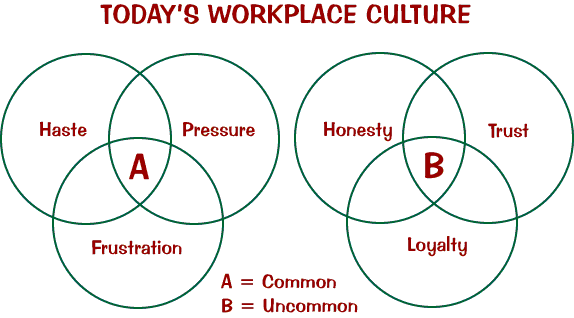
Here’s my “workplace” version:


Why do we accept this as normal?

I cannot see that any working culture marked primarily by constant haste and distraction, continual pressure, and frustration on a massive scale could possibly be described as either “efficient” or “inevitable.”

Yes, the business environment is competitive. It always has been. Is it any more competitive than it used to be? I doubt it.

Yes, the business environment is competitive. It always has been. Is it any more competitive than it used to be? I doubt it. The competition is simply different, that’s all. But even if the level of competition has increased, that’s no reason to accept a wretched kind of workday and career experience as normal.

Human beings choose and sustain their working environment the way it is. It isn’t a natural product, like the weather, over which mankind has no control. We chose capitalism over communism and a centrally-planned economy; that wasn’t an “act of God,” it was an act of mankind. We choose to operate within a global economy, because enough people believe that it works for them—at least in the sense of increasing their prosperity and that of their organizations. Boards of directors don’t have a totally free choice over how they structure and run their businesses. They have to comply with the law and various regulations and expectations. Yet, even with all that taken into account, they still have a great deal of freedom in what they choose to do. That’s even more true of private companies, family-owned businesses, and sole proprietors.

Why do so many stick to a business model that creates so much stress and misery? Is it a failure of imagination, a lack of nerve, or a simple ignorance that any alternatives are possible. People like Ricardo Semler have shown that there are other ways—probably many, many of them.

Shouldn’t we be trying a few?


Email Newsletter icon, E-mail Newsletter icon, Email List icon, E-mail List icon
Sign up for our Email Newsletter


Labels: , ,

Add to Technorati Favorites Stumble Upon Toolbar

Tuesday, February 13, 2007

Start Practicing “Conscious Incompetence”

If a thing is worth doing, it’s worth doing badly first. In the real world, doing something new almost always means doing it poorly the first few times. Improvising never produces a polished result, but it's nearly always the first step towards creating something new and worthwhile. To do something new, you have to make a conscious decision to let yourself try things that you know you can't do. That's practicing "Conscious Incompetence."


Sir Winston Churchill wrote:
Success is the ability to go from one failure to another with no loss of enthusiasm.
The way to get out from the herd and let adversity itself turn you into the next big success is to practice “Conscious Incompetence.”

Why do you need it? To make time and space for learning. What is it like when you do something you haven’t done before? You do a pretty poor job of it. You do it badly. There’s no other way to learn. If you’re only willing to do things well, you can’t improvise or do anything new. To develop your potential you must start to cultivate a new skill: the skill of “Conscious Incompetence.”

In the world of work, there is so much pressure for doing things correctly from the start that most people live in a constant state of anxiety. If you aren’t allowed a period of grace to learn by doing things badly, you’d better stick just to what you know you can do already. If you’re to “hit the ground running” in a business that has “no room for passengers,” you must either do everything competently from the start or risk being pushed aside. The result of such needless torment is that people draw back from new areas. They’ve survived to the point of doing something—anything—capably, so they don’t want to risk themselves by stepping outside this hard-won comfort zone.

“So what exactly is it?”

“Conscious Incompetence” is doing something that you know you can’t yet do, let alone do well, for the purpose of learning how to do it better. It’s allowing yourself to make a mess and get things wrong, because you’ll never know how to do better until you get past that point. And it’s the basis of all learning. If you can’t allow yourself to make mistakes and probably look silly doing it; if you can’t allow yourself to attempt what you know you won’t be able to do at first; if you can’t allow yourself to take the risk of screwing up; then you also can’t allow yourself to learn or develop. And if your boss or your organization demand near perfection from the first moment, they’re fools. The only result will be employees who never try anything new at all.

“Conscious Incompetence” should be required behavior in every organization. This is true for individuals, teams, and the whole corporation too. The world makes unavoidable and unexpected demands on us. Such demands force us along new paths, if we want to avoid the fate of the dinosaurs. Improvising and learning by doing are perfectly natural human activities. So are making a mess, failing the first few times, and getting in a muddle with new ideas, but only making them deliberate will allow us to use them effectively, whenever and wherever and however we want—without feeling so embarrassed or silly that we resolve not to risk either again.

“How do I start?”

By seeing what might work and trying it, even if you’re certain that you’ll do it badly at first. This requires four steps:

Step 1: Ask yourself, “Do I think this might be a useful idea or skill?”
If the answer is “yes,” consider how you can try it out. It’s very easy to be misled by appearances or the opinions of others. Those who advised major corporations to indulge in creative accounting were simply giving opinions. Were their opinions correct? Events have proven they were not. What appears to be new and useful maybe a delusion or a miracle. You won’t know until you try.

This sounds simple, but it’s amazing how often managers turn down most fresh options without even trying them, purely because they aren’t things they know they can already do well. If what you try doesn’t work, drop it. But at least you now know that it isn’t really an option, and—far more important—you know why.

Don’t accept conventional wisdom. Don’t make easy assumptions (to assume, it is said, is usually to make an ass out of U and me). Distinguish causes from their effects. Explore, poke, probe and question. Don’t worry what others think. What passes for thinking most of the time within organizations is merely the rearrangement of old habits and preset opinions. As the playwright George Bernard Shaw, who was neither troubled by modesty nor inhibited in his comments on others, once wrote:
Few people think more than two or three times a year. I have made an international reputation for myself by thinking once or twice a week.
Merely by trying things others ignore or turn down without question, you’ll build an enviable reputation as an outstanding creative thinker.

Step 2: Ask yourself, “What tells me that the conventional answer to this is true?”
You need to be clear about what is going on. If someone tells you, “we have a retention problem,” take the time to ask whether that is true; and if you think it may be, take the next step and explore what you can see, hear or experience that actually tells you that’s the problem that exists.

Confusion is the enemy of effective judgment. Perhaps a problem does exist, but if you’re confused about its nature and extent, there is little chance that you can take correct decisions on what to do about it.

The fear that is generated in harsh times makes us hurry to premature