Saturday, March 31, 2007

News and Views: March 31st 2007

Ways to rejuvenate during your workday

Here are many different suggestions on how to refresh yourself during your work day, courtesy of The Ledger in Florida. As a birder, I especially like this one: put work out of your mind by listening to a tape of bird sounds. But the suggestions include breathing exercises, going to the gym, or just taking a walk. There’s also good advice that you should watch for any early signs of mounting stress—headaches, short tempers, trouble sleeping, and low morale—and act before it gets worse. [link]

Tips for coping with stress at the office

Here are some more tips for coping with the kind of office environment that feels more like an extreme assault course of a survival exercise. The part on limiting distractions is something that anyone can do— but, oddly, many resist. I suggested similar ideas to a stressed person only today and got a decidedly luke-warm response. I wonder why? Maybe I touched on the fear that underlies people’s obsession with responding to every call or e-mail: the fear that if they don’t, they’ll be either left out, or miss something important. Rational? I don’t think so. [link]

New generation, new ideas

Newsweek joined in the discussion about whether our current concerns with stress and overwork are due more ot the peculiar attitudes and habits of the Baby Boomer generation than anything inherent in work and the workplace. Looking at small, family-owned businesses, they claimed survey results show that:
Unlike previous generations, for Gen Y work-life balance isn’t just something to strive for—it’s a given. In a Universum survey of 37,000 recent college grads, 59% pegged balancing their personal and professional lives as their top career goal.
Then, perhaps conscious that this could be taken for a claim that young people are somehow lazy or feckless, they add: “. . . an interest in work-life balance doesn’t mean Gen Y’ers are resistant to working long hours—they just want to work differently.” It seems that meaningful work matters most. Interesting. [link]

Maybe you can’t have balance without boundaries

David Brewster thinks so, and he makes a persuasive case. Check it out. I especially warm to the idea that you need to establish boundaries around your expectations. I’m sure that over-active ambition leads to a great deal of frustration, when expectations rise to the point where they become impossible to match—especially when the boss has the expectations, and the staff are the ones who have to try to match them. [link]

Stephen Covey on work/life balance

In the pages of Forbes, Stephen Covey has weighed in on the work/lie balance debate. He has a slightly different perspective, summarized as a concern that people rarely have very clear objectives about what they want, so finding a balance with other things becomes almost impossible. But he doesn’t confine his strictures to individuals. Here’s what he has to say about organizations:
. . . there is another profoundly pervasive cause for work-life imbalance. It is to be found in the painful and surprisingly ineffective way most organizations work. In no way is this pain more clearly or practically manifest than their inability to focus and execute on their highest priorities.
I think he’s right on that one. Covey adds:
Despite all our gains in technology, product innovation and world markets, most people are not thriving in the organizations they work for. They are neither fulfilled nor excited. They are frustrated. They are not clear about where the organization is headed or what its highest priorities are. They are bogged down and distracted. Most of all, they don’t feel they can change much. Can you imagine the personal and organizational cost of failing to fully engage the passion, talent and intelligence of the workforce? Can you imagine the waste of time, energy and resources?
I very much agree. [link]

When less means more

The Courier-Mail in Australia says bluntly that:
Working less is not only good for you. It can help save the environment and the push is on to slow us down.
Or, at least, that is what the paper reports that Professor Tim Robinson from the Queensland University of Technology’s School of Economics says. He claims that working fewer hours not only improves quality of life, it reduces environmental damage.
The more we work, the more we contribute to traffic congestion, energy consumption in terms of electricity and air conditioning and deforestation from the amount of paper used.
I hadn’t ever thought of Slow Leadership as an environmental movement, but the professor makes a persuasive case. Reader comments are interesting here. Not surprisingly, some people think that it’s easy for a professor to suggest working less, since he earns far more than they do. It’s that old economic trap again—do you prefer (or need) a better quality of life or more money? [link]

Priorities?

Here’s an interesting perspective on work/life balance, stated by a recent graduate interview by the Chicago Tribune:
Work-life balance is very difficult to achieve in shorter time frames. I think of it instead as constant prioritization. If you prioritize correctly you will have balance over time.
Maybe part of the frustration some people have with not getting the right work/life balance is caused by that constant bugbear of American culture: wanting it all and wanting it now. The curse of instant gratification may apply to work/life balance too. [link]

Laugh and the work world laughs with you

That’s the title of a posting on The Canadian’s blog. The writer, Craig Harrison, is a professional speaker and trainer, and offers a number of ways to bring humor and fun into the workplace, claiming that it can increase productivity, encourage creativity, enhance team building, and improve esprit de corps. See what you think. [link]

Maybe it’s all a matter of perspective

That’s the idea of Will Herman, who claims that:
. . . most statements like these [about work/life balance requirements] are vast oversimplifications of the situation. There is no one formula for balancing work and life - each person has their own and, like most things in life, it’s dynamic. Therein lies the challenge. You have to figure out what is best for you at any given time and try to make it work.
In a follow-up posting, he tells his own story. Worth a look. [link] [via]



Email Newsletter icon, E-mail Newsletter icon, Email List icon, E-mail List icon
Sign up for our Email Newsletter


Labels:

Add to Technorati Favorites Stumble Upon Toolbar

Friday, March 30, 2007

Taking the time for complexity

Over-simplification and management by slogans threatens to drag us all into mediocrity

Hamburger Management is big on simplicity—and speed. It tries to find quick and simple answers to everything, since there’s no time available to develop a proper understanding of often complex situations. True experts in a topic can often make something extremely complex seem understandable by anyone, but that comes only as a result of decades of deep thought and experience. What Hamburger Management offers is simply the Disneyfication of leadership.

We live in a complex world. We’re complex creatures, full of complex thoughts and emotions. Nothing about us is straightforward, from the trillions of trillions of connections our brains can make to the way we’ve taken something as necessary as the continuance of our species and turned it into a maze of hopes, desires, fears and opportunities for righteous condemnation. Many of today’s organizations are massive—financially, geographically, and in terms of products handled and people employed. It’s probably fair to say that much of modern life, but especially business life, has never been more complex, interconnected, and far-reaching in its effects.

And still, despite all of this, managers and business leaders remain hooked on the notion that there’s a simple, quick answer to everything.

The myth that life is simple undermines comprehension, decision-making, learning, and even happiness.

We’re urged to “keep it simple, stupid.” Complex projects, requiring decisions that may result in investments of millions of dollars, must be reduced to an “elevator speech” of thirty seconds or less. Opinions on matters so difficult and involved they almost defy comprehension are delivered in fifteen-second sound-bites. The Powerpoint presentation—that modern obsession designed to reduce every communication to a list of bullet points—has replaced any kind of reasoned argument, or careful explanation of options, evidence, and risks. Executives rush from meeting to meeting, rarely allowing themselves the time either to consider what they are about to decide, or reflect on what they have just accepted or turned down.

In an atmosphere like this, it become impossible to learn anything. The very best that can be done is to apply simplistic rules of thumb and take mostly emotionally-based decisions. Thoughts and the weighing of evidence take time. Emotional responses are virtually instant; plus they come with an impressive feeling of certainty, even if that feeling is based on almost nothing tangible. Is it any wonder that, in an age of news broadcasts reduced to slogans and sound bites sandwiched between far more extensive advertising, discussion programs aimed at producing confrontation rather than insight, and the written word reduced to books hyping “The Secret” and other panaceas for every known situation, few people even grasp the pressing need to slow down and allow yourself time to sort out fact from fiction and carefully-constructed spin?

The myth that life is simple undermines comprehension, decision-making, learning, and even happiness. Wishing doesn’t make the wish come true. Panaceas rise and fall with monotonous regularity, each one making a fortune for its proponents, then sinking almost without trace—only to be reborn a few years later in a fresh format. There is no credible evidence that the universe responds automatically to our thoughts and wishes, let alone the business world. Intention may help focus your thinking, but it provides no guarantee of success. Simple answers are simple for a very good reason: most of them have sacrificed understanding and reality in favor of sounding good.

Facts will stand up to any scrutiny. Hype and spin cannot stand up to a single, well-chosen question.

It’s a sad failing of the human race that we nearly all want something for nothing—to be able to enjoy the fruits of success without the effort (and the time) that it always takes. Since civilization began, there have been glib snake-oil salesmen peddling easy, no-fail answers to life’s problems; just as there have been gurus of every kind assuring their followers that all it takes to win happiness and salvation is obedience to their every word and a few simple “spiritual”or mental exercises—known, of course, only to them.

Embrace life’s complexity. Don’t fall prey to the naive illusion that there is a simple, easy answer to every problem. Go beneath the spin, the presentation, the marketing, to the meaning below. Demand to see the evidence. Then demand the time to test and check that evidence fully. Facts and sound logic will stand up to any scrutiny. Hype and spin cannot stand up to a single, well-chosen question. Don't be hurried. Speed is usually a principal factor in disasters of every kind. The person in a rush is the one who misses all the warning signs, cuts all the corners, and jumps to conclusions without any real evidence to back them up.

Hamburger Management urges us to operate in a multiple-choice manner in a business world full of long, complex essay questions. To be genuinely simple takes long periods of time and enormous effort devoted to understanding issues in their full complexity—plus outstanding intelligence. To be simplistic takes neither effort nor thought nor time to consider and reflect. Slow Leadership isn’t slow for no reason. It’s slow because it takes time to get complex things right. Anyone can make a mistake in a heartbeat.

There’s power and interest and potential in complexity. Why throw it away to accept today’s shoddy, simplistic alternatives? Why take the risk of getting things badly wrong, just to save time in the short-term? Won’t those hurried mistakes mean that you’ll have to spend even more time later to try to put them right?


Email Newsletter icon, E-mail Newsletter icon, Email List icon, E-mail List icon
Sign up for our Email Newsletter


Labels: , , , ,

Add to Technorati Favorites Stumble Upon Toolbar

Thursday, March 29, 2007

By their fruits ye shall know them

Bad decisions reveal bad leaders, whatever the excuses they make

How can you gauge the quality of leadership in an organization? There’s one, simple way: by looking at the decisions they make. When short-term decisions are the norm, greed is everywhere, and ethics are either ignored or seen as something to be “got around” for the sake of profit, you know that the leadership has become so riddled with Hamburger Management that it has reached rock bottom.
Two news stories in two days brought home to me just how far down the scale of basic leadership competence organizations can go. One was about a company that allowed secret military information about night-vision equipment to be provided to companies abroad, including some in China. I say “allowed.” That’s too weak a word. According to a spokesperson from the US Justice Department, some of the organization’s executives not only knew that they were breaking the law, they tried to work out the best ways of doing it, so as not to be caught. The United States attorney, John L. Brownlee, said in a statement. “The criminal actions of this corporation have threatened to turn on the lights on the modern battlefield for our enemies and expose American soldiers to great harm.”

Why did they do it? To save money by outsourcing, so inflating profits.

The other story was about Circuit City. It seems they are planning to lay off more than 3000 experienced, higher-paid people and replace them with new recruits at lower wages.

Why? To boost the bottom line.

This time, even some of the financial analysts expressed surprise. The New York Times quoted one as saying:
While we view these cost cuts as clearly good for near-term earnings, they are not necessarily the way to drive longer-term operational success. It stands to reason that firing 3,400 of arguably the most successful sales people in the company could prove terrible for morale.
Yet, despite this clear statement that management were making a decision that mortgages the future for short-term gain, the company’s shares rose by more than 2 percent. It seems that Wall Street still can’t manage to raise its eyes beyond the next quarter. Never mind that customers will now, presumably, be served by newer, less qualified and experienced staff when they want to buy an expensive flat-screen TV or some other expensive electronic gizmo. Who cares about providing quality service when there is money to be made?

. . . he found it incredible that a business would endanger the lives of American soldiers, just to increase their profits by a few percentage points.

Short-termism is the essence of Hamburger Management. Yet how staff behave, especially towards customers, is telling the rest of the world—very clearly and loudly—how good the executives are as leaders. When I see poor staff, I know the leadership is crap. And don’t give me all that rubbish about blaming the quality of the people available. If management employs the cheapest people that they can hire, there’re getting what they deserve and telling potential recruits that they would rather fire you than reward you properly. As a result, good staff soon won’t be seen dead working in their organization. Worst of all, management obviously don’t care. Only the cheapest is right for their customers. Never mind the quality, feel the profits. However they slice it, it’s clear who will be to blame for the long-term decline of the business. There can be no excuses.

What about the ethics of decisions like this? Is it right to break the law and send military secrets to possibly unfriendly countries to make a buck? Is it right to fire good employees, just because you may be able to hire less good ones more cheaply? I listened to a US government official saying that he found it incredible that a business would endanger the lives of American soldiers, just to increase their profits by a few percentage points. I want to ask him what world he was living in. There are executives out there who would sell their children into slavery to boost the value of their stock options.

Civilized societies don’t foster unbridled greed.

It’s high time we took a very long, careful, and objective look at the kind of business communities we in the West are allowing to develop. Do we want truly unfettered capitalism, where everything is fair and all that matters is how much profit the company reports each quarter—and how much cash the executives take away as a result? Do we want the pursuit of money and power to become the sole arbiter of what is acceptable? Do we want our business leaders to put personal greed before the public good?

If we don’t, it’s time that we found ways to rein back the less acceptable forms of corporate behavior. Civilized societies don’t foster unbridled greed. They don’t condone law-breaking in search of better-looking figures. Nor do civilized organizations. I have yet to hear that anyone involved in these dubious decisions has been disciplined, let alone fired.

“By their fruits ye shall know them,” it says in the New Testament. What do these decisions tell you about the businesses involved?


Email Newsletter icon, E-mail Newsletter icon, Email List icon, E-mail List icon
Sign up for our Email Newsletter


Labels: , , , ,

Add to Technorati Favorites Stumble Upon Toolbar

Wednesday, March 28, 2007

Accept it: you can’t concentrate on two things at once

Multi-tasking isn’t a solution to soaring workloads. It’s a huge part of the problem.

There are some topics that it’s worth returning to periodically; some myths that are so deeply-rooted in our culture that eradicating them is like getting rid of couch grass—you know that it will take many, many applications of weedkiller to do the job. One of these topics is multi-tasking. The more stressed people become, the more they attempt to do several jobs simultaneously. Yet research (and commonsense) strongly suggests that the human mind simply isn’t designed to work that way. Here’s another dose of anti-multitasking “weedkiller.”
What is multi-tasking? It’s a process of mental juggling with tasks or thoughts: trying to handle two or more tasks simultaneously, switching constantly between tasks, or jumping through several in rapid succession. It’s become a staple of macho styles of management, especially Hamburger Management. So much so that people don’t just rely on this supposed ability to handle their crushing workloads; they boast about how many disparate jobs they can handle at the same time. It’s another case of: “I’m better than you are, because mine (my mutli-tasking) is bigger than yours.” The kind of infantile boasting that we fondly think is confined to adolescent boys, but turns out to be just as prevalent in middle-aged ones, especially after several drinks.

Of course, organizations have come to rely on this supposed multi-tasking ability to allow deeper and deeper cuts in staffing to save cost and boost short-term profits. So people pile on the work, constantly switching between tasks, while being distracted by all the e-mails, phone calls, BlackBerry messages and the like that they imagine they have to handle to prove their management and professional ability. Since there’s no time left in normal office hours for real work, what with all the pointless meetings as well, they take work home every evening and weekend, telling themselves that they’ll be able to do it then in peace and quiet.

That doesn’t work either, of course. There are domestic and family matters to attend to. Perhaps the television is on in the same room, or nearby. Other people interrupt with questions, comments, or futile requests for attention. After a day spent juggling half a dozen tasks and distractions at once, the evening or weekend is devoted, in large part, to the same thing. Stress is piled on stress. People lose sleep to work; and when they do get to bed, their brains are on hyperdrive, so sleep is patchy and interrupted.

Multi-tasking isn’t a solution. It’s a vast and growing part of the problem.

Research shows convincingly that doing more than one task at a time, or jumping between tasks, especially complex ones, takes a heavy toll on productivity. This macho approach to handling greater workloads turns out to make the people who use it less productive, not more.

The truth about multi-tasking is simple. You can never have more than 100 percent of your attention available. Split it across two tasks and nothing changes. Still 100 percent. Only now each task has 50 percent—or one has 70 percent and the other 30 percent, however you choose to share out your attention. Even if you “oscillate” between the tasks, each gets only 100 percent for a limited time, before you switch back to the other one. Maybe not even that, since it is known that it can take the mind up to 15 minutes or more to get back to full attention on the task that you previously dropped. Take the average attention devoted over any period and it must be less than 100 percent (remember all the gaps with zero, plus the “warm up” periods?). Now suppose you’re multi-tasking between three or four tasks. How much of your attention will each one get? You do the math. Of course, this assumes you are ever able to put 100 percent of your attention on any task. In most organizations, that’s rarely possible, what with meetings, phone calls, e-mails, and all the other distractions.

People who believe they can multi-task effectively share a dangerous delusion: that paying attention to several things simultaneously actually increases their available attention above 100 percent, so they can still focus fully on every task. This is logical nonsense. It’s like saying you can spend your total income on food and housing and have the same amount available to spend on an expensive vacation. Of course, some people even believe that. It’s called “getting hopelessly over your head in debt.” But there are no banks or credit-card companies available to lend you more attention, even at racketeering levels of interest. However you divide up your attention, you’re stuck with the same overall amount. Just 100 percent, never more.

If you still don’t believe me, look at this research published in the extremely prestigious scientific journal “Nature.” Putting attention on something necessarily means taking it away from something else. Every distraction consumes attention. Every extra task takes attention away from all the others.
A study of brain activity in subjects performing a task in which they were asked to ‘hold in mind’ some of the objects and to ignore other objects has revealed significant variation between individuals in their ability to keep the irrelevant items out of awareness. This shows that our awareness is not determined only by what we can keep ‘in mind’ but also by how good we are at keeping irrelevant things ‘out of mind’. This also implies that an individual’s effective memory capacity may not simply reflect storage space, as it does with a hard disk. It may also reflect how efficiently irrelevant information is excluded from using up vital storage capacity.
Or how about this article in the New York Times [via] ? Or this one in TIME magazine?

Our total awareness is limited to only three or four objects at any given time. We can concentrate fully on only one.

Because of this “extreme limitation,” people need to control what reaches their awareness, so only the most relevant information in the environment consumes their limited mental resources. Try to fill your mind up with too many things (e.g. by multitasking) and your “limited mental resources” will be as surely overwhelmed as they would be by all those irrelevances. It will be like the party where you’re holding a glass in one hand and a full plate in the other when the Chairman comes along to shake your hand. You just know something is going to drop!

How long will it take to convince everyone, including the grab-and-go organizations and macho Hamburger Managers out there, that true multi-tasking isn’t possible? That what they are doing is lowering productivity, raising stress levels, and turning creative, productive people into semi-idiots?

I don’t know the answer, but I’m sure it won’t be a quick fix. In the meantime, for the sake of your own sanity and health, refuse to join in the whole multi-tasking nonsense. Slow down. Only check e-mails at set times. Turn off your cellphone whenever you can. Don’t attend pointless meetings. Keep right away from inane activities like Instant Messaging people all the time. And if your boss asks you to take on still more work, ask him or her which existing items you should drop to make room.

But above all, never, never, join in all the silly boasting about how much work you can handle and how well you can multi-task. Killing yourself for your career means you won’t be around to enjoy your success, while your organization will. Remember the Latin phrase, much beloved by mystery writers, cui bono? (who benefits). Organizations benefit from multi-tasking and Hamburger Management, not employees. Why should you go along with that? Besides, as the research proves, multi-tasking makes you less effective and productive. If you’re under pressure, multi-tasking is trying to put out a fire with gasoline.


Email Newsletter icon, E-mail Newsletter icon, Email List icon, E-mail List icon
Sign up for our Email Newsletter


Labels: , , , ,

Add to Technorati Favorites Stumble Upon Toolbar

Tuesday, March 27, 2007

Management today is becoming a fantasy game

He (or she) that expecteth too much often receiveth nothing at all.

When it comes to key decisions in the business world, expectations seem to outweigh reality on just about every occasion. The results include endless gyrations in financial markets, increasing levels of stress and anxiety, and the needless loss of excellent staff. It’s time to get our feet back on the ground.
Have you noticed how much the world we live in today is driven by expectation, especially the world of work? Expectation trumps reality on just about every occasion, from the stockmarket to the boardroom and the office cubicle.

Let’s suppose that Acme Corporation reports a profit of $200 million for the quarter. That’s a tidy amount of money. Last quarter, they made $195 million, so they are consistently in the black by a substantial margin. Yet their share price falls on the news, perhaps by a significant amount. Why?

Expectations. The gurus of the stockmarket expected a higher profit, so Acme Corporation’s performance is judged to be below standard. But while this seems logical at first, it takes no account of whether those expectations were reasonable—or even had any rational or objective basis at all.

Reality is immediately trumped by expectations—even if those expectations are based on nothing more than hot air.

A great many expectations in the financial markets and the media have neither factual basis or logical support. They are created from rumors, hopes, fears, and fantasy. In our imaginary example, Acme Corporation is returning a steady and substantial profit. But that reality is immediately trumped by expectations—even if those expectations are based on nothing more than hot air.

We can see the same process working at the individual level in many organizations. Sara Smith has a good performance record. She works hard, has good skills and a sharp mind, and maintains a clear focus on what needs to be done. Her boss has high hopes for her. Suddenly, things seem to go awry for Sara. She gets a performance rating of “adequate” and a long lecture from the boss on “letting the team down.” She’s urged to work harder. Hints are even dropped that her career prospects are on the line. Whatever happened?

Nothing. Sara has been doing what she has been praised for doing in the past. But her boss’s expectations have soared into the stratosphere. Without any reference to Sara, he has created a dream of constantly-accelerating results, all based on his imagined view of Sara as a whizz-kid. As her manager, he is already enjoying (in his head only, alas) the praise and rewards showered on him from the top brass. All it needs is for Sara to comply.

But Sara has a life outside of work. She is a good employee and well aware of the need to give a fair day’s work in return for her salary. But, when that is done, it’s time to go home and enjoy the rest of her world. She is not aware of her boss’s glorious dreams for her, and would not go along with them if she was. So she keeps right on doing what she has always done—only suddenly it’s no longer enough.

In this tragi-comedy of errors and misunderstandings, the boss feels fully justified in re-classifying Sara’s performance downwards, based on his expectations of what (in his mind alone) it ought to be. Not surprisingly, Sara is hurt and confused. She cannot see where she has failed. In her bewilderment, she starts to lose confidence in herself and the others around her. Her performance really does falter.

When the boss once again expresses disappointment and anger, Sara decides enough is enough. She looks for another job. When she leaves, her boss sees a team member who never really had the “right stuff.” Sara sees a boss, and an organization, that has no clear standards and arbitrary ideas about what is required.

It is the perfect lose:lose scenario, played out in hundreds of workplaces every day.

The reality is that they are both wrong. The organization has lost an excellent employee, and must now incur extra cost to replace her. The boss allowed unsupported expectations to become his reality, ignoring what was really going on. He has failed as a leader and cost the business a great deal of money as a result. Sara has lost a job that she enjoyed—and probably taken away a severely lowered sense of self-confidence that may indeed impact her subsequent career. It is the perfect lose:lose scenario, played out in hundreds of workplaces every day.

Reality is what counts. Expectations are insubstantial thoughts—mere dreams and hopes—often based on little or nothing at all. To allow expectations to guide actions is like driving along with your eyes shut, following an imaginary road map inside your head. Is it any wonder if disaster lurks at every corner?

In a world driven by the media, expectations create headlines whereas facts produce only dull text.

We have lost sight of the difference between legitimate hopes and goals and the reality that follows. There is nothing wrong in setting goals for yourself—or others—so long as everyone is able to probe and question how reasonable those goals are before accepting them. The notion that, merely by setting a “big, hairy, audacious goal,” you will galvanize peak performance is total fantasy. I can set myself the goal of earning $10 million next year, but such a goal has not the slightest contact with reality—nor can I justify it by enthusiastic wishing. So why do we do it? Mostly, expectations are more exciting than reality. And in a world driven by the media, expectations create headlines where facts produce only dull text.

Leaders and managers need to have the best possible grip on reality, however disappointing that reality may be. Nothing is to be gained by indulging in fantasies, even if they are well meant. Leave exaggerated expectations and imaginary scenarios to media hacks and political lobbyists. To succeed in life and work, every decision and choice has to be made on reality as it stands—never allowing your dreams for something very different to be confused with what is happening in the real world.


Email Newsletter icon, E-mail Newsletter icon, Email List icon, E-mail List icon
Sign up for our Email Newsletter


Labels: , , ,

Add to Technorati Favorites Stumble Upon Toolbar

Monday, March 26, 2007

What a difference a word makes!

Why “improving motivation” is rarely, if ever, the answer.

Current ideas about motivation are a prime example of management theory and jargon twisted into the service of Hamburger Management. “Improving motivation” has become a group of impersonal techniques, to be applied to people in the way that you might apply a technique to herding cattle. What if we changed the words? What if we dropped all the talk about motivation used the word “encouragement” instead?
Motivation is all the rage. It’s often seen as a universal requirement for everyone, whether they are expected to motivate themselves (as many self-help gurus proclaim), or to motivate those that they supervise (as legions of consultants and corporate trainers advocate). But what is motivation? Can it live up to the exaggerated claims now being made for its almost panacea effect?

At its simplest, motivation simply means “moving.” From there, it has come to mean moving towards some goal or end point. Self-motivation (as in: “Fred is able, but lacks self-motivation) is moving yourself in some definite direction. Elsewhere, it means little more than displaying energy and enthusiasm: a willingness to take positive action and utilize skills and abilities in the required direction. And in much official and business communication, the complex and abstract phrase “lacks motivation” is preferred—as more politically correct—to the simpler English “lazy” or “indolent.”

Motivation is also used in the sense of “making others motivated.” The verb “to motivate” is a staple in management jargon. Leaders are required to motivate their people—which means to cause them to do what the leader (and their organization) wants. How is this done? Typically, by application of the age-old process of “carrot and stick.” To get the donkey (or employee) to move where you want, you must either dangle a carrot in front of its nose (an incentive, bonus, or reward desirable enough to cause forward movement in that direction); or apply a stick to the other end of the poor beast’s anatomy (disciplinary action, punishment, withdrawal of privileges) to urge it forward in that way.

I am far from the first to wonder whether any leader can actually motivate another person in the way motivation is usually seen. Incentives (actually bribes) work for a time, but are subject to rapid inflation. Today’s incentive is tomorrow’s expectation. Punishments may produce movement, but they are hardly likely to produce enthusiasm. As has been found with the use of torture (or “strong interrogation methods,” if you prefer), people will say or do many things to stop the pain, but rarely mean any of them (or offer the truth, if something else will do just as well).

There is a fundamental problem with all the talk of motivation: it ignores or glosses over a search for the real causes of poor progress. Like so many other “techniques” that have become part of Hamburger Management, it’s a flashy, superficial, supposedly simple answer to an enormous range of largely unknown problems. What if we changed the word? What if leaders were expected not to motivate their people, but to encourage them?

Encouragement is a warm, natural, human activity; motivation is cool, detached, mechanistic.

Encouragement (literally, filling someone with courage) has little to do with either the stick or the carrot (save when it is used as a euphemism). To encourage someone, you must get to know them, find out their strengths, help them overcome their fears and the obstacles that hold them back, praise their achievements and support them through bad times. Encouragement is a warm, natural, human activity; motivation is cool, detached, mechanistic. Self-motivation could be replaced by self-encouragement: the process of helping yourself by building greater self-confidence and recognizing when your fears are the real obstacles to progress.

When someone fails to make progress, or appears indolent and disinterested, there has to be a reason. It could be something in that person’s character. It could be that he or she is in the wrong job, or having personal problems, or feeling unwell, or missing some essential skill or experience, or is fearful of making a mistake, or lacks the confidence even to try. The list could go on and on.

Sadly, the typical Hamburger Manager has neither the patience nor the inclination to discover the truth. So a panacea—a catch-all solution—is quickly applied: motivation. First the carrot, then the stick. Then, if that fails (because willingness to move was never the problem), the person is labeled “unmotivated” and swiftly removed in some convenient way. It’s as if you got into your car, found that it would not go faster than 20 miles per hour, and either filled the tank with the highest octane fuel that you could find or kicked the bodywork hard as a solution to the problem. When both failed, you would next abandon the vehicle on the side of the highway and go buy another.

Wise managers see improving motivation for what it is: a simplistic group of quick-and-easy “answers” to difficult problems. Instead of joining in the frenzy, they step aside and do what great leaders, great teachers, and great mentors have done since humankind began. They take time with each person and encourage them to clarify, then solve, whatever it is that is holding them back from what they can and should become. They don’t do anything to the other person. They don’t apply a technique. They neither run ahead of the other, waving a carrot, nor press on them from behind, wielding a big stick. They walk beside them, seeing what they see and helping them to understand it in ways that shift a negative and frightening prospect into something positive and inviting.

Wise managers see improving motivation for what it is: a simplistic group of quick-and-easy “answers” to difficult problems.

Don’t try to motivate people. Encourage them. Don’t worry whether or not you feel motivated, Recognize what needs to be done and do it, trusting that you will find the stimulus that you need from the courage and confidence that will build within you as a result. Life is always movement. Trust it.


Email Newsletter icon, E-mail Newsletter icon, Email List icon, E-mail List icon
Sign up for our Email Newsletter


Labels: , , , ,

Add to Technorati Favorites Stumble Upon Toolbar

Saturday, March 24, 2007

News and Views: March 24th 2007

One stress: many cures . . .

It seems that everyone has an idea about causes for stress. According to The Canadian, it’s laughter. The British Psychological Society reports on the benefits of a stable relationship. But the Belfast Telegraph of Northern Ireland wins the prize with no less than 10 ways to beat stress. Take your pick. [link]

Benchmarking stress . . .

It’s all very well knowing that stress exists in the workplace, but how can you tell if it’s a problem where you work? Here are 10 helpful indicators. The author says: “Corporate leaders and managers sometimes erroneously manage stressed people by using increased demands and closer supervision. Instead, you should use stress-reducing techniques to manage the stressors.” Sound advice. [link]

How about a change . . ?

Enough about stress. What about changing things first. Not so easy, according to Management Issues, though it does offer you a series of fairly conventional ideas on how to bring change about. But what about “The cosmic egg of change” as an idea? According to Max McKeown, “change management models, frameworks, four steps, seven steps, and so on, don’t tend to worry about what happened before. They start as though everything just ‘was’.” He points out how convenient this is as a way of suggesting that all the problems came from nowhere, so today’s managers can’t be blamed for any of them. All they have to do is instigate change to be absolved from all responsibility for the mess that they are changing. Neat! [link]

Spartan training—literally . . ?

Wayne Turmel has a great piece about the new blockbuster movie “300”, about how 300 Spartans held out against impossible odds. It seems some macho managers are already seeing this as justification for their “tough guy” style. They ought to know better than take any Hollywood movie as remotely close to historical truth. As Wayne correctly points out, the Spartans were a group of people whom you wouldn’t want to join. Their militaristic culture made even Nazi Germany look liberal. They had totally enslaved the original population of their land and so lived in constant terror of a revolt. Their response to this was the ultimate in siege mentalities, coupled with constant, brutal suppression of their slaves. Their leaders were, I guess, the products of such a system: egotistical, ultra-macho thugs who had been born to the idea that they must never show any weakness or human feeling, and only death in battle was a suitable end. Umm? Did I say it wasn’t a film about modern management? Perhaps I was wrong after all. [link]

Those Brits are obsessed with sex . . .

It seems that British HR professionals have found a new way to grab people’s attention and get them excited (sorry!) about the problems of stress. They are pointing out that workplace stress can ruin your sex life. According to Personnel Today, “There is a growing body of evidence that workplace stress affects sexual health, which in turn makes employees even more stressed and unproductive. The problem is at its height in the US, where doctors report that a failure to switch off from work is putting pressure on patients’ sexual relationships. One female patient asked her doctor if it was normal for her husband to put his Blackberry on the pillow while they made love.” I won’t steal the writer’s thunder any further. You’ll have to read it for yourself. [link]

What is Generation X anyway . . ?

It’s always amusing when the media strike up a bandwagon, then others wade in to claim it’s nothing but hot air. Start with this piece, claiming a “revolution” in workplace attitudes from the so-called “Generation X.” Then try the rejoinder. [link] As a "Baby Boomer," I can say that I don't believe in generational stereotypes anyway. How are they different from gender, race, or any other kind of stereotyping?

Men, it seems, are making heroic gains in the battle for balance. How did I miss that . . ?

According to this writer, research finds that men are making headway in the herculean struggle to balance work and family. He rather spoils the effect of this amazing statement by then claiming that: “we’re also feeling more harried.” Seems he wants it both ways. And I guess he has something of a gender bias when he points out that: “Women get all the sympathy for being sandwiched between nuclear family and aging parents, but a third of the 93 million Americans who take care of two, three, or more other people are guys.” So what? Stress is stress, regardless of whether the person stressed is male or female. I’m afraid I don’t buy the “let’s all feel sorry for guys” message. [link]

They would say that, wouldn’t they . . ?

According to research sponsored by a teleconferencing company: “British managers waste £17 billion a year on unnecessary face-to-face meetings and lose the equivalent of 23 working days a year traveling to and from business appointments.” Hmmm. I agree that many of meetings are unnecessary, most are a waste of time, and such benefit as they do provide could almost always have been gained another way. But isn’t teleconferencing just a way of having a meeting via the ether? You’re still stuck in a room, listening to windbags polishing their egos. Only now you have to stare at a TV or computer screen, instead of being able to see the idiot who’s talking live. Teleconferencing may save some travel, but it’s the meetings that are the problem, not how you get to them. [link]

Yet another entry in the category of “surveys that produce the most obvious findings . . . ”

How's this? "It isn't inadequate processes, strategy or technology that lead so many organizational change programs to run into the sand. The main reasons for failed change are all about people." Wow! [link]

Mini stress busters . . .

I started with workplace stress, so I'll end with it too. How about "Ways to rejuvenate during your workday" as an idea. You could take a hike, go to the gym, do some breathing exercises, or listen to bird songs. If any of these appeal, this is the place to find out more. [link]


Email Newsletter icon, E-mail Newsletter icon, Email List icon, E-mail List icon
Sign up for our Email Newsletter


Labels:

Add to Technorati Favorites Stumble Upon Toolbar

Friday, March 23, 2007

Real courage is knowing when to let go

Why “hanging tough” is typically a sign of leadership cowardice.

Letting go of the past—even the most successful and joyful parts—is an essential discipline for everyone. Too many of us cling to burdens that no longer fulfill any useful purpose, lacking the courage to face reality and give lost hopes and failed ideas a decent burial. Stress, pain, and frustration are all we get in exchange for such misplaced loyalty. Buddhists believe that most of the troubles people face are caused by “attachment”—by our habit of clinging to ideas and situations that are long past their “use by” date. I believe there is a good deal of truth in this viewpoint, especially in the workplace.
Many organizations, and their leaders, cling to products that should have been replaced, working practices that no longer work, management techniques that are long past whatever usefulness they ever had, and projects that should have been abandoned as unworkable months or years ago. People are loathe to give up what’s familiar, even when it causes them more problems than profit. They also invest so much of their self-esteem and credibility in some of these outdated activities that giving them up feels like having a limb amputated.

And while we all know that those in positions of authority—and that includes ourselves—tell lies when it seems useful to do so, the lies and half-truths that we tell ourselves always result in the most pain and frustration. It’s too easy to convince ourselves that it will all come right, if only we persist just a little longer, when the reality is that all chance of success disappeared long ago.

In today’s macho cultures—especially Hamburger Management—being a “quitter” is almost the ultimate term of abuse. It isn’t only in the political arena that the “tough guys” constantly claim that their critics are going to “cut and run.” For macho management types, almost any kind of desperate clinging to failing ideas can be supported for years by claiming that the alternative involves weakness and cowardice.

In reality, of course, letting go of something often demands extraordinary courage, especially if it was once a much-loved and extremely successful operation. Sadly, nothing in this world lasts for ever and even the most successful ideas eventually run out of steam. That’s why we all need to take time out on a regular basis to question our preconceptions and review our lives for the sins of clinging to something we ought to let pass.

When is it time to summon the courage to let go?
  • When something that used to be important or successful is showing signs that its power is waning. The technique you mastered way back then that has served you so well, but now seems to have lost its edge. The approach on which you built your reputation, but which is being replaced by fresh ideas or new technologies. The beliefs that have sustained you, but whose truth you are now unsure about.

  • When a hope, a dream, or an expectation isn’t going to happen. We all suffer from selective vision, clinging to our dreams and hopes long after it’s become plain that they aren’t going to come to fruition. Few things cause more frustration, misery, and stress to ourselves and those around us than hanging on to some increasingly forlorn belief. It’s like carrying a corpse around, pretending life will somehow return.

  • When a plan or a project has clearly failed. Giving up is an extremely tough thing to do, especially when you know that some of your credibility is going to be lost, along with time, cash, and the organization’s expectations. It takes real courage to face reality and admit to being mistaken. Yet the alternative—to hang on until your rigid fingers are pried away from the levels of command—is still worse. Everyone else knows it has failed. Would you rather have their forgiveness for making a mistake; or their pity for being too stubborn and blind to admit to it?

  • When enough is enough. Clinging to what is no longer useful causes pain to others as well as to you. You may be silly enough to accept that pain, but that does not give you the right to continue inflicting pain on others: you subordinates, your colleagues, your friends, or your family. Making others hurt to avoid admitting to your own folly is the ultimate in selfishness.
From time to time, we all need the courage and the wisdom to let go and face the reality that what we once found indispensable is no longer useful. Continually putting off that time is a true sign of cowardice. Until you admit the truth, you cannot learn new ways to replace what now needs to be laid to rest.

Old, outworn ideas; past achievements not firmly past; old grudges and half-forgotten wrongs; failed policies and projects that never quite made it; let them all go. Lighten your burden in this world. It’s tough enough going without weighing yourself down with all manner of useless baggage from the past.


Email Newsletter icon, E-mail Newsletter icon, Email List icon, E-mail List icon
Sign up for our Email Newsletter


Labels: , , ,

Add to Technorati Favorites Stumble Upon Toolbar

Thursday, March 22, 2007

Does it have to taste bad to do you good?

Many of the choices people make about work are based on that set of conventional values collectively termed the Puritan Work Ethic. I have explained before that I believe this group of beliefs is outmoded and counterproductive. Yet, even if you accept the Work Ethic at face value, it contains some notable oddities, especially the idea that effort confers value by itself.

According to popular belief, derived from the Puritan Work Ethic, a major part of the value of any action comes from the effort it takes to achieve. Something that demands a long period of extreme effort and determination will be worth more than whatever comes to you easily.

This may—possibly—have contained some small truth when applied to activities that required either the skill that comes from years and years of experience or manual dexterity. However, it makes little sense when you apply it to knowledge work.

If knowledge-work activity takes great effort and determination, that must mean one or more of these descriptions apply:
  • It’s something you have never done before, you are not competent in doing it, or you lack the know-how and training required. Basically, you are out of your depth.
  • It’s something you haven’t done for a long time, so you are extremely rusty. Once again, this means you are not competent.
  • You hate doing whatever it is, you have no interest or aptitude for it, and you are only involved because you have no choice. As a result, you are likely to be unmotivated as well as incompetent.
We recognize expertise in large part by the way the expert makes extremely difficult actions seem effortless. Where we would huff and puff, and grit our teeth, and produce a pitiful result, the expert smiles and brings off a brilliant outcome without visible effort. All that skill and expertise is revealed by the ease with which the action is done.

The major confusion is between the determination and effort needed to do something difficult and what it takes to learn how to do it.

Part of the nonsense that what is hard work is also valuable is based on the childish view that to be good for you “medicine” must taste bad. You can almost hear the worried parent saying: “I know that it tastes awful, but it’ll do you good, I promise.” But the major confusion is between the determination and effort needed to do something difficult and what it takes to learn how to do it. Many worthwhile things take a good deal of effort to learn, but that doesn’t mean they should also be very laborious to do once you have learned how to do them.

It’s worth the effort to learn something well precisely because it makes doing it easy, once you have learned enough. If you follow the reasoning of the Puritan Work Ethic, learning to do something easily devalues it. To stay with high-value work, you would always need to be doing whatever you do with least ease: things you are poor at and do badly.

Part of the perverted thinking behind the Puritan Work Ethic is the idea that “mortifying the flesh” is a good thing: that the joys and pleasures of this world are temptations that take your mind away from heavenly things. If you think this way, you almost have to see ease and pleasure as somehow evil. I believe that very few people truly believe that this is the case, but some of this thinking still hangs around in the opposite belief that what costs you pain is somehow better. Americans, in particular, suffer from a residue of puritanical values from their past, which is probably why they see Europeans as likely to be lazy and prone to a lack of serious morals.

What is work? Surely it’s mostly what people do to earn a living. There’s no logical reason why it should be hard work. Work that hurts is in no way better than work that is fun. The English language contains many words with multiple meanings and “work” is one of them. In the sense of gainful employment, there’s every reason to aim for a state where work contains little or no “work” (in the sense of effort and striving) at all.

Don’t fall for the nonsense of the Puritan Work Ethic. Those puritans believed everything about this world was evil, especially if it happened to be fun and enjoyable. If something is hard work for you, even after you’ve spent time practicing and learning how to do it properly, give it up. Focus on doing what comes easily. You’ll get better results and have a happier life.


Email Newsletter icon, E-mail Newsletter icon, Email List icon, E-mail List icon
Sign up for our Email Newsletter


Labels: , , , ,

Add to Technorati Favorites Stumble Upon Toolbar

Wednesday, March 21, 2007

What do you have time for?

What you make room for in your schedule reflects your true values


There’s a joke that goes like this: “Which three statements are never true?” The answer is:
  • “My check is in the post.”
  • “Of course I’m not just interested in persuading you to have sex with me.”
  • “I’m from Head Office and I’m here to help you.”
I want to add a fourth: “I really meant to do it, but I didn’t have the time.”

What this statement actually means is either “I didn’t want to,“ or “I didn’t know how to,“ or “I spent the time doing something else more important to me.

Lack of time is an attractive excuse, because it implies that you’re blameless—a helpless victim of stress, overwork, and external circumstances. Of course, you may object that you truly do have far too much to do and something had to be left out. But who decided what you did in the time available? Either you set those priorities yourself, or you’re the helpless slave of some all-consuming power that decides how you spend every moment of your time.

I’m much less interested in what people don’t have time for than what they do.

Lack of time is an attractive excuse, because it implies that you’re blameless.

When someone says they don’t have time for family, or friends, or hobbies, or recreation, because they have so much work, what I hear is someone telling me that work is the most important aspect of their life. It comes first. Let’s be honest, it must do, or they wouldn’t accept living the way they do. If they choose to be at their desk by 5:00 a.m. and stay until 9:00 p.m., they are making success at work the only true goal of their life.

Just about everyone goes to great lengths to make time for whatever they believe is most important. We all have the same amount of time available to us, so how we use it nearly always shows what we value most. Of course we face decisions about what to do first. Of course we have to choose between competing claims on our time. Of course we probably have more demands on us than we have time to meet them. Nevertheless, we can nearly always manage to find time for what we cannot imagine doing without.

I imagine cavemen were little different. They had to choose whether to hunt, or make pots, or paint pictures on the cave walls, or help with the children and tidy up the cave. And I expect some of them grumbled that they fully intended to make a new carrying board for the baby, but the hunting took so long, and the clan chief was such a bastard about demanding help to make a new headdress, and the dog needed more training before the next hunt. and so on and so on.

When you find yourself saying that you didn’t have time for something, take a moment to remember what you did find time for. Whatever you say to the contrary, that’s where your priorities lie at present.

When you find yourself saying that you didn’t have time for something, take a moment to remember what you did find time for.

So if you’re continually telling people that you’d like to relax more, achieve a better work/life balance, improve your education, plan to set up your own business, spend more time with your family, or generally sort out your life, but you don’t have time, you’re not telling the truth. Those things are lower down your list of priorities than whatever it is that you’re spending all that time on. So be honest with yourself. Admit who’s choosing to spend his or her time that way. And if you still want to do what you claim you want, push something else out of the way and make the time.

If you don’t have time for building the life that you say you want to live, what do you have time for?


Email Newsletter icon, E-mail Newsletter icon, Email List icon, E-mail List icon
Sign up for our Email Newsletter


Labels: , , ,

Add to Technorati Favorites Stumble Upon Toolbar

Tuesday, March 20, 2007

Myths of management

Is competition always so beneficial?

Business uses ideas from many sources, but the military and the sports arena are the origin of more business ideas (and downright myths) than anywhere else. Perhaps that’s because of the domination of business by men. The military was, until very recently, a male preserve; and sport has long been a staple of male conversation, since the days when it consisted of kicking an enemy’s head around a muddy field. Sport has influenced business as much as business has now come to dominate sport.

Competition is essential to sport, whether you play against your own past achievements or another team or individual. Take away the element of competition and football becomes group of hooligans in helmets knocking one another over. Golf becomes the stupidest way imaginable for putting a small, white ball into a series of holes in the grass—and why would you want to do that anyway? And tennis . . . why should one person hit a ball to one another over a piece of netting, only to have the other person hit the ball back again?

The assumption that putting people into competition against each other inevitably causes them to work harder or better is just that—an assumption.

Business is not a game—though many people treat it as such. It has a purpose, and supposedly that purpose is beneficial. Competition between products or corporations may be essential to prevent monopolistic exploitation in a free market (if only because we accept that organizations will not restrain themselves otherwise), but the assumption that putting people into competition against each other inevitably causes them to work harder or better is just that—an assumption.

Competition is said to bring out the best in people, but outside the sporting arena, most people find competition increases their anxiety and level of fear. Do people do their best work when they’re anxious, frightened and under stress? Do you? If you win, all is well, and you may forget the terror you felt. If you lose…well, who cares about losers? I’m not saying competition always has such negative effects, but it’s very far from being a universal spur to healthful actions.

There’s the problem. For every winner, there must be one or more losers. And before you say losing will spur them to greater efforts next time, think about it. Is that simply your experience? Or do many “losers” resolve never to repeat such humiliation again? Doesn’t it also cause alienation and wreck people’s self-esteem? And doesn’t it sometimes drive people to seek to win by any means available, including deceit and violence?

Before you say losing will spur them to greater efforts next time, think about it. Is that simply your experience?

Of course, competition in sport has another purpose: it’s what spectators come to watch. The best game, from the spectators’ point of view, is a close-run match where neither player or team seems capable of beating the other. But if winning is all that counts, as we’re often told in the business world, the best game from the player’s point of view will always be the one where he or she dominates to such an extent the opponent never has a chance. Win fast with little or no effort. But who would go to watch? And without spectators and TV audiences, there would be no money. That’s why the organizers try so hard to produce matches which hang in the balance, even, in the case of some “sports,” to the extent of choreographing events and sending players into the game with suitable scripts.

Business isn’t—yet—a spectator sport (though Donald Trump and his imitators seems to be trying to make it one), so ease of winning ought not to be a problem. If you want to be a winner, pick on others who have no chance against you. And that’s exactly what happens, only it’s usually done by competing against superficially able “opponents” whose ability has been hamstrung in some way—because you’re the boss; because you’ve made it clear you’ll destroy their careers if they make you look bad; or because you’ve rigged the game against them in advance.

There used to be a time when awards were about showing outstanding skill or ability, regardless of other people, not just winning and losing.

Making people compete against one another for rewards, attention and praise has become traditional, but it’s not the only way to set standards or share prizes. There used to be a time when awards were about showing outstanding skill or ability, regardless of other people, not just winning and losing. When showing your skill and sportsmanship counted for more than coming out on top. Thanks to the media’s obsession with turning everything into a no-holds-barred wrestling match, politicians have become die-hard competitors, judges preside over trials that closely resemble gladiatorial contests, and even literary awards are tricked out in the paraphernalia of competition, complete with squabbling judges and post-game slanging matches. And as for the Oscars . . .

Competition spurs some people to higher effort. It convinces many others it’s not worth trying and being humiliated. It causes some to seek to win by honorable means, and others to cheat. So who rises to the top? The able and honorable competitor, or the cheater? Can you tell—until it’s too late? Does the rash of top executive prosecutions tell you anything about the results of a “winner takes all” outlook?

Myths are not lies. They contain an element of truth, somewhere. They only become dangerous when they’re treated as self-evident. Competition in business is far from being the best way to encourage individual or team excellence, let alone the only one.


Email Newsletter icon, E-mail Newsletter icon, Email List icon, E-mail List icon
Sign up for our Email Newsletter


Labels: , , , , ,

Add to Technorati Favorites Stumble Upon Toolbar

Monday, March 19, 2007

What causes stress?

It’s not always what you that think it is


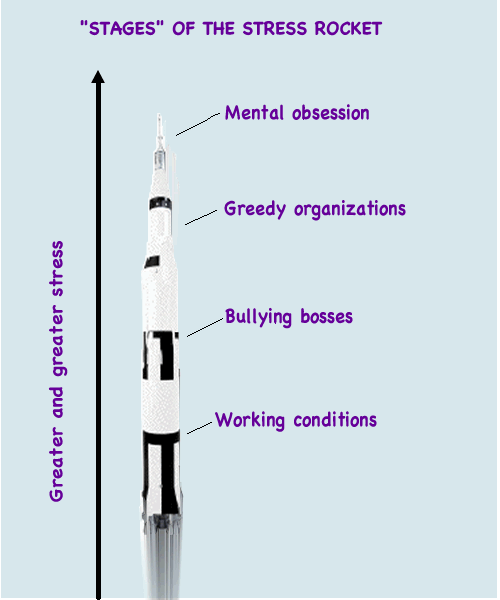
It’s very easy to concentrate only on the visible and external causes of stress: things like long hours, bullying bosses, crazy profit expectations, and continually shortening deadlines. Are these causes of stress? Yes, indeed. Do they lead to serious problems? Yes again . . . but not in every case. One of the criticisms thrown against the whole “work/life balance” movement is that it over-dramatizes these aspects of life, sees universal problems where none exist, and ignores people who handle such stressors with ease. The critics have a point, but not the whole point. Maybe the answer to what really causes stress lies within us.

According to the critics of those who draw attention to stress at work, hard work never killed (or significantly harmed) anyone. Long hours are simply a fact of modern life, like idiot TV programs and fast food. Just as eating fast food on occasion does no harm, so working long hours isn’t harmful either, unless taken to excess (I wonder what would count as “excessive” long hours. Maybe 20 hours per day, 7 days a week?). All these causes of workplace stress—long hours, bullying bosses, crazy profit expectations, and continually shortening deadlines —are dismissed either as problems capable of an easy solution or the whining of the chronically lazy.

I’ve deliberately stated these objections in extreme terms, since that is how they are often delivered. But when you cut out the inflated rhetoric, it must be admitted that the critics have a point. Most of us know of people who work very long hours, do so quite voluntarily, and thrive on it. There are folk for whom a terrifying deadline is a source of motivation, rather than dread. And there are assuredly people who set themselves seemingly impossible goals and expectations, yet still meet them—and experience excitement and joy as result, not exhaustion.

Is the answer to stress</