Thursday, November 30, 2006

The Truth About Communication



Organizations today are suffering from a plague of pointless and unnecessary communication. People are rushed off their feet because they waste so much time attending meetings, talking on the telephone, or reading e-mails, all in the cause of “better communications.” Team working is in danger of becoming as much of a plague as termites—and just as destructive. “Improving communications” is not a panacea for all management ills; often, it’s not even relevant to the actual problem. It’s time to shut up and let people get on with their jobs.


Here’s an interesting and provocative post from management consultant Kevan Hall. It starts like this:
Want to give yourself an extra productive day every week without spending any more time at the office? You can do just that—and improve job satisfaction for yourself and others—by cutting out unnecessary teamwork, reducing communication and relaxing central control.
What Kevan is promoting is unabashed management heresy, and I couldn’t agree with him more! We don’t have too little communication in organizations today, we have way too much. Let me put that more clearly. There is far too much communication of the wrong type, and not enough of the right kind.

What’s the wrong type of communication? The things Kevan writes about. Here are some examples of my own:
  • Unnecessary teamwork and far too many tedious meetings. Team working has become a plague. Like termites, it’s creeping in everywhere and destroying initiative, self-confidence, personal responsibility, and creativity. I’m all in favor of working in a team when it’s appropriate: that means only when what needs to be done cannot be accomplished by individuals working independently. Believe me, that’s far less than you have been brought up to think. Team working is not the same as working in a coordinated way. Nor is it the same as being co-operative and helpful to others. Neither of those needs a team to happen. In the vast majority of situations, the best way to get something done is to give it to someone and tell them to get on with it. Getting a team together simply slows work up and ensures nobody feels individually responsible.

  • Teams water down accountability. For some people, teams are great for this very reason. Accountability shared—as widely as possible—usually works out to be no true accountability at all. When things go wrong, nobody is to blame because everybody is to blame. Besides, the torrent of finger-pointing that goes on (It was her. No, it was him. I say it was both of them) obscures actual responsibility like a sand storm. There’s nothing like safety in numbers.

  • All the meetings for “co-ordination” and “reporting back” waste so much time that the actual work goes more and more slowly. Then it drops behind schedule and that spawns still more meetings to “monitor progress.” If the meetings were thrown where they belong (in the garbage), there would be some actual progress. As Kevan says:
    Participants at our online survey tell us that they spend more than a third of their time in meetings—more than half of which they don't really need to be attending at all. This meeting overload ties up something like 20 per cent of all management time—and it achieves almost nothing. A particular favourite is activity reviews where individuals tell you what they did last week. These consume around an hour per week of time for many teams and is [sic] usually of no interest or use to anyone.
  • “Better communication” is treated as a panacea. Improving communication (as long as it’s the right kind) will only help in certain cases: the cases where communication is actually the problem. Elsewhere it’s either useless or actively harmful, if it draws attention away from the real cause of the difficulty. But “improving communications” training is a favorite of consultants and trainers precisely because it’s so vague and imprecise in meaning or objective that you can never prove why it didn’t work. Organizations have been brainwashed into accepting that it’s important. Communication is talking. To be successful you need to do something, for heaven’s sake!
Have you ever asked yourself why so many communications are “top down?” The answer is simple: because they are all about control. My guess is that a huge majority of meetings have far less to do with co-ordination or co-operation than they have to do with the boss staying in control and knowing what everyone else is doing. If you tell someone to achieve a result and let him or her alone to get on with it, you have to trust that person. If you set up a team, and convene regular “progress meetings,” you can give the illusion of delegation, while checking up on everyone in minute detail. In fact, you can probably so tie them up in “reporting back” and “sharing ideas” that you will, in effect, reduce them to obedient toilers while someone else (you) controls exactly what they do.

What are the right reasons to communicate? Simply these:
  1. To explain, simply and clearly, exactly what you (the supervisor) expects: the objectives, the means to be used (if you know), the extent of initiative allowable, the time-scale, and the means for contacting you for help or guidance (but only if necessary).

  2. To make clear your support for the person to whom you have given the task; and to bolster his or her confidence.

  3. To listen to what they want to tell you. A teaspoonful of genuine and truthful bottom-up communication is worth more than a barrelful of the usual top-down kind. If you truly want to know what is going on, shut up and listen.

  4. To respond to questions (only if asked) and give praise for a job well done at the end. If the job isn’t well done, you either didn’t train the person well enough before they started, gave the job to the wrong person, messed up the briefing (see point 1), or failed to listen. In just about every case, more than 50% of any blame (usually more like 90%) lies with you. If you feel the need to chew someone out, start with yourself.
Communication is a tool, just as team working is a tool. As the boss, it’s your job to choose the right tools at the right time, and use them correctly. If people don’t know what they are supposed to do, can’t keep other (necessary) people informed when required (and only then), go off at a tangent, or just get plain muddled and lost, you are the one primarily at fault. And that’s not a communication problem, it’s a personal one.

Add to Technorati Favorites Stumble Upon Toolbar

Wednesday, November 29, 2006

Disrespect, Disillusion, and Dysfunctional Management

I am always trying to point out how Hamburger Management—that cult of whatever is quickest, demands least thought, and cuts back most on immediate costs—is no more than a short-term seduction that leads to inevitable disaster. It’s gratifying, therefore, to be able to report some hard evidence to back up my point of view.

A study by the University of Florida has revealed that employees who feel mistreated by their managers usually try to get even. The angrier people became, and the more they saw their supervisor’s behavior as unfair, the more likely they were to misbehave and waste company time on things like surfing the Internet. It seems that, all over the world, bad management leads to bad tempers. Hamburger Management takes callousness towards employes to a whole new level, so it’s not surprising that those who reported that management ignored their feelings and concerns were more likely to repay such ill-treatment by stealing, picking fights with co-workers, calling in sick, or taking time off without permission. An article published in the January 2003 edition of the journal Occupational and Environmental Medicine suggests that most important work factors associated with psychological ill health and sickness absence in staff are:
. . . long hours worked, work overload and pressure, and the effects of these on personal lives; lack of control over work; lack of participation in decision making; poor social support; and unclear management and work role.
All of these are associated with Hamburger Management.

In Australia, despite low unemployment, more than half of those questioned in an annual survey in 2005 said they were unhappy with their jobs. The major culprit? Managers who fail to live up to standards of openness and honesty.

In September 2005, The Conference Board reported on widespread employee disengagement throughout US industry. Even among the most highly paid, only a quarter said they were motivated by their jobs and a third described themselves as "detached."

British businesses too, according to a survey in November 2005, are being held back by inadequate management, uninspiring bosses, and lack of vision. It seems that pressure from above to meet unrealistic objectives and deadlines is leading to increasingly unethical behavior by lower-level managers.

Younger workers are becoming less likely to invest themselves wholeheartedly in a job, mostly because they have learned the limits on corporate loyalty to employees and become cynical about fine-sounding statements from above, according to this survey.
Younger workers are less likely to channel their passions into a job. They are apt to see work as a means to an end. The work week gets them to the weekend, and that’s when the fun begins. They are wise to the transitional economy. They know that employers will not show them loyalty over the long-term - they have watched their parents pass through an uncertain career. So they see the job as a short-term contract that can be renewed, by both parties, as long as both parties are satisfied. This generation serves as its own free agent.
Bosses may be single-minded in pursuit of financial goals, but still blind to the impact of their behavior on the very employees whose commitment is vital to get them there. Even the present, usually incentive-based systems of compensation are adding to the problem, according to a new book.

With such overwhelming evidence that current, Hamburger Mangement-style approaches are dysfunctional to the point of complete uselessness, you might expect to see a rush towards finding better alternatives. Not a bit of it. Blinded by the imperatives of driving up the share price and meeting continually escalating profit projections (in truth, the same process, linked to massive, short-term rewards for corporate executives), corporations are still clinging to the belief that such “soft” human issues as employee satisfaction count for very little compared with “hard” measures of financial performance.

As my grandmother used to say, “It’s all bound to end in tears.” Organizations are busily teaching their staff some extremely negative lessons for the longer term: that loyalty goes only one way; that people are easily expendable; that you have to look out for yourself; and that self-centeredness and personal advantage are sure routes to success. How these lessons will play out remains to be seen, but they are unlikely to prove helpful as skills become harder to find, and talented employees find themselves in ever greater demand. And that is without factoring in novel elements like Monster.com, which allow people to keep their resumes continually on show to prospective employers. The cost of dysfunctional, obsessive, hard-driving Hamburger Managers may soon become more than even the most profit-oriented organization can bear.

Add to Technorati Favorites Stumble Upon Toolbar

Tuesday, November 28, 2006

Organized Abuse

Bob Sutton has posted an interesting—and sometimes somewhat horrifying—post called The Damage Done. He points out that:
. . . multiple surveys from the U.S. and the United Kingdom suggest that between 15% and 25% of employees report being the victims of persistent psychological abuse at work (and the percentages are much higher in some occupations, like nursing).
Nearly all of us have suffered from such jerks and sadists in the workplace at one time or another. It’s no fun, as you know. Bob’s posting contains some compelling first-hand accounts of the bad feelings and other negative effects produced by wretched bosses whose characters are tainted with mean-mindedness, egotism, bullying, and tyranny. Women are especially likely to suffer this type of abuse—and not just from male bosses either.

Everything that Bob says is true and correct, but, in line with his forthcoming book The No Asshole Rule: Building a Civilized Workplace and Surviving One That Isn't, he concentrates on individuals. If that were the only problem, it would still be important to deal with in any civilized society.

It isn’t. Many organizations have institutionalized such barbaric behavior. Their corporate cultures are disfigured with tolerance (even encouragement) for bullying, discrimination, petty tyranny, and the continual harrying of people to deliver greater and greater profits for a few fat cats at the top.

The top executives in such organizations are often the most egotistical, bullying, and autocratic people around, and they teach those below them to behave in the same way.
Of course, they don’t describe themselves in such realistic and unflattering terms. They use phrases like: “It’s a jungle out there, and you have to be tough to compete.” They joyfully repeat the old saw that if you can’t stand the heat, you should get out of the kitchen. They promote bullies and brown-nosers, claiming that they have earned those higher positions because of they way that they consistently “bring home the bacon,” conveniently ignoring how these people do it. The top executives in such organizations are often the most egotistical, bullying, and autocratic people around, and they teach those below them to behave in the same way. They pride themselves on being hard on weakness, and (like all bullies) are always ready to polish their egos, or make a few bucks, by screwing anyone who looks weaker then they are.

It’s time we spoke out and told the truth about this kind of organization, full of jerks and bullies. When jobs are scarce, people will sometimes put up with such foul behavior and convince themselves that they have no alternative, if they want to eat. I’ve worked under such a regime in the past, and I soon came to believe that I would rather starve! It isn’t worth it. Nor is it tolerable in a civilized country.

Anyone who believes he or she has a good range of career choices in the marketplace won’t put up with being messed about by some idiot, bullying boss.
The law can only go so far. Besides, animals like this are often rich enough—or sufficiently eager to spend the shareholders’ money—to hire smart lawyers and weasel their way out of any charge—especially if the government of the day is half-hearted about enforcing the letter of the law on potential financial supporters. But the power of public opinion is not so easily bought. Getting a reputation as a“JerkFest” —an organization that harbors and supports jerks and assholes in leadership positions, in order to make quick, short-term profits—is a great way to ensure that no sensible person will even consider working there. Nor will these organizations retain the talent that they do have. Anyone who believes he or she has a good range of career choices in the marketplace won’t put up with being messed about by some idiot, bullying boss. The only people who will stay are either trying to take the business for as much as they can, in the shortest time, before they get out; or are certified jerks and assholes themselves; or are desperate, because no one else will employ them.

Unless executives want to take that risk, for themselves or their organizations, honesty—and kindness—is by far the better policy.
Using uncivilized, bullying, and sadistic approaches to leadership—all the more extreme examples of “Hamburger Management”—may look as if it will deliver better profits that the nice guys get. In the short-term, that may be true. But beyond that, it will hurt any organization by developing a bad-smelling reputation amongst employees, customers, suppliers, and everyone else needed to make the organization work. We’ve seen in recent years what happens when ruthless, egotistical executives get into trouble: all those who fawned over them during their fifteen minutes of fame turn on them in an instant and help thrust them down. Unless executives want to take that risk, for themselves or their organizations, honesty—and kindness—is by far the better policy.

Add to Technorati Favorites Stumble Upon Toolbar

Monday, November 27, 2006

Practicing Stress

When you practice something, whether it’s playing a musical instrument or a game like golf, you do it over and over. Gradually, the more you practice, the better you get. That’s what many of us do with the negative parts of working life, like stress, rushing around, and making ourselves miserable and ineffective with distractions. We practice them until we become truly expert at producing them all. Maybe we need to practice something different.


At my church last Sunday, the speaker said something quite profound. It all began with him talking about a bumper sticker, with the words: “Good morning! Time to start on the stress.” Everyone laughed. Then he pointed out how many of us spend the major part of our time running over and over all the bad things of life in our minds: the messes at work, the jerks we encounter, and all those daily irritations and setbacks that tick us off. We practice being cynical and hardened until—guess what?—that’s exactly what we have become.

“Suppose,” he said, “that you met someone who regularly said, ‘Good Morning! Time to start on another wonderful day.’ Ninety percent of people would dismiss that person as a nutcase. The other ten percent would want to try whatever he or she was smoking.” We all laughed again, though a little ruefully this time. “What if,” the speaker went on, “you practiced being grateful instead of cynical and world-weary? Suppose when someone around you was angry, you reminded yourself to be grateful for the chance to practice your patience a little more?”

I can certainly do with as much practice in being patient as I can get. Far from hanging loose and letting it all go, I often get irritated when anything doesn't work right first time; or some driver in front of me stares at our wonderful Arizona mountains, instead of racing away the moment the traffic lights turn to green.

Everyone gets stressed from time to time. But if you practice it, you’ll become really good at getting as stressed as possible in as short a time as may be.
Thanks to the speaker’s wise words, I started thinking, especially about stress and similar topics. Everyone gets stressed from time to time. But if you practice it, you'll become really good at getting as stressed as possible in as short a time as may be. You'll see sources of stress everywhere—even where other sufferers would not notice it. It’s the same with speed and haste. The more you rush at things, convincing yourself that there isn't a moment to be lost, the quicker your whole pace of life will become, until you are permanently on edge and permanently exhausted by running so fast.

Many of us practice being distracted too. The moment that the phone rings, you snatch it up. If an instant message arrives on the computer, you drop everything else to deal with it immediately. Then you also become so expert at responding swiftly to e-mails that you check every few minutes to see if any new ones need an answer. As a result, your working day becomes disjointed, your concentration fractured, and your time beset with constant interruptions. You flit from task, to phone call, to e-mail, to cell phone, and back to the task again; never spending more than a few minutes on any one thing. No, you are not suffering from attention deficit disorder. You have practiced so much that you have become really, really expert at being easily distracted.

What if you tried something different?

For a start, everyone knows that if you don't practice a musical instrument (or a golf game, or any other skill) for a while, you become rusty and your level of skill declines steadily. If you tried consciously to avoid practicing being stressed or distracted, the same would happen. You would become far less adept at it.

The best that you can do—and it's still very much worth it—is to avoid situations or actions guaranteed to pile on the problems.
But that might take a long time. And while you could choose deliberately to avoid your piano or guitar—or stay away from the golf course—it's impossible simply to decide to keep away from all stress and every kind of distraction. Life serves them up, whether you want them or not. The best that you can do—and it's still very much worth it—is to avoid situations or actions guaranteed to pile on the problems. Don't join the group grousing around the water cooler. They're pumping up one another's stress level with all that complaining and gossip. Turn off instant messaging. Keep away from your e-mails, save at set times.

Still, most of us need something more, and that's where practicing the opposite behavior comes in. When you're stressed, be grateful for the chance to practice relaxing and improving your patience and detachment. Do the opposite from acting stressed. Take deep breaths. Relax and give yourself time to think. Really practice, as hard as you can, and do it again and again. Instead of rushing around, practice slowing down and using your mind to save your legs. When distractions arrive, practice ignoring them, even though your habits are screaming at you to snatch up the telephone, or check—just once—in case there's somethig important in your e-mail box. Then be grateful for these distractions that provide you with a priceless series of chances to practice being centered and concentrated on what you know matters most.

Over time, you'll become extremely adept at lessening the impact of life's irritations and upsets. You'll slow down and find enough time to live, as well as exist.
The practice effect works just as well on good habits as poor ones. Over time, you'll become extremely adept at lessening the impact of life's irritations and upsets. You'll slow down and find enough time to live as well as exist. And because you are no longer continually practicing getting mad, being cynical, or becoming stressed, you'll find all of those states harder to get into.

Finally, remember to practice being grateful: grateful for all the people and events that help you to learn to live your life more gracefully. And grateful for what most of us ignore or take for granted: a spectacular sunset, birds singing of spring on a cold winter's day, the night sky blazing with stars, and friends and family to warm your heart—and to forgive you when you still get it wrong and screw up your own day. Gratitude is probably the single best antidote to stress. It's just that most of us never find the time to take a dose when we need it.

Add to Technorati Favorites Stumble Upon Toolbar

Saturday, November 25, 2006

The "Tried and True" Addiction

Leaders who become addicted to “tried and true” organizational or business methods ignore the reality that change is constant and can go a long way in the course of one working life. The first solid step into the future is always to let go of the past. Business is not a matter of unchanging laws that must be followed without question. It never has been. It’s time to slow down and realize the importance of accepting and welcoming change.

Many leaders, in business and elsewhere, have addictions. Some are addicted to power, some to status, others to money or political influence, or taking risks. A few become addicted to good works and the public esteem that they can bring. Many are addicted to speed and excitement: the rush that they get when there’s a crisis to be solved and everyone—at least in their own minds—turns to them as the savior of the moment. Addiction of one type or another is easy to fall into when you sit in a position of power. And addiction can quickly come to dominate your thoughts and decisions.

One problem with all addictions is a variant on the law of diminishing returns. The actions or events that once brought satisfaction start to become commonplace. They no longer deliver the same “hit.” You need continually to “up the ante:” to move to more and more extreme versions of behaviors that used to be sufficient. Those addicted to power can never get enough, and are swiftly turned into autocrats who demand involvement in everything. The status-addicted become pompous fools, continually showing off their badges of office. Those who are speed or risk addicted fling themselves into ever more dangerous situations, until the inevitable pile-up destroys them.

Our tried and true game plans are never safe or permanent. We just like to believe that they are.
And then there are the many, many leaders who become addicted to their own, “tried and true” game plan for success. Maybe it has worked for them, perhaps several times, in the past. Quite likely, it has—or had, once—much to recommend it. It was practical, built on commonsense and well-established ways of thinking. It felt safe. But our tried and true game plans are never safe or permanent. We just like to believe that they are.

Times change. Contexts alter and shift into fresh patterns. Like the weather, the only thing that is unchanging about the environment in which organizations move is that it is inconstant. Some changes are small; many are large enough to shift our world around into entirely unexpected patterns. And what was once tried and true, and a pattern for assured success, becomes a liability: a comfort blanket we should have left behind in childhood, yet are still clinging to as mature adults, while “feeling safe” demands becoming ever more conservative in outlook, like the risk taker who must take bigger and bigger risks to get the same thrill.

Many of the automatic responses of today’s leaders come from supposed tried and true business methods. Like all folk wisdom, its origins are lost somewhere in the past, and it has been repeated and repeated until it has been encapsulated into sayings everyone knows—and some still treat as the epitome of wisdom. It has lost any links to the time when, once, it was current and relevant, and swims instead into a future where it has no place.

Try stopping sometime and linking some piece of management lore back to its true place in history. Take an idea like motivating people by setting them “stretch” objectives, and imagine the situation where the idea was first considered and adopted. A company full of people maybe just emerging from the days when work meant doing exactly what you were told and doing it every day, in detail and without fail. The days when advanced technology was just becoming more widely available, and it was clear that most people were wary about grasping the untried opportunities it offered—and even fewer understood what might be possible. To the time when what mattered most was to encourage people to try.

Instead of large numbers of staff with untapped abilities and time on their hands, we have burnout and excessive work demands. Do you still need to “tempt” people into trying new things? Will offering—or, more likely, demanding—that they meet objectives that presently lie out of reach still motivate and challenge them?
Now fast forward to today. How much of that environment remains? People take high tech solutions as a given and the opportunities it can offer as commonplace. We have experienced decades of change from a time when “good” employees simply followed set procedures and written instructions without deviation. The majority of organizations have cut staff to the minimum; and those few that remain are struggling to keep up with basic demands. Instead of large numbers of staff with untapped abilities and time on their hands, we have burnout and excessive work demands. Do you still need to “tempt” people into trying new things? Will offering—or, more likely, demanding—that they meet objectives that presently lie out of reach still motivate and challenge them? Or will it feel like the straw that is in danger of breaking the camel’s back?

Look back, say, twenty years, and try to chart the amount of change that has taken place in your own industry since then. Is it likely that methods and ways of thinking that were tried and true two decades ago will still apply? America is, oddly enough for a nation built on unfettered growth and the dreams of millions, an extremely conservative place, both socially and intellectually. The Far East, and even Europe, are more progressive. Where once immigrants accepted that they might fulfill their wildest dreams, the prevailing culture has become tied to preserving ideas and ways of life associated more with the past than the future. Perhaps it is always thus. Those who are wildest and most radical in their youth become some of the most extreme reactionaries in middle age.

Maybe that is why so many business leaders stay attached to the notion that there are eternal, tried and true ways of running an organization. They too were once fiery young managers, filled with zeal and ambition. Now they have made it to the top—to corporate middle and old age—and the swing to becoming conservative and reactionary is in full flow. Sadly, reality pays no heed to such human foibles. For our world, change is always as swift, unpredictable, and filled with sudden leaps into the unknown as the dreams of the most ardent and revolutionary youth. It is also quite as ruthless in sweeping away whatever went before. You keep up, or you are thrown into the garbage. It’s your choice.

Buddhists teach that clinging to the idea of permanence is the cause of most of our human suffering. They could well be right. The first solid step into the future is always to let go of the past. Business is not a matter of unchanging laws that must be followed without question. It never has been. Only in our imaginations is the universe a predictable place.


Add to Technorati Favorites Stumble Upon Toolbar

Friday, November 24, 2006

Sick Bosses Create Sick Businesses

Dr. Robert Kuhn writing in Chief Executive, lists “12 CEO Diseases” that afflict organizations and the people in them. I don’t think these diseases are exclusive to CEOs. In my experience, they afflict many managers at all levels, but their effect is more strongly felt if the person suffering from them holds a position with considerable power.

I won’t list all twelve diseases, or the “cures” that Dr. Kuhn prescribes. You should read his article for that information. What I will do is pick out certain diseases that are, in my view, especially prevalent. Many are major symptoms of Hamburger Management.

Here’s the second of Dr. Kuhn’s diseases:
Goals Too Aggressive. Unrealistic goals “demotivate,” especially when compensation is involved. One CEO expected his plastics company to continue its 30 percent annual growth rate, not appreciating that with a larger base and a mature market their era of high growth had to end; the result discouraged managers.
The obsession with short-term goals is ruining many organizations. It’s part of “managing by numbers,” which is a common symptom of Hamburger Management. To produce “good” results, numbers must always rise. That is, of course, nonsense, but it’s an extremely prevalent idea. No notice is taken of the context, or the fact that 10% annual growth for a small start-up might be very slow, while a similar percentage growth rate for a vast multi-national would be so rapid as to be unsustainable.
Power Building Trumps Wealth Building. CEOs tend to make decisions that enhance their scope and influence, even at the expense of increasing shareholder value—and this can be paradoxically true even when the CEO is a large shareholder. Sometimes, for effect, I put it this way: “I want a CEO whose greed exceeds his ego.” Sure, greed and ego are both unpleasant traits that are impolite to laud in public, but by privileging greed over ego I make the point that good CEOs should be motivated more by amassing wealth for their shareholders than by accreting empires for themselves.
Here I must part company with Dr. Kuhn. Both greed and ego are bad for the business. Is ego worse? Maybe, maybe not. Dr. Kuhn is clearly of the opinion that shareholder value equates with immediate profits. This is, in my opinion, a bad error. Value is value, not merely monetary value. In the long-term, value must mean a business that continues to prosper in its markets. The only way to secure that is through building a strong and contented customer base, maintaining high levels of service and quality, continuing to produce innovative ways of pleasing your customers (and adding new ones), and keeping the finances of the organization stable and strong. Grabbing as much money as possible now, especially if that means doing things likely to jeopardize the future, is bad business and bad management.
Not Respecting or Recognizing the Ideas of Others. In general, CEOs are egotistical. Highly successful almost by definition, many CEOs would seem to have every right to be self-impressed. However, when you hold the top spot, puffing yourself up at the expense of subordinates pollutes the organization. You benefit when your people are encouraged and empowered to generate novel ideas.
I’ve written before that the best source of innovative ideas is the ranks of middle managers of any organization. They aren’t committed to the status quo in the way they those nearer the top often are; and they have enough experience to be able to discriminate between a practical innovation and one that is off the wall. Best of all, they would love—truly love—to contribute their creativity to help the organization. Sadly, they are usually ignored.
Seeing Only Summaries. A CEO should perceive the world as it truly is; if cluttered and chaotic, so be it. When information is always “high level,” predigested by staffers, a CEO may be perceiving an artificial world, a virtual reality as it were, of cleanly manicured lawns.
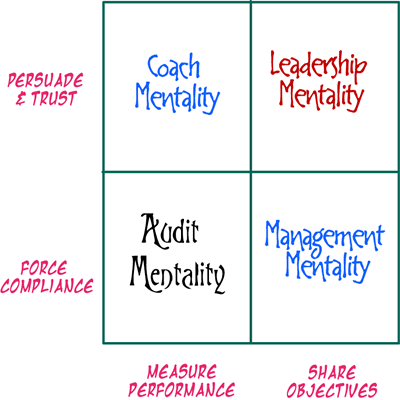
This is a part of “managing by numbers:” that insane process of ignoring the reality of the business in favor of numbers on a spreadsheet, produced by accountants and others afflicted with “audit mentality.” It’s fatal to forget that statistics are not reality. At best, they are a very partial and limited window on a part of reality: the part that fits with the assumptions on which the statistics are based. Besides, statistical illiteracy is another CEO disease: one that Dr. Kuhn fails to mention.
Generalizations. CEOs like to spot trends, finding deep principles to predict and affect business. But beware of averages, which can deceive. . . .
This is managing by numbers again. The media love to produce sweeping generalizations, because they make for easy headlines. Corporate PR types share the same outlook. Sadly, too many executives fall prey to believing their own corporate PR. The search for simple, eternal business principles is mostly a search for panaceas. If they existed, they would have been found by now.
Falling for Current Trends. It’s easy to be sucked into the vortex of current trends, whether macroscopic movements or management theories. . . . Falling for Contemporary Tricks. Every few years, it seems, there is some new fad with which CEOs must contend. . . .
I have put these two CEO diseases together, because, for me, they are aspects of the same thing: the Hamburger Management obsession with imitation and jumping onto every temporary bandwagon. Whether it’s following “industry best practice” or the fads and fashions peddled by consultants, it comes to the same thing: an incomprehensible belief that you can gain competitive advantage by copying everyone else; and that playing catch-up is the way to get ahead. The only sense I can make of it is that, like teenagers, some corporate bosses feel the way to show your individuality is to act and dress like all your friends. At least teenagers have the excuse that they are rebelling against their parents. Corporate executives don’t have corporate parents to rebel against. Or maybe it is simply the herd instinct, coupled with a belief that there is safety in numbers and you won’t be criticized for doing what everyone else did first. Whatever the reasons, they have to be bad ones.

As I said at the start of this piece, these diseases aren’t confined to CEOs. They are part of a general trend towards debased, short-term, mindless kinds of leadership. They are contributing to uncivilized workplaces and excessive pressures on the people who work there. It’s high time that they were exposed and stamped out.

Add to Technorati Favorites Stumble Upon Toolbar

Thursday, November 23, 2006

Measuring Contribution

Today’s obsession with “management by measurement” (especially numerical measurement) is a major contributing factor to the decline of a civilized and truly productive workplace. In place of using intelligence and understanding to gauge progress towards agreed goals, business leaders follow more or less fixed ratios and “key indicators.” Trying to manage that way is doomed to produce simplistic, often highly inaccurate decisions. Asking purely quantitative questions—or trying to force qualities into a spurious, quantitative format—is mostly useless and frequently grossly misleading. Organizations and business are far too complex to be reduced to a few, simple numbers on a spreadsheet.


One of the pleasures of blogging is the way so many people contribute by adding their comments and questions to what I have written. They often raise extremely valuable questions, challenging me to think and make good on assertions I have made in my posts. A recent question was so interesting that I thought it should not simply be confined to the comment section of a single posting, but was worthy of much wider circulation.

The question was: “How would you measure the amount of wealth that an employee is contributing?”

I think the best analogy for the whole process is the difference between a painter like Cezanne and someone using a “painting by numbers” kit. One does it faster, but I know which one I would prefer to own.
Regular readers will know that I believe that the current obsession with “management by measurement” (especially numerical measurement) is a major contributing factor to the decline of a civilized and truly productive workplace. In place of using intelligence and understanding to gauge progress towards agreed goals, business leaders follow more or less fixed ratios and “key indicators.” They no longer try to manage the business in relation to the real world. Everything is centered on taking such action as will make the numerical indicators arrive at the “right” place. It’s the commercial equivalent of the nonsense in schools today where teaching isn’t based on encouraging learning, but linked solely to standardized test scores (But that’s another story). I think the best analogy for the whole process is the difference between a painter like Cezanne and someone using a “painting by numbers” kit. One does it faster, but I know which one I would prefer to own.

Still, whatever I think about the idiocies of much of the measurement in use today, the point remains that it is necessary to be able to decide whether individuals—or groups or departments—are contributing real value to the business. You also need to know whether you are actually making progress towards your business goals, or simply kidding yourself.

Here’s how I think you can start to answer these question in terms of value. You need to understand these things about every employee, group, or project:
  1. Is he/she/their/its presence and activities adding to the overall, long-term value of the business? Examples might include providing useful and creative ideas, developing productive business relationships, enhancing the organization’s reputation, or delivering outstanding levels of service and support to customers or clients.

  2. Does he/she/they/it increase the ability of the business to deliver on its promises? Here I would look to providing a steady contribution and long-term commitment to the success of the business, the willingness to help create a civilized and effective workplace environment, going the extra mile when that mile is needed, and contributing in full measure to business success by freely offering his/her/its/their full potential and capacity.

  3. Does he/she/they/it act as a good corporate citizen? This means keeping confidential what should be kept confidential, avoiding being a jerk whenever possible, being kind and helpful to colleagues and customers, and refraining from spreading malicious gossip. But it also means being willing to speak out whenever unethical, discriminatory, dishonest, or other unacceptable behaviors are encountered.
You will notice that most of my “measures” are qualitative. If you are measuring value (which is itself a quality, not a quantity), you have to use appropriate measures—and that means qualitative ones.

Even obviously quantitative inputs, like finance or production capacity, have little meaning without qualitative measures being attached to them.
I think that most behavioral or creative inputs to any business have to be measured in qualitative terms. Even obviously quantitative inputs, like finance or production capacity, have little meaning without qualitative measures being attached to them. Some outputs may be suitable for quantitative measures alone (profit, sales made, number of customer complaints), but even then they will have very little meaning without understanding their qualitative aspects. If production is high, is it the right kind of production? Is the business operating in the right place, at the right time, and aimed at the correct customer needs? Whatever the level of sales, are they “good” sales (ones that have been gained from customers convinced about maintaining a long-term relationship with your organization); or “poor” sales (obtained only through discounting or similar means, where the customer feels no loyalty and will switch to whoever offers the lowest price at the time)?

Only our mad lust for speed, our idiotic assumption that numbers are somehow more “scientific” than qualitative measures, and the unwarranted reverence given to accounting are preventing people from seeing the truth: if you want value and quality, that is what you must track . . .
Asking purely quantitative questions—or trying to force qualities into a spurious, quantitative format—is mostly useless and frequently grossly misleading. Organizations and business are far too complex to be reduced to a few, simple numbers on a spreadsheet. Trying to manage that way is doomed to produce simplistic, often highly inaccurate decisions. Only our mad lust for speed, our idiotic assumption that numbers are somehow more “scientific” than qualitative measures, and the unwarranted reverence given to accounting are preventing people from seeing the truth: if you want value and quality, that is what you must track, whether you can reasonably use numbers or must rely on your wider intelligence and commonsense instead.

Add to Technorati Favorites Stumble Upon Toolbar

Wednesday, November 22, 2006

The Fragile Power of Reputation


In business, reputation is worth hard cash. Risking it for expediency, speed, or short-term gain (the hallmarks of Hamburger Management) is the height of folly. Yet that is what too many organizations and their leaders do today, often on a regular basis. If those in charge of your organization don’t see preserving or enhancing its reputation in the world for honesty and quality dealings with others as one of their primary duties, get out while you can. They are headed for a nasty fall someday soon—quite possibly much sooner than they think.


In business, a solid reputation is worth hard cash. The better your reputation, the more likely it is that bankers and investors will put money into your enterprise—and do so on favorable terms. Suppliers are more willing to allow you advantageous credit deals. Customers will seek you out and remain loyal in the face of attempts by your competitors to steal them away. High-quality staff will be quicker to find and easier to retain. In fact, all your costs will be reduced, while your ability to sell your products and services at better-than-routine prices will be enhanced at the same time.

So why would any sane group of executives ever put this priceless asset at risk? Everyone knows that while it can take decades to create a favorable reputation, you can destroy one almost in an instant. When that happens, the effect on the business is little short of catastrophic—and it lasts and lasts, maybe for decades. Outright dishonesty, like Enron practiced and tried to conceal, can wreck a business altogether. But any loss of reputation hurts. Credit tightens, suppliers drive harder bargains, talented staff flee, and customers leave you without a backward glance.

Lowered quality, cutting corners, driving employees every harder, and stepping away from moral, if not legal, obligations in areas like pensions and healthcare benefits may please Wall Street for a few days; but the longer-term impact on reputation can quickly turn any such benefit into a major liability.
A major part of the danger of short-term approaches like Hamburger Management is the threat posed to a hard-won reputation. To sacrifice peoples’ good opinion for the sake of short-term profit is the height of stupidity. Lowered quality, cutting corners, driving employees every harder, and stepping away from moral, if not legal, obligations in areas like pensions and healthcare benefits may please Wall Street for a few days; but the longer-term impact on reputation can quickly turn any such benefit into a major liability. Besides, who wants to build the kind of reputation that includes sharp dealing, disregard for customers, screwing suppliers and treating employees more like indentured servants—or even slaves? Look at the money Wal-Mart has been spending of late to try to counter a negative reputation; or how hard it has made it for them to gain agreement to build new stores in some localities.

Hamburger Management isn't a smart idea. It's a dumb way to destroy your reputation, like a group of greedy children frittering away the inheritance given to them by honest, hard-working parents. What will be the impact on international trade—and the nation's financial standing—if U.S. commerce as a whole throws away its reputation for honesty and high standards, in favor of a few years of easy money for fat cats?

You don't rate as a leader due to position, reward, or glamor. What makes you a leader—a true leader—is your reputation for honesty, high standards, wisdom, and the determination to set other's needs above your own.
Leadership doesn't only mean taking tough decisions in a technical or competitive sense. It means acting as a steward for the organization's values and reputation; and— if necessary—defending that reputation stubbornly against all the siren calls of those wishing to set short-term personal and organizational profit above everything else. You don't rate as a leader due to position, reward, or glamor. What makes you a leader—a true leader—is your reputation for honesty, high standards, wisdom, and the determination to set other's needs above your own. Lose that and you become just another wannabe fat cat, with ethics that are as laid set aside as a tart's underwear—and for much the same reasons.

Add to Technorati Favorites Stumble Upon Toolbar

Tuesday, November 21, 2006

Keeping (or Restoring) Trust

A study published via Knowledge@Wharton has some important findings in the area of trust at work: one of the most abused and ignored areas of human interactions in recent years. Maurice E. Schweitzer, professor of operations and information management and a co-author of the report, characterizes how trust and trust violations influence people's behavior in the workplace like this:
Trust is the social glue that holds things together. It allows us to engage in social and commercial ventures. You can't contract everything. We develop relationships that are based on trusting that things will work out.
In the workplace, trust is an essential element between colleagues sharing a project, people trusting that the boss will arrange equitable rewards and recognize good work, or customers trusting that the product or service you supply will be there on time and match up to what you promised.

It makes little business sense to violate others’ trust, yet as the authors of the report say:
Trust is critical for organizations, effective management and efficient negotiations, yet trust violations are common. Trust violations can range from serious misdeeds that constitute fraud ... to more common forms of trust violations, such as the use of deception in negotiations.
The more that people feel they have been mislead deliberately, the longer it takes for them to rebuild any trust in that person.
Once trust was violated, the researchers found that a simple apology did very little to make things better. Perhaps we have all become too used to the kind of knee-jerk apology that has more to do with feeling sorry you have been caught than any genuine remorse at doing something dishonest. A promise to change behavior helped restore trust, especially initially, but a promise like that was not as effective when there had been deception of any kind. In fact, deception proved to be the worst aspect of having your trust abused. While people will, generally, forgive untrustworthy behavior—so long as it is not too common, and the person promises to reform in the future—untrustworthy action compounded by deception will so destroy a person’s reputation for honesty that it can be difficult to restore. The more that people feel they have been mislead deliberately, the longer it takes for them to rebuild any trust in that person.

I think the hardest aspect of dealing with deliberate deception is that is makes the person who has been deceived feel like a fool. Not only has their trust been violated (bad enough on its own), but the other person has shown the world how easily they can be taken in. In fact, the very act of deception means that you must assume the person who you are going to deceive isn’t bright enough to spot what you are doing.

Hamburger Management is full of manipulation and deception: acknowledging fine work, followed by lay-offs when they offer short-term profits; finding ways to downgrade payment and limit benefits, while those in more senior positions take home vast rewards from stock options; manipulating financial statements to give the appearance of success, when failure is the reality.
Is deliberate deception that common in organizations? I would say it is. Not always in the simple form of lying, cheating, or setting out to screw the other person in some negotiation—though all those are common enough. The commonest form of deliberate deception is manipulation: the boss who uses fake promises and insincere protestations of regard to manipulate people into working extra hours without pay, or digging him or her out of hole. The superior who invites ideas, then passes them off as his or her own to those higher up on the organization. The management that is full of fine words about honesty and ethical dealing, then uses them as a smokescreen to cover dubious business dealings that guarantee a profit. Hamburger Management is full of manipulation and deception: acknowledging fine work, followed by lay-offs when they offer short-term profits; finding ways to downgrade payment and limit benefits, while those in more senior positions take home vast rewards from stock options; manipulating financial statements to give the appearance of success, when failure is the reality.

Suppose you have been foolish enough to act in a dishonest way. Maybe you have even used some of the commoner forms of deception and manipulation, because you were taught that this is the way “strong” bosses behave. Is there any way to put it right?

The article that began this post makes these suggestions:
  • Give a clear apology

  • Show Genuine remorse

  • Offer to make the harm good

  • Own up to what your actions have made you (an idiot and a jerk)

  • Ask for forgiveness
I would add this: Learn from your mistake. Abusing trust and manipulating people is seductive precisely because it seems to offer quick returns with a good chance that you won’t be found out. In fact, other people are not nearly so stupid as serial deceivers wish to believe. You will probably be found out in time. When that happens, you will have destroyed something more precious than you imagine: your reputation for honest dealing. Once it is gone, it cannot be recovered quickly or easily. Everyone will hear about it and none will trust you as they once did. That goes for your bosses as well. While they may secretly congratulate you on “bringing home the bacon,” however you did it, you can be sure that they will have noted your actions and will take care in future that you have no opportunity to deceive them. After all, there’s nobody so distrusting of other people as a person who cheats.

Add to Technorati Favorites Stumble Upon Toolbar

Monday, November 20, 2006

A Disappearing Asset . . . Trust

Here's a fascinating instance of the general lack of trust in organizations today, courtesy of Management Issues: Execs don't trust their own companies with private information. According to a survey of more than 1,700 senior-level corporate and technology leaders in the USA and UK looking at the importance, impact and influence of trust, privacy and security within the corporate world, almost a third of senior executives do not trust their own companies to handle private or sensitive information.
The study also found that despite a growing awareness of risk management and security issues in the corporate world, more than a third of the companies polled do not task senior leaders with protecting the trust that customers, investors and even their own employees have placed in those companies.
And look at this: not only do a third of executives not trust their own companies, the same proportion are either unsure or don't think that most of their business partners consider them to be trustworthy.

Is it any wonder that so much time and effort has to be spent "checking up" on people, when even those at the top think their own colleagues don't trust them? Could there be a more chilling indictment of the typical organizational culture around today?

Add to Technorati Favorites Stumble Upon Toolbar

Cop-outs, Excuses, and Put-downs


When an organization has to resort to mindless excuses and put-downs to stop necessary change from even being considered, you know that you have just about reached rock-bottom in complacency and mindless attachment to defending the status quo. Yet that is what is common in many companies today: managers who routinely set aside potentially useful ideas without any form of rational argument. Using a well-worn set of rude and dismissive phrases, they browbeat their subordinates into remaining quiet about the inefficiencies and stupidities that are all too obvious.


Most companies are horribly complacent. The guys in charge got to their current positions under the status quo, so they have little or no real interest in changing anything. The current system must be good, because they are the kind of people that it produced. That's why they so often react to new ideas with a "so what?" response; and why they defend the status quo by saying things like: "This may sound harsh, but that's the way the world is." Of course, they pay lip service to wanting greater creativity, but only as long as it remains within bounds. Improvements on current ways of doing things are acceptable. Significant changes are viewed with emotions ranging from deep suspicion to outright hostility.

Such organizations fail to get the full range of innovative suggestions from their employees because they actively discourage truly fresh ideas. Very, very few proprerly creative ideas are ever subjected to reasoned consideration or argument. Instead, complacent managers have developed a series of instant responses to any suggestion that is too threatening to their pre-determined point of view. These phrases have two important purposes:
  1. To stop any further discussion or consideration of the idea; and

  2. To belittle the person who made the suggestion and make him or her feel foolish, so such behavior won't be repeated.
There is a list of instant, thought-free excuses for keeping things as they are that is almost endless. Here are some serial offenders:
  • There's no budget (money/space in the program) for it.

  • We tried something like that years ago and it was a disaster.

  • The customers (suppliers/staff/shareholders/top brass) will never buy it.

  • When you've been around as long as I have, you'll understand why that will never work.

  • That simply isn't a practical suggestion. It will never fly.

  • Sorry. It's not worth the risk

  • So what? (Said with a shrug and usually followed by: "Let’s move on, shall we?")

  • That's the reality of life around here. If you don't like it, you know what to do.

  • I can tell you right away that no one else will support you on that (said glaring around to make sure nobody does).

  • (Sigh) Isn't it wonderful to be so idealistic and naive.

  • Perhaps we should set up a working group to discuss it (. . . and bury it).

  • Forget the blue skies stuff. Come down to earth with the rest of us.

  • What an amazingly courageous, unusual, and personally risky idea. Is anyone else ready to support it? (. . . and put his or her neck into the noose as well.)
Complacency is especially prevalent wherever who you know is more important than what you know. If office politics and brown-nosing are the ways to succeed, it's unreasonable to expect ambitious people to risk offending those higher up by even suggesting that the current way of doing things (which is usually the result of decisions by those presently in alpha-dog positions) should be changed to any significant extent.

It is becoming clearer and clearer that the way organizations are run today is a failure. Look at all the scandals and criminal charges against corporate executives. Consider how the tide is changing against over-payments to CEOs and the casual plundering of corporations for personal gain. Listen to the pitiful wailing by those in charge against regulations that force corporate wrong-doing out into the open. Visit almost any business school and see the frantic attempts to find space in the curriculum for more substantive courses on business ethics.

The time for mindlessly defending the status quo is (hopefully) past. Its failures have become too obvious to ignore or paper over. Corporate America (and the rest of the developed world along with it) is in urgent need of fresh ideas, before businesses from nations who don't carry so much baggage from the past sweep on past and consign us to the margins. I heard recently that the giant US automakers are pleading with the government for relaxation of regulations and handouts from taxpayers. I don't hear Toyota making the same requests. Could it be that they don't need to, because they have seen the need for change and grasped it whole-heartedly?

Don't let the conservatives browbeat you into accepting that there is nothing to be done about the status quo. We made the world how it is today. Who keeps it running that way? We do. But since we made things like that, we can change them as well.

Add to Technorati Favorites Stumble Upon Toolbar

Saturday, November 18, 2006

Divine Discontent

Dame Anita Roddick, the founder of The Body Shop chain of stores, has written a piece in The Financial Times in which she attacks business schools for their failure to understand what it takes to be an entrepreneur. Predictably, a range of business school spokespersons has sprung to their defense and attacked Ms. Roddick in return.

I don’t want to get involved in this argument, but I couldn’t help noting this comment from Ms. Roddick:
The problem with business schools is that they are controlled by, and obsessed with, the status quo. They encourage you deeper into the world as it is. They transform you into a better example of corporate man. We need good administration and financial flair, after all, but we need people of imagination too.
Whether or not business schools help potential entrepreneurial types, it is a valid point that too much of the business world in general suffers from this obsession with preserving the status quo.

Among the actions that Ms. Roddick suggests, these in particular seem to me to be likely to prove helpful to anyone who leads an organization:
  • Tell stories. The central tool for imagining the world differently and sharing that vision is not accountancy. It has more to do with the ability to tell a story.

  • Concentrate on creativity. It is critical for any entrepreneur to maximise creativity and to build an atmosphere that encourages people to have ideas.

  • Be passionate about ideas. Entrepreneurs want to create a livelihood from an idea that has obsessed them; not necessarily a business, but a livelihood. When accumulating money drives out the ideas and the anger behind them, you are no longer an entrepreneur.

  • Feed your sense of outrage. Discontentment drives you to want to do something about it. There is no point in finding a new vision if you are not angry enough to want it to happen.
Complacent, satisfied, comfortable people do not make change. Why should they? Nor do those who have been convinced by anyone that the way things are today represents the best of all possible worlds—or, at least, the only kind of world that is possible.

Let us cherish our imagination, our vision, our discontent, and, above all, our sense of outrage at the mess we see around us. Maybe then we will summon up the courage to do something about it.

Add to Technorati Favorites Stumble Upon Toolbar

Friday, November 17, 2006

Industry Worst Practice

Forget industry best practice. It’s a waste of time if you want any kind of advantage in the marketplace. All this imitation merely encourages sameness and creates mediocrity. Most companies are full of creative people and innovative ideas, yet they are ignored in favor of following the crowd. Slow down, think for yourself, and take a few real risks. Who knows, this time luck may be on your side.


Don’t waste your time seeking out—let alone following—so-called “industry best practice.” It may be a constant mantra of management consultants and certain business schools, but just a little reflection will prove that it has little to recommend it.

For a start, whatever the “best practice” may be, it is already in use, probably by many organizations. That means it offers no competitive advantage. How can it, when others are already following an identical approach, and many more—persuaded by all those eager consultants—are jumping on the same bandwagon every week? At best, following industry best practice is a catch-up exercise; at worst (which it frequently is), it becomes the mindless imitation of fashionable fads and fancies. No one ever gained an advantage by imitation.

What those consultants and writers describe is usually not what the firms in question actually did. It’s a sanitized, cleaned-up, and carefully reorganized version of events, based on hindsight. That’s why it usually sounds so simple and easy to follow. In describing their own success, organizations, their leaders, and their PR consultants, leave out all the messy parts, especially any that might indicate false starts, mistakes, and misunderstandings. They tidy away embarrassing mis-steps and smooth over disagreements and changes of plan mid-way through the process. What emerges isn’t what they really did, or thought, or understood at the time. It’s what an extremely friendly and partisan writer imagines that they would have done—if only they hadn’t been quite so uncertain that it would even work.

It’s well known that nearly all the companies extravagantly praised in best-selling business books quickly crash and burn. The reason is simple. Most of what they did right was due to luck . . . and their luck ran out.
Have you ever noticed how nobody ever says something like: “We set out with one idea, kept changing it because it didn’t work, and were just about to give it up altogether, when someone—we can’t recall quite who—started a totally crazy course of action in desperation. And then—we have no idea how—it suddenly worked amazingly well. What was our secret? Hell, we were just lucky!” That would be a more truthful explanation of the start of most industry changes than the neat explanations which (so conveniently) trace the cause of success to the outstanding ability of the guys at the top. It’s well known that nearly all the companies extravagantly praised in best-selling business books quickly crash and burn. The reason is simple. Most of what they did right was due to luck . . . and their luck ran out.

Life changes, circumstances change, public opinion changes. What worked so well in yesterday’s world becomes a liability in today’s . . . and a recipe for disaster in tomorrow’s. The strongest argument of all for ignoring industry best practice is simple: it is yesterday’s idea that was successful in yesterday’s context. What makes you think it will be anywhere near as good today or tomorrow? Unless your situation and circumstance are totally static—which is pretty near impossible over more than a few days—things will already have changed, possibly in quite significant ways.

There is a clear, simple, and readily available alternative to industry best practice. It is called thinking for yourself, and it works by using the imagination, insight, and ideas kept locked in the heads of people in the organization.
There is a clear, simple, and readily available alternative to industry best practice. It is called thinking for yourself, and it works by using the imagination, insight, and ideas kept locked in the heads of people in the organization. They are locked up there because they are typically ignored, underrated, or dismissed in favor of imitating supposedly proven success elsewhere. Best of all, this approach is free; and those who have the ideas that you need will be overjoyed to share all that they have.

Why do leaders persist in choosing industry best practice over using their own organization’s imagination and creativity? Fear, mostly. The fear of taking a risk. The fear of being wrong. The fear of being held accountable. Business leaders like to be seen as courageous risk-takers, but most of them are as timid as a church mouse when it comes to doing anything different than their peers in other companies. That’s why most preside over mediocre businesses with mediocre profits and mediocre products. Imitation feels safe because you never stand out enough to attract criticism. Sadly, your results will never stand out either.

Add to Technorati Favorites Stumble Upon Toolbar

Thursday, November 16, 2006

The Essence of Delegation


What prevents most people from becoming effective leaders? They believe that, if they have the authority to make an important decision, and must take direct responsibility for the outcome—especially if that choice proves to be a mistake—they must make that decision personally. It seems impossible to consider that they might allow a subordinate to make the decision under any circumstances. It seems too great a risk—bordering on culpable folly—to allow someone else to make a potentially erroneous decision for which you will ultimately be held responsible. Yet that is an essential part of all good leadership.


Leaders are continually urged to become better delegators. It’s sensible advice. Much of the overwork and pressure that is endemic in organizations comes from a simple inability to delegate. Whether you call it “staying in the loop” or “keeping your finger on the pulse,” or use any of the other fancy ways of describing the rooted tendency to want to be involved in everything that might possibly affect you, the behavior is the same. It’s why circulation lists have become bloated out of all proportion, and people waste large amounts of their time attending pointless meetings.

The result is obvious. Their subordinates are given boring, routine, trivial work—and expected to like it—while they hold onto anything interesting that might affect actual business results.
But have you noticed that almost nobody has the slightest problem in delegating work that they see as boring, trivial, routine, or inconsequential? They cannot be rid of that fast enough. What they cling onto—like leeches—is whatever they think is important, especially if the result might reflect on them or alter their standing in the eyes of the people above them. The result is obvious. Their subordinates are given boring, routine, trivial work—and expected to like it—while they hold onto anything interesting that might affect actual business results.

That isn’t delegation. That’s the action of any privileged person who can afford servants to handle the boring parts of life, while he or she sits around and pretends to be above such mundane concerns. It turns subordinates into slaves or despised gophers, who can learn little of any use for their future development, since they are rarely allowed to deal with anything challenging. It’s also extremely risky. Should some crisis occur, when passing important work to subordinates becomes an unavoidable necessity, those subordinates will have neither the knowledge nor the experience to handle it. Mistakes and muddles are inevitable, further reinforcing the leader’s comfortable view that only he or she has what it takes to deal with important issues correctly.

Many of the greatest leaders spend nearly all their time coaching others to do the jobs that they would otherwise have done, believing (correctly) that their real job is to train and develop their subordinates, not carry out tasks they could perfectly well have delegated.
Delegation is inviting others to share your full workload, not just the boring bits. It is getting them involved in ways that can add to your own thoughts and ideas. It is using all the extra ability and creativity that they can bring. Of course, it inevitably involves some risk: the risk that they will make a mistake that you might not have made yourself. But then, they may very possibly save you from mistakes you definitely would have made, so it balances out. Indeed, many of the greatest leaders spend nearly all their time coaching others to do the jobs that they would otherwise have done, believing (correctly) that their real job is to train and develop their subordinates, not carry out tasks they could perfectly well have delegated.

Being a major-league leader means delegating everything you possibly can—and then some. It means accepting that you will continually carry the can for things that others have done; and dealing with that by training and developing them to do what you ask them as well as possible, not by hanging onto the decisions yourself. The essence of delegation is trust, which is why it is so often poorly done. If you don’t trust your subordinates, why are you their leader? They would be far happier and better off without you. Consider that.

Add to Technorati Favorites Stumble Upon Toolbar

Wednesday, November 15, 2006

Jerk-infested Waters

Bob Sutton’s new book, “The No Asshole Rule,” is one you will want to read. Witty, irreverent, and frequently spot-on, it is full of useful advice for anyone who has ever suffered from having to work with the kind of mean-spirited, aggressive, small-minded, obnoxious jerks who ruin the working day for everyone else. Just like us here at Slow Leadership, Bob’s objective is to help create a more civilized, less stressful, and more enjoyable workplace culture, free from the actions of those who are so blinded by short-term profit that they can’t see the mess they are making of everyone else’s life.

Bob Sutton’s forthcoming book, “The No Asshole Rule,” is an important one for every manager and recruiter to read. It clearly and patiently shows the havoc and misery caused in too many organizations by the presence of mean-spirited, bullying, obnoxious people—the assholes of the title—who get into positions of power or leadership. We’ve all suffered from such people, and everyone knows they are there, but it has taken Bob Sutton’s courage and sense of humor to bring the problem right out into the open and suggest some practical ways to deal with it. In many ways, Bob is singing the same song as Slow Leadership. His emphasis is on the individual assholes whose presence blights the workplace; ours is on the systems, assumptions, and outdated ideas that help institutionalize asshole-type behavior in the organization itself. We both believe that there is no reason why organizations should be such uncivilized places to work; or be so tainted by the kind of behavior no one would tolerate if it occurred anywhere else.

The title comes from a long-time rule in Bob’s faculty at Stanford that no new faculty member would be recruited—however productive or eminent—if he or she was suspected of being an asshole. Sticking to the rule ensured a harmonious, productive department, free of a great deal of the petty, useless, political infighting and mean-minded attitudes that disfigure much of the academic world. So . . that's number 1 point: the “No Asshole Rule” has been tried and it works.

Morally, ethically, and even simply on the basis of common humanity itself, anyone who tolerates such people is equally an asshole, and deserves nothing but our contempt. Yet just about anything, it seems, can be justified by bringing home the bacon.
As Bob makes clear, assholes are tolerated—even welcomed—in some businesses because they are seen as delivering results and profits. It’s another case of the end justifying the means. He documents a particularly nasty case where nine women reported sexual harassment; yet the man in question was merely removed from further criticism by being promoted. Instead of that prime example of what Bob calls a “Certified Asshole” being summarily ejected for his base, pathetic conduct (which is what he richly deserved), the women who complained were ignored and humiliated. Morally, ethically, and even simply on the basis of common humanity itself, anyone who tolerates such people is equally an asshole, and deserves nothing but our contempt. Yet just about anything, it seems, can be justified by bringing home the bacon.

Nearly all certified assholes are bullies who consistently brown-nose those above them and drop the brown stuff on those beneath.
Bob’s book provides some telling ideas. He helps define asshole behavior, distinguishing between someone who is just having a bad day, or making a temporary fool of him or herself (Haven’t we all done that?), and “Certified Assholes:” persistently mean-spirited, nasty, and destructive jerks for whom assholedom is a complete way of life. He suggests a simple test to diagnose assholes, based on exploring the difference between how someone treats those who are powerless versus the powerful. Nearly all certified assholes are bullies who consistently brown-nose those above them and drop the brown stuff on those beneath. He charts the damage done to individuals, the organizational culture, and actual performance by tolerating assholes. And he shows how to implement the no asshole rule, then enforce it, and keep it alive. He often hits nails squarely and resoundingly on the head like this:
Writing, displaying, and repeating words about treating people with respect, but allowing or encouraging the opposite behavior, is worse than useless. In addition to the well-documented damage inflicted when bullies run amok, an organization and its leaders are seen as hypocrites, which fuels cynicism and scorn.
As I said, we all have the potential to behave like assholes on occasion, so Bob’s book has a great section on how to stop your own “Inner Jerk” from coming out and spoiling your life. Sometimes it only takes coming into contact with a typical asshole Hamburger Manager—a high-energy, aggressive, mean, bullying type—to transform otherwise pleasant people into pale copies of the prevailing kind of alpha dog.

There’s a big part of the problem. The alpha dogs appear to be successful and revered, so others are tempted to do what they do. It takes courage to stand out against them. So if the alphas in your organization are graduated members of the Certified and Recognized Assholes Program (CRAP for short), which all too many are, it won’t be long before they are teaching others to behave like they do—and get away with it.

Imitation, as I have so often noted, is endemic throughout organizations, from top to bottom. So Bob’s chapter on how to survive nasty people and workplaces is likely to be a boon to nearly everyone. I particularly liked the injunction to look for small wins, and the advice on how to limit your exposure to certified assholes whenever you can.

It is clear that organizations that become jerk-infested waters don’t do so by chance. They have attitudes and criteria for success that are supportive of all the assholes who thrive there.
There isn’t a word like “asshole” that applies to the kind of organizational cultures and assumptions that foster and tolerate such obnoxious behavior. There ought to be. It is clear that organizations that become jerk-infested waters don’t do so by chance. They have attitudes and criteria for success that are supportive of all the assholes who thrive there. They tolerate abusive behavior in the cause of profit and short-term business advantage. They turn a blind eye when people are humiliated and abused, just so long as the abuser is