Tuesday, May 15, 2020
A few ideas to help you through a busy day
- Nobody cares if you can’t dance well. Just get up and dance anyway. Sitting life out is a sure recipe for frustration and regrets. If you never try, you can never succeed. If you’re too afraid start out badly, you won’t start at all. Many people stick to doing only those things they can do well, so they end up with a restricted, tedious life. Ignore all the macho rubbish about winning. Do what you enjoy doing and you’ll have a great time, even if you don’t make it to the top.
- When everything is coming your way, you’re probably in the wrong lane. Sometimes we all need a sharp whack over the head to wake us up and alert us to the fact that we’re on a track that doesn’t work for us. The trouble with rushing through life is much the same as the problems you’ll face if you try to rush through an unfamiliar city: it’s extremely easy to take wrong turnings and end up in a mess. Slow down and look where you’re going is good advice for life as well as driving.
- Some mistakes are just too much fun to make only once. Nearly all creativity springs from setting out to do, or explore, or research one thing and ending up with something totally different and unexpected. Making mistakes is an essential part of all innovation. People who never make mistakes don’t allow themselves to do anything new.
- Don’t take it all so seriously. My grandfather’s typical response to me, whenever I complained to him about some problem or setback, was: “It’ll all look the same in 10 years time.” As a child, I thought he was just trying to wind me up. Now I agree with him. Mostly, the things we get most worked up about turn out to be of zero importance in the longer-term. Meanwhile, we’ve no attention left over to notice those things that are going to change our futures. Accept that some days you’re the pigeon, and some days you’re the statue.
- Keep away from jerks as much as you can. Jerks contaminate everything around them. I sometimes wonder if their sole purpose in life is to serve as a warning to others. Trying to change them usually makes you more frustrated . . . and leaves them exactly as they were. If you lend a jerk $50 and never see them again, it was probably worth it. If you find a way to warn yourself when you’re being a jerk, it’s definitely worth it, even if it costs you $200.
- Politeness costs little and is worth more than you imagine. You never know when you might need help from that person you’re chewing out; or when you discover, in the middle of laying down the law, that you are the one who has screwed up. Always keep your words soft and sweet, just in case you have to eat them. If you can’t be kind, at least have the decency to be silent. And try never to put both feet in your mouth at the same time, because then you won’t have a leg to stand on.
- The best way to look the people around you is to consider a box of crayons. Some are sharp, some are pretty, and some are worn and dull. Many have weird names, and all are different colors. But they all have to fit in the same box.
Life is fascinating and the more people you meet and know, the more colorful the palette becomes. It’s very interesting overall. Now it’s one thing to observe all of this. It’s another entirely when it affects you personally. So at one point in my assessment, I had to ponder if the people around me were part of the problem or part of what was helping me hang in there. I concluded it was definitely both, so this factor was a wash. (Source: www.leavecorporateamerica.com)

Labels: enjoying work, stress, work/life balance

Monday, May 07, 2020
Playing the game of life
Sports players are not the game. You are not your work.
It’s common for writers to compare working life to sport in one way or another. The idea of winners and losers, of team effort as a key to success, of inspirational coaches and great leadership on and off the field of play, all provide good analogies for handling our working lives. But sport and working life are not quite as similar as some people claim. Knowing the key differences can save you from many bad situations.Working life certainly feels like one of the more competitive kinds of game. There are usually some more-or-less established rules of play, rewards for success, opponents to be avoided or overcome, and friends to be helped. Survival in such a competitive, often ruthless environment, depends on how well you play. . . doesn’t it?
Good team mates in sport and at work can be a great source of support. The “other side” will try to bring you down if they can. You definitely need skill and practice to be good. Coaches can help you do better. Team managers can—and will—impose penalties for slacking or failure. There are winners, losers, persecutors, and victims in the game of working life. Generally speaking, you can’t opt out of the game of work either, since you need money to be able to live, and working is where most people get it.
So far, so good. But knowing the critical ways in which working life differs from any kind of sport or game is essential to be able to succeed—or just to survive, with your sanity and self-respect intact.
Here are some critical differences from the sporting world that jump out for me:
- Work really isn’t a team sport. You may be part of a team, but most organizations handle rewards and assessments of performance individually. You can’t avoid direct, personal accountability for your actions or decisions. In a sports team, you expect all your team mates to be on your side. In teams at work, this isn’t always a safe assumption.
- Sport is a short-term activity, limited by the set length of the playing period. After the game, you get to walk away. Staying in a job or a relationship you hate, or that doesn’t work for you, has long-term consequences. Don’t risk them for short-term success or comfort. Playing the wrong sport won’t ruin your life. Working somewhere that isn’t right for who you are—which means consistent with your deepest values—will. It is a seriously bad idea.
- The sports field, court, or whatever else it is called, is a clearly bounded, well understood situation. Everyone knows what’s there, what counts and what doesn’t, and where you can play to best effect. The working environment is messy, uncertain, ill-defined, and constantly changing. Yet your survival depends still on how well you understand it and take appropriate action. Sometimes, it’s more like a battlefield than a baseball diamond or a tennis court. Don’t assume others will play by the rules—or that there even are any.
- Winners in sport almost always win because of better preparation. It may not seem like that to the losers, because winners sometimes seem to carry off winning performances with ease, but winning is rarely an accident. The best players will lose sometimes. The worst lose all the time. In the business world, it’s tempting to assume that the same is true. It isn’t. Chance plays a far greater role. Don’t get puffed up and assume one or two successes mean that you’re brilliant. Luck is sometimes on your side. Too many people ignore the part it plays. Stay humble and you’ll avoid falling from that pedestal you put yourself on.
- Winners in sport and work learn from past mistakes. They never stop learning and practicing. Do you imagine that Tiger Woods believes he can walk onto a golf course and win without hours and hours of focused practice beforehand? But at least he knows what the game is. To win in the workplace means understanding the politics well enough to know what is really wanted from you. Bosses often don’t—or won’t—tell you.
So what can you do?
- Stay wake and alert. Don’t be lead astray by simplistic recipes for success.
- Learn, practice, re-learn, re-practice . . . then do some more of both. Never stop learning and practicing. Nothing will ruin you faster.
- Don’t be naive, but don’t lose heart either. Sure there are some bad things out there, but there are many good ones too.
- Most of all, stay calm and detached from the emotional turmoil around you. Neither sport nor working life are as serious as their devotees believe.
Labels: enjoying work, work choice
Wednesday, May 02, 2020
Whose life is it anyway?
Giving in to dogma will cripple your identity
Thanks to Ririan Project, via Leon Ho at Lifehack.org, for pointing me to this quote from Steve Jobs of Apple:
Your time is limited, so don’t waste it living someone else’s life. Don’t be trapped by dogma—which is living with the results of other people’s thinking. Don’t let the noise of other’s opinions drown out your own inner voice. And most important, have the courage to follow your heart and intuition. They somehow already know what you truly want to become. Everything else is secondary.There are many subtle ways that we are trapped into following someone else’s opinion of how our life should be lived. It’s not just the obvious pressures, like the norms of society, the demands of employers, or even the laws where we live. It’s the softer and more insidious urgings like these:
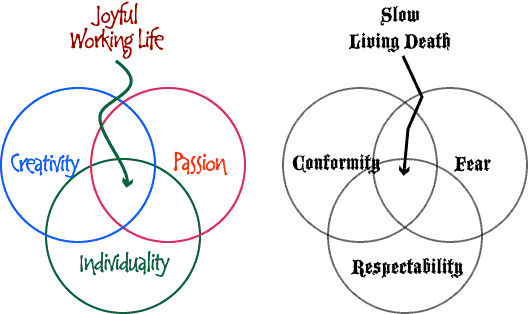
- Wanting to be liked. Most people want to be liked by those they come into contact with. To be willing to be disliked, even by a few, is a price rather few people are willing to pay for staying true to their ideals. But it’s worth asking yourself whether it’s really true that being liked always demands quite so much conformity. Some people will dislike you whatever you do, and being seen as a doormat isn’t much of a way to show others your true value. It’s probably correct that too much conformity is as much a cause of dislike as too much rebellion.
- Wanting to fit in. There is so much pressure to fit in, to be a good team player, to accept the will of the majority (or, more often, the tiny minority in power). Just recognize what is causing you to yield to this pressure. It’s fear. The fear of being excluded, laughed at, challenged, or even attacked. People who work really hard to fit in are extremely fearful and anxious. It seems as if being part of the team, never rocking any boats, should produce a quiet life. In reality, it causes constant anxiety about avoiding what others might interpret as either being too independent or getting above yourself.
- Wanting to avoid blame. There are many people who are so afraid of being blamed for anything that they automatically follow every possible rule and always try to avoid doing anything that causes them to stand out. For them, “I was only following orders” is the best excuse possible, should any criticism be in the offing. Does it work? Not really. Instead of being blamed for whatever mistake was made, they usually end up being blamed for blindly doing what they were told: not a person who tried and got it wrong, but a person without any initiative—not even enough to recognize that what they were told to do was likely a mistake.
- Wanting to appear respectable. In our society, those who question the norms are usually demonized as agitators, lefties, and people with dubious morals—or no morals at all. Creative people are alternately idolized (if they are successful) or laughed at as freaks and losers. Never mind the fact that just about everything the rest of us enjoy in life, from security to iPods, is due to the efforts of just such creative types. Only fear makes respectability look attractive. The more typical marks of respectability are far less pleasant: bigotry, small-mindedness, hypocrisy, and cant.
- Wanting to please. This is the most insidious trap of all. It feels good to please people. It gives you a glow. Small children want to please their parents. Lovers want to please one another. What could be wrong in that? Only that the cost of pleasing others all the time is going to be the crippling or loss of your own identity. And that, over the years, hidden resentment from doing this can build up to the point where it destroys the very relationships you have tried so hard to preserve.
If you want to live in a better world—and who wouldn’t, seeing the mess this one is in—there’s no alternative but to play your part in changing things. You cannot leave it to others. That’s neither honest nor practical. As another quote from Steve Jobs puts it;
We’re here to put a dent in the universe. Otherwise why else even be here?
Labels: career choice, enjoying work, fear, work choice
Monday, April 30, 2020
What does it mean?
Today’s management approaches are all abstractions and no humanity
Hamburger Management has a spreadsheet in place of a heart and a profit-and-loss statement for a soul. Is it any wonder that is has to resort to violent, artificial means of motivating people? Giving huge rewards to a chosen few and driving the rest by threats and intimidation isn’t motivation. Nor is using smart sound-bites and slogans. There is only one way to fill people with joy in what they do and bring out their highest abilities—and that way hasn’t changed since the human race began.Motivation is the subject of more articles and training courses than almost any other management “technique.” Yet I’m constantly appalled at the nonsense that I see written and handed out on the topic. Mostly, Hamburger Management ignores the purely human aspects of the enterprise, preferring to focus on spreadsheets, ratios, and results. It does notice motivation however—mostly, I suspect, because that seems to offer a way of getting people to work harder for the same pay or even less. Hamburger Managers are expected to motivate their people,
often by standing behind them wielding a big stick. If that doesn’t work, they stand just ahead, waving a large carrot and shifting it just out of reach each time their people get close enough to feel they might be able to get their hands on it.
This kind of artificial, carrot-and-stick motivation is a potent cause of workplace stress. It’s as if you’re in a car driven by someone who accelerates madly whenever there’s some space ahead, then stands on the brakes when they seem about to throw you headlong into something. It doesn’t make for a relaxing ride, and it’s hell on the brakes and the tires. Yet that’s the atmosphere in many organizations today: a scary ride mixing being forced to drive way too fast with suddenly being dragged to a halt when the organization decides it can’t afford what it will take to make you keep up the constant acceleration.
What all this sham motivation misses is what truly makes people love their jobs.
Meaning
People only care deeply about what they do when it gives their lives meaning and purpose. They don’t really work for money, they work for what money means to them: security, good food, pleasure, status, fun, relaxation. They don’t respond to incentives, they respond to what the incentives mean in their lives: praise, recognition, self-worth, and a sense of value from achievement. Even punishment and threats only work when they truly mean humiliation, loss, or sharp, personal pain.Managers who ignore this haven’t a hope of producing anything but the minimum effort.
Part of something wonderful
True motivation means giving people something real to care about—lasting values like truth, friendship, honor, loyalty, justice, love, and self-worth. It means letting them see why they’re doing what they’re asked to do, and how it will contribute to something they find worthwhile. Of course people want personal success and rewards. But few want these things at any price. Instead, the vast majority of folk give the highest value to the feeling that they are part of something wonderful. They want to believe that the world (or, at least, the part of it that they inhabit) cares about and values what they do.They also want to feel that the organization cares about them. Slowing down gives leaders time to explain the meaning of the work, to show its value. It also lets them that show that they care about their people.
Blood, sweat, and tears
When someone truly cares about us, we almost automatically start to care about them. All the great leaders of the past have known this. Napoleon talked personally with his soldiers and handed out medals to show them that he cared about their hurts and valued their bravery. They responded by fighting for him until the last. Winston Churchill walked in the bombed ruins of London and spoke the words the defiant people would have spoken if they’d had his eloquence. He didn’t talk about abstractions, like overall war plans or strategic objectives. He spoke about real things: blood, sweat and tears. He embodied the values the nation was fighting for. He gave meaning to people’s efforts to stay alive and fight back.Hand people instructions and they’ll do no more than you tell them to—and maybe not even that. Give them rules and they’ll find ways around them. Talk about financial ratios, profitability, and return on investment, and their eyes will glaze over. But give people something to believe in—a sense of meaning and purpose in what they do— and show them that they matter, and they’ll produce efforts and results you wouldn’t have imagined possible.
Labels: enjoying work, leadership, slow leadership
Monday, April 23, 2020
The problem of ambition
Is being strongly ambitious a benefit? Is searching for excellence always worth it? Whatever happened to “good enough?”
The Ancient Greeks had a word for the behavior shown by over-ambitious people who went too far in striving for excellence. The word was hubris. Not in our modern use of the word as meaning little more than being somewhat too big for your boots, but in its original sense of causing your own destruction by drawing down the wrath of the gods. The writers of Greek tragedies focused on showing the effects of hubris on previously successful people: men like Oediipus the king, who blinded himself, and King Agamemnon, murdered in his bath by his wife and her lover. In our modern world, we have forgotten that the pursuit of excellence can sometimes go too far: that crossing certain boundaries turns success into a nightmare of deceit, stress, and guilt. Maybe we ought to recover this idea, for the sake of our sanity.This is something that it’s worth thinking about; a saying I came across somewhere (I can’t recall quite where), but which has stuck with me because it seems to express something profound about the way that most of us live our lives:
80 percent of the problems in your life come from wanting what you don’t have. The other 20 percent come from getting it.Our consumer society cannot exist without a large majority of people constantly wanting what they don’t (yet) have. Advertisers and marketers spend their lives promoting craving in potential customers: not just a craving for particular products, but a generalized sense that you are never complete. There is always something new to long for—and seek to find some way of possessing. Always something more to pull you on into greater and greater hubris.
People in the past shared the belief that mankind began in an ideal state (the Golden Age or the Garden of Eden) and, since then, has descended in a more and more debased and troubled existence. Nearly everyone nowadays believes the exact opposite. Our superficial assumption of progress convinces us that each year will be better, more prosperous, more plentiful than the last. Success can never be too great. Like the profits in commercial endeavors, the only acceptable direction is upwards—and the faster the better. But is it true?
Our belief in unending progress is just as much a cultural myth as those ancient beliefs in a Garden of Eden and a subsequent fall from grace. Before we dismiss these stories as simple pessimism, consider this: they actually offer us a clear-sighted view that going too far typically extracts a terrible price in mental health; one that quickly destroys all the success that went before. With constant ambition and desire for more comes constant anxiety. What if your progress falters? What if others do better than you? What if you suffer some significant failure that thrusts you backwards? What if the only way to go on winning seems to be to lie, cheat, and use any means to destroy rivals? What if failure, however small, flips you into depression, or even a psychotic episode?
 It’s no coincidence that the highest achievers are typically the most anxious and stressed. Those who have gained most have most to lose. Stress hits hardest at those who are most productive and successful. They live with a constant sense of fear. They worry whether their progress is good enough. Whatever they earn, whatever level in the hierarchy they reach, however many goods they buy, there is always more, just out of reach. They cannot relax because they never reach the point where they feel relaxation can be justified. They have lost the notion of “good enough;” of reaching a state where what they have is sufficient, so that they can now spend time enjoying it. They never recognize the point when productivity becomes less important than pleasure.
 To find pleasure in your life, you first need to come to terms with the fact that constant economic striving and enjoying yourself are rarely fully compatible. Making time and space for pleasure usually demands stepping back from all that striving to be the leading rat in the race. “Good enough” can be better than excellence, if the price of achieving excellence is continual overwork with a thick topping of anxiety and guilt.
Even for businesses, the cost of being the market leader can become too high to tolerate. A good business that provides sufficient wealth for those whom it employs, some reasonable stability for the future, and a lifestyle that has a good balance of pleasure as well as productivity, used to be the ideal. Only in recent times has that image been replaced with that of an organization that is never satisfied with anything; and which automatically responds to meeting any goal by setting another, more demanding than before.
We need to see this for what it is: not some profound and inescapable truth, but just another cultural norm that will, one day in the future, seem just as strange as the wearing of powdered wigs and knee-breeches seems to us today. For most of us, “good enough” is in truth very good indeed. Pushing too far beyond it often produces more stress than is compatible with a good life. The problem of ambition has always been the same: knowing when to stop.
Labels: burnout, civilized work, enjoying work, fear, stress, work/life balance
Thursday, April 19, 2020
Getting it wrong to get it right
Organizations (and people) who are afraid to make mistakes can neither live nor learn effectively.
Yesterday, I wrote about Professor Russell Ackoff’s interview with Peter Day, reported here on the BBC web site. In the second part of that interview, the topic shifts away from business schools towards another key question: how can you be successful if you ignore, or hide, or deny your mistakes? Aren’t mistakes the basis of virtually all learning? If you don’t learn from them, who or what will be able to teach you anything?It sometimes seems that our society is obsessed with prying into the mistakes of others, but that isn’t really true. The media have a prurient fascination with the mistakes of the rich and famous—especially any that involve sex—and there are many who take an equally perverse joy in proving to themselves that those whom they secretly envy are, in reality, no better then they are. Yet the greatest effort goes into hiding mistakes, or denying their very existence, as if making a mistake were the most shameful of social diseases. Politicians, business leaders, the rich and famous, all spend lavishly on covering up their mistakes.
Our society's petty and mean-minded ways of dealing with mistakes, focused as they are on pointing to others’ misdemeanors, while carefully concealing or ignoring your own, are so common that we scarcely notice any more. Sadly, this is also the way that mistakes are treated in most organizations: as something to be ashamed of, to punish, and to conceal or deny whenever possible. Listen to Professor Ackoff:
You never learn by doing something right, because you already know how to do it. The only opportunity for learning is to identify mistakes and correct them. If you are in an organization which says that mistakes are a bad thing, learning is suppressed. So you either try to avoid mistakes, or if you make them, you shift blame to someone else.The simplest way to avoid mistakes is to do nothing; or at least to do nothing new or different from the conventional. If you resolutely stick to whatever is the most obvious, the most orthodox, and the most common, you at least have the chance of deflecting criticism by the time-worn practice of pointing to everyone else and saying that they did the same. As Ackoff points out, organizations have elaborate measurement and recording systems to note even the slightest sins of commission—doing what you ought not to have done—and none at all to deal with the worst kind of mistakes in business: not doing what you should have.
The worst kind of mistake is not being wrong, but something you did not do that you should have done. Errors of omission are responsible for failures and bankruptcy.I think that he is right about that. Following the herd and sticking to the conventional and orthodox makes you mediocre and pedestrian, but it takes a long time to bring your business to its knees. Missing opportunities, ignoring mistakes, staying complacent in the face of change, and suppressing new ideas will all ruin you faster and much more effectively.
Yet that is what so many organizations are doing. They’re so hell-bent on imitating others and avoiding risks that they take the biggest risk of all: ignoring reality.
Choosing to stay the same is a choice with as many consequences as choosing to change in some way. One merely feels more active than the other.
Deciding not to do something is just as much a decision as its opposite. Choosing to stay the same is a choice with as many consequences as choosing to change in some way. One merely feels more active than the other. In reality, both represent an equally significant response to events. If one is punishable, so should the other be. Of course, honest mistakes—those made despite every effort to get it right—are no more worthy of being punished than getting wet when it rains. Life is unpredictable and often cruel. Only the dead are free from further errors.To learn fully from your own mistakes, you should make as careful a note of when you decided not to act as when you did. Refusing to act is still your choice, and you should trace its consequences carefully. If you don't, at least half the lessons life can teach you will never be recognized. Sometimes the greatest gamble of all is to refuse to throw the dice.
In my own experience, as you get older, you spend far more time aware of all the opportunities that you didn’t take, and the things that you didn’t do—and now wish that you had—than regretting the mistaken actions or choices that you did go through with. Though you know that many of those missed opportunities would not have worked out—that you would have suffered hurts you avoided and much pain and embarrassment—you become aware of what you have missed that was far more valuable: experiences that would have taught you lessons that now you can never learn.
Getting it right, in work or life, nearly always involves a great deal of getting it wrong as well. Success depends critically on how you face up to failure, take the lesson it offers, and start again. Opportunities missed are usually gone for ever. The road not taken never shows up on the map again.
That’s why rushing through life, obsessed with conventional success and fixated purely on material gain, may produce riches and fame, but very often misses out on happiness and contentment. The New Testament of Christians asks: “What shall it profit a man if he gains the whole world, yet loses his soul?” You only have one trip around the sun. Use it well, or lose the chance of living and learning forever.
Labels: enjoying work, fear, management attitudes
Friday, March 23, 2020
Real courage is knowing when to let go
Why “hanging tough” is typically a sign of leadership cowardice.
Letting go of the past—even the most successful and joyful parts—is an essential discipline for everyone. Too many of us cling to burdens that no longer fulfill any useful purpose, lacking the courage to face reality and give lost hopes and failed ideas a decent burial. Stress, pain, and frustration are all we get in exchange for such misplaced loyalty. Buddhists believe that most of the troubles people face are caused by “attachment”—by our habit of clinging to ideas and situations that are long past their “use by” date. I believe there is a good deal of truth in this viewpoint, especially in the workplace.Many organizations, and their leaders, cling to products that should have been replaced, working practices that no longer work, management techniques that are long past whatever usefulness they ever had, and projects that should have been abandoned as unworkable months or years ago. People are loathe to give up what’s familiar, even when it causes them more problems than profit. They also invest so much of their self-esteem and credibility in some of these outdated activities that giving them up feels like having a limb amputated.
And while we all know that those in positions of authority—and that includes ourselves—tell lies when it seems useful to do so, the lies and half-truths that we tell ourselves always result in the most pain and frustration. It’s too easy to convince ourselves that it will all come right, if only we persist just a little longer, when the reality is that all chance of success disappeared long ago.
In today’s macho cultures—especially Hamburger Management—being a “quitter” is almost the ultimate term of abuse. It isn’t only in the political arena that the “tough guys” constantly claim that their critics are going to “cut and run.” For macho management types, almost any kind of desperate clinging to failing ideas can be supported for years by claiming that the alternative involves weakness and cowardice.
In reality, of course, letting go of something often demands extraordinary courage, especially if it was once a much-loved and extremely successful operation. Sadly, nothing in this world lasts for ever and even the most successful ideas eventually run out of steam. That’s why we all need to take time out on a regular basis to question our preconceptions and review our lives for the sins of clinging to something we ought to let pass.
When is it time to summon the courage to let go?
- When something that used to be important or successful is showing signs that its power is waning. The technique you mastered way back then that has served you so well, but now seems to have lost its edge. The approach on which you built your reputation, but which is being replaced by fresh ideas or new technologies. The beliefs that have sustained you, but whose truth you are now unsure about.
- When a hope, a dream, or an expectation isn’t going to happen. We all suffer from selective vision, clinging to our dreams and hopes long after it’s become plain that they aren’t going to come to fruition. Few things cause more frustration, misery, and stress to ourselves and those around us than hanging on to some increasingly forlorn belief. It’s like carrying a corpse around, pretending life will somehow return.
- When a plan or a project has clearly failed. Giving up is an extremely tough thing to do, especially when you know that some of your credibility is going to be lost, along with time, cash, and the organization’s expectations. It takes real courage to face reality and admit to being mistaken. Yet the alternative—to hang on until your rigid fingers are pried away from the levels of command—is still worse. Everyone else knows it has failed. Would you rather have their forgiveness for making a mistake; or their pity for being too stubborn and blind to admit to it?
- When enough is enough. Clinging to what is no longer useful causes pain to others as well as to you. You may be silly enough to accept that pain, but that does not give you the right to continue inflicting pain on others: you subordinates, your colleagues, your friends, or your family. Making others hurt to avoid admitting to your own folly is the ultimate in selfishness.
Old, outworn ideas; past achievements not firmly past; old grudges and half-forgotten wrongs; failed policies and projects that never quite made it; let them all go. Lighten your burden in this world. It’s tough enough going without weighing yourself down with all manner of useless baggage from the past.
Labels: civilized work, enjoying work, priorities, slow leadership
Thursday, March 22, 2020
Does it have to taste bad to do you good?
Many of the choices people make about work are based on that set of conventional values collectively termed the Puritan Work Ethic. I have explained before that I believe this group of beliefs is outmoded and counterproductive. Yet, even if you accept the Work Ethic at face value, it contains some notable oddities, especially the idea that effort confers value by itself.
According to popular belief, derived from the Puritan Work Ethic, a major part of the value of any action comes from the effort it takes to achieve. Something that demands a long period of extreme effort and determination will be worth more than whatever comes to you easily.
This may—possibly—have contained some small truth when applied to activities that required either the skill that comes from years and years of experience or manual dexterity. However, it makes little sense when you apply it to knowledge work.
If knowledge-work activity takes great effort and determination, that must mean one or more of these descriptions apply:
- It’s something you have never done before, you are not competent in doing it, or you lack the know-how and training required. Basically, you are out of your depth.
- It’s something you haven’t done for a long time, so you are extremely rusty. Once again, this means you are not competent.
- You hate doing whatever it is, you have no interest or aptitude for it, and you are only involved because you have no choice. As a result, you are likely to be unmotivated as well as incompetent.
The major confusion is between the determination and effort needed to do something difficult and what it takes to learn how to do it.
Part of the nonsense that what is hard work is also valuable is based on the childish view that to be good for you “medicine” must taste bad. You can almost hear the worried parent saying: “I know that it tastes awful, but it’ll do you good, I promise.” But the major confusion is between the determination and effort needed to do something difficult and what it takes to learn how to do it. Many worthwhile things take a good deal of effort to learn, but that doesn’t mean they should also be very laborious to do once you have learned how to do them.It’s worth the effort to learn something well precisely because it makes doing it easy, once you have learned enough. If you follow the reasoning of the Puritan Work Ethic, learning to do something easily devalues it. To stay with high-value work, you would always need to be doing whatever you do with least ease: things you are poor at and do badly.
Part of the perverted thinking behind the Puritan Work Ethic is the idea that “mortifying the flesh” is a good thing: that the joys and pleasures of this world are temptations that take your mind away from heavenly things. If you think this way, you almost have to see ease and pleasure as somehow evil. I believe that very few people truly believe that this is the case, but some of this thinking still hangs around in the opposite belief that what costs you pain is somehow better. Americans, in particular, suffer from a residue of puritanical values from their past, which is probably why they see Europeans as likely to be lazy and prone to a lack of serious morals.
What is work? Surely it’s mostly what people do to earn a living. There’s no logical reason why it should be hard work. Work that hurts is in no way better than work that is fun. The English language contains many words with multiple meanings and “work” is one of them. In the sense of gainful employment, there’s every reason to aim for a state where work contains little or no “work” (in the sense of effort and striving) at all.
Don’t fall for the nonsense of the Puritan Work Ethic. Those puritans believed everything about this world was evil, especially if it happened to be fun and enjoyable. If something is hard work for you, even after you’ve spent time practicing and learning how to do it properly, give it up. Focus on doing what comes easily. You’ll get better results and have a happier life.
Labels: civilized work, enjoying work, lifestyle, stress, work/life balance
Tuesday, March 20, 2020
Myths of management
Is competition always so beneficial?
Business uses ideas from many sources, but the military and the sports arena are the origin of more business ideas (and downright myths) than anywhere else. Perhaps that’s because of the domination of business by men. The military was, until very recently, a male preserve; and sport has long been a staple of male conversation, since the days when it consisted of kicking an enemy’s head around a muddy field. Sport has influenced business as much as business has now come to dominate sport.
Competition is essential to sport, whether you play against your own past achievements or another team or individual. Take away the element of competition and football becomes group of hooligans in helmets knocking one another over. Golf becomes the stupidest way imaginable for putting a small, white ball into a series of holes in the grass—and why would you want to do that anyway? And tennis . . . why should one person hit a ball to one another over a piece of netting, only to have the other person hit the ball back again?
The assumption that putting people into competition against each other inevitably causes them to work harder or better is just that—an assumption.
Business is not a game—though many people treat it as such. It has a purpose, and supposedly that purpose is beneficial. Competition between products or corporations may be essential to prevent monopolistic exploitation in a free market (if only because we accept that organizations will not restrain themselves otherwise), but the assumption that putting people into competition against each other inevitably causes them to work harder or better is just that—an assumption.Competition is said to bring out the best in people, but outside the sporting arena, most people find competition increases their anxiety and level of fear. Do people do their best work when they’re anxious, frightened and under stress? Do you? If you win, all is well, and you may forget the terror you felt. If you lose…well, who cares about losers? I’m not saying competition always has such negative effects, but it’s very far from being a universal spur to healthful actions.
There’s the problem. For every winner, there must be one or more losers. And before you say losing will spur them to greater efforts next time, think about it. Is that simply your experience? Or do many “losers” resolve never to repeat such humiliation again? Doesn’t it also cause alienation and wreck people’s self-esteem? And doesn’t it sometimes drive people to seek to win by any means available, including deceit and violence?
Before you say losing will spur them to greater efforts next time, think about it. Is that simply your experience?
Of course, competition in sport has another purpose: it’s what spectators come to watch. The best game, from the spectators’ point of view, is a close-run match where neither player or team seems capable of beating the other. But if winning is all that counts, as we’re often told in the business world, the best game from the player’s point of view will always be the one where he or she dominates to such an extent the opponent never has a chance. Win fast with little or no effort. But who would go to watch? And without spectators and TV audiences, there would be no money. That’s why the organizers try so hard to produce matches which hang in the balance, even, in the case of some “sports,” to the extent of choreographing events and sending players into the game with suitable scripts.Business isn’t—yet—a spectator sport (though Donald Trump and his imitators seems to be trying to make it one), so ease of winning ought not to be a problem. If you want to be a winner, pick on others who have no chance against you. And that’s exactly what happens, only it’s usually done by competing against superficially able “opponents” whose ability has been hamstrung in some way—because you’re the boss; because you’ve made it clear you’ll destroy their careers if they make you look bad; or because you’ve rigged the game against them in advance.
There used to be a time when awards were about showing outstanding skill or ability, regardless of other people, not just winning and losing.
Making people compete against one another for rewards, attention and praise has become traditional, but it’s not the only way to set standards or share prizes. There used to be a time when awards were about showing outstanding skill or ability, regardless of other people, not just winning and losing. When showing your skill and sportsmanship counted for more than coming out on top. Thanks to the media’s obsession with turning everything into a no-holds-barred wrestling match, politicians have become die-hard competitors, judges preside over trials that closely resemble gladiatorial contests, and even literary awards are tricked out in the paraphernalia of competition, complete with squabbling judges and post-game slanging matches. And as for the Oscars . . .Competition spurs some people to higher effort. It convinces many others it’s not worth trying and being humiliated. It causes some to seek to win by honorable means, and others to cheat. So who rises to the top? The able and honorable competitor, or the cheater? Can you tell—until it’s too late? Does the rash of top executive prosecutions tell you anything about the results of a “winner takes all” outlook?
Myths are not lies. They contain an element of truth, somewhere. They only become dangerous when they’re treated as self-evident. Competition in business is far from being the best way to encourage individual or team excellence, let alone the only one.
Labels: civilized work, enjoying work, fear, management attitudes, stress, trust
Monday, March 19, 2020
What causes stress?
It’s not always what you that think it is
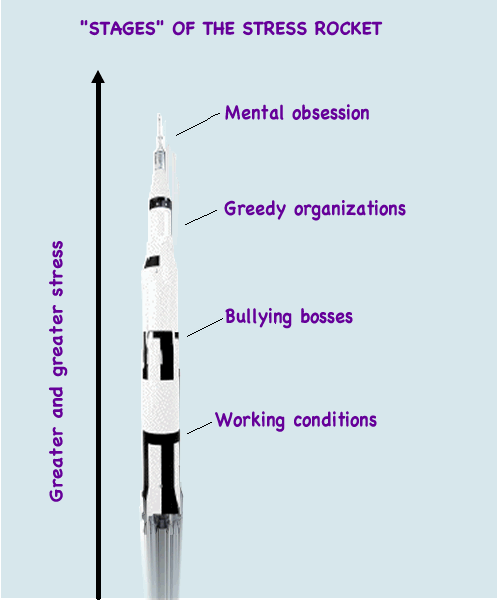
It’s very easy to concentrate only on the visible and external causes of stress: things like long hours, bullying bosses, crazy profit expectations, and continually shortening deadlines. Are these causes of stress? Yes, indeed. Do they lead to serious problems? Yes again . . . but not in every case. One of the criticisms thrown against the whole “work/life balance” movement is that it over-dramatizes these aspects of life, sees universal problems where none exist, and ignores people who handle such stressors with ease. The critics have a point, but not the whole point. Maybe the answer to what really causes stress lies within us.
According to the critics of those who draw attention to stress at work, hard work never killed (or significantly harmed) anyone. Long hours are simply a fact of modern life, like idiot TV programs and fast food. Just as eating fast food on occasion does no harm, so working long hours isn’t harmful either, unless taken to excess (I wonder what would count as “excessive” long hours. Maybe 20 hours per day, 7 days a week?). All these causes of workplace stress—long hours, bullying bosses, crazy profit expectations, and continually shortening deadlines —are dismissed either as problems capable of an easy solution or the whining of the chronically lazy.
I’ve deliberately stated these objections in extreme terms, since that is how they are often delivered. But when you cut out the inflated rhetoric, it must be admitted that the critics have a point. Most of us know of people who work very long hours, do so quite voluntarily, and thrive on it. There are folk for whom a terrifying deadline is a source of motivation, rather than dread. And there are assuredly people who set themselves seemingly impossible goals and expectations, yet still meet them—and experience excitement and joy as result, not exhaustion.
Is the answer to stress to find, and work on, only what you truly love? Well, maybe.
You cannot simply dismiss the evidence that there are more than a few people who see hard work as pleasant, and not at all stressful. Is this just another case of: “different strokes for different folks?” Is it simply a reflection of the difference—as so often claimed—between those who are doing what they love, and the rest of us who do what we must? Is the answer to stress to find, and work on, only what you truly love? Well, maybe. But my own experience suggests that only a small proportion of people even know what work thay might they truly love doing; and an even smaller proportion find themselves able to make this a source of sufficient income to serve as their sole, or even primary, employment.Maybe the problem is that we so often take a rather simplified view of the phenomenon of workplace stress.
There are, it’s quite clear, externally-applied stressors: compulsory long hours, insufficient resources, fear of job loss. These do cause stress in the majority of people, though a minority find them acceptable, or even stimulating. This parallels human activities like climbing mountains or parachuting. the majority of people find the very idea of frightening or negative, but a dedicated few enjoy them thoroughly. Still, I know of no organization that makes jumping out of an airplane and dangling on a piece of nylon fabric compulsory for everyone, not even the parachute corps. So pointing out that some people seem to enjoy what others find stressful is no argument in favor of imposing it on everyone.
There’s also good evidence to suggest that most stress is produced in the mind, both by our reactions to events and by our attitudes and thoughts. I happen to be afraid of heights. I know my response is illogical, but I cannot stop myself from becoming physically sick and terrified if I stand near the edge of a precipice. The stress that I suffer is caused by my mind. I know this, because people standing around me are quite at ease, and even lean over the edge to get a better view.
Still, even this understanding is of little use if it merely applies to certain individuals. Are there general mental causes of stress: ones that apply to the majority of people? I believe that there are, and that they contribute at least as much to today’s epidemic of workplace stress as the far more often blamed working conditions and crass bosses.
Here are some that I think are common enough to qualify as typical:
- The obsession with being in control. I’ve noted several times in these postings that belief in your ability to control anything absolutely is a dangerous and stressful illusion. Yet many go much further. They seek to control almost every aspect of their work, even their life: future results, the actions of those around them, external events, even the thoughts, beliefs, and attitudes of customers and clients. Such folly is doomed to constant failure. That would be stressful enough. But what makes it still worse is that such people—and not a few organizations—don’t just believe this kind of direct control is possible; they demand it. For them, it is the mark of success, as compulsory as turning up to work, or following legitimate orders from the hierarchy. It’s bad enough to fail all the time. How much more stressful is it to feel that succeeding in this obsessive control is both possible and required? This production of permanent failure, frustration, and guilt is a major cause of stress, especially in otherwise successful people.
- Linking satisfaction to specific, external circumstances. This is so common that most people don’t even recognize it as abnormal. It expresses itself in statements like: “I’ll know I’ve succeeded when I’ve [fill in the blank].” Or “My goal is to have [this status, these possessions, this level of income, this lifestyle]. Then I will be happy.” Aside from the fact that no one can control the future, so even the hardest work may fail to produce the desired “goodies” due to events completely outside your control, most people have no proof at all that what they claim they are working for will make them happy, even if they get it. Most of these desires aren’t even based on thorough, personal consideration of the likely costs, benefits, and alternatives. They’re picked up from the media, friends, the fashion of the moment, and the continual activities of marketers and advertisers, whose job depends on maintaining everyone in a constant state of unfulfilled desire for still more things, however much they've alreadty got.
- The illusion of continual growth. Very few things grow without limits. Nature doesn’t contain any creatures that live for ever, grow to infinite size, continually learn to run faster the longer they live, or possess abilities that have no limits. Even the human capacity to learn, while “infinite” in most individual cases only because we typically use so little of it, has limits somewhere. Nevertheless, many people act on the assumption that as soon as you have something (wealth, power, status, possessions), the only natural course is to seek still more. Once again, marketing and advertising encourage this idiocy. If they didn’t, they would have to face the reality that even people with three cars cannot drive more than one at a time, and someone with a lust for buying shoes equal to Imelda Marcos's still has only two feet. Never being satisfied is bound to produce stress over time, since you will be so tormented by the imagination of all that you still don’t possess that you will never enjoy what you have.
- Egotism, pure and simple. Very small children are supreme egotists. As their brains develop enough to form a conception of themselves as separate from others, they become obsessed with being the center of attention at all times. Happily, for most this is simply a phase of development, like sucking their thumb or repeating the same nonsense syllables for hours with no sign of being tired of them. It seems, though, that some people never grow out of the egotistical phase. Even as adults, they behave as if the whole universe revolves around them. Many of them become senior executives.
We are back to the stressful effects of seeking the impossible. The more egotistical your thoughts, the more every setback, problem, difficulty, harsh word, or simple piece of bad luck will feel as if it is personally directed at you. Where others may shrug and accept that things just didn’t turn out as they hoped, you will be driven to seek out why you were treated so badly by events, or by others. Simple upset becomes translated into personal insult. A moment’s frustration becomes hours of churning anger at the “unfairness” of it all.
Stress has many causes and demands an equal number of solutions. We should try to create more civilized workplaces and limit the external causes of stress wherever we can. But this will never be sufficient on its own. The internal causes of stress—obsession with control, seeking satisfaction in externals, the illusion of “necessary” growth, and personal egotism—must also be conquered before stress at work can become limited to obviously pathological cases.
Stress soars like a multi-stage rocket, with each stage (working conditions, bullying bosses, greedy organizations, and personal obsessions) driving it higher and higher. Until all the stages have been tackled, you will never be able to keep it down to earth.
Labels: burnout, civilized work, enjoying work, stress, work/life balance
Wednesday, March 14, 2020
What makes a company the best to work for . . . four times in a row?
There’s no problem, it seems, combining a great workplace with great profits
The Times of London announced recently that W. L. Gore, makers of Gore-Tex fabric, has come top in “The Sunday Times 100 Best Companies to Work For” survey for the fourth year running [link] . The paper describes this contest as “the UK’s toughest survey to measure staff satisfaction.” The survey, submitted by almost 150,000 employees, covered eight key areas:
- Leadership by the head of the company and senior managers.
- Stress, pressure, and the balance between work and home duties.
- The immediate boss and other day-to-day managers.
- Immediate colleagues.
- Pay and benefits.
- How much companies are thought to put back into society, and the local community in particular.
- The company itself, as opposed to the people.
- Whether staff feel challenged by their job, their skills are being used, and the scope for advancement.
Here’s what a spokesperson for W. L. Gore said on winning again:
Workplace engagement, we strongly believe, is a competitive advantage. Competitive advantage when used correctly not only creates income and profit, which we are great at doing, but also comes with a responsibility to society as a whole. We are successful because of the ability of our associates to grow, explore and learn in an environment of freedom and trust.It would be hard to find a simpler statement of the principles and benefits of Slow Leadership: a responsible organization that values trust, focuses on its wider role in the community, not just profit, and sees the creativity, growth, and freedom of its people as an important part of its corporate role. Gore remains the best company to work for because it gives its employees better personal growth, a more attractive working culture, and a stronger sense of belonging than any other company in the contest.
Interestingly, overall satisfaction with all of the companies in the survey rose this year. People think that they are well paid and have strong opportunities for personal growth. As usual, small companies do better then large ones, probably reflecting the greater flexibility small employers can offer.
However, there is one dark spot on the horizon. In the category of “employee well-being” (stress, pressure, and the balance between work and home duties), there was a significant fall in scores, which the survey authors see as “a reflection of the consistently poor scores recorded for workplace stress and feeling exhausted by the end of the day in the bigger companies in particular.”
Surveys like this give the lie to the argument by many macho organizational leaders and politicians that ideas like work/life balance and avoiding excessive stress are merely fancy ideals proposed by liberals and do-gooders. Gore makes high profits and is the leader in its field, yet manages at the same time to provide a civilized and attractive working environment and be a good citizen in its community. If they can do it—and do it better than anyone else in Britain for four years in a row—what is stopping everyone else?
Labels: corporate culture, enjoying work, stress, work/life balance
Wednesday, February 28, 2020
The Critical Importance of NOT Doing Things
Why a “don’t do” list is vital to good working habits
Most gurus and teachers spend their time telling people what to do. But if you’re already over-stretched and facing an unending future of still more pressure, that’s not likely to appear palatable. Here’s how NOT doing things can help even the most stressed person find ways to improve their working life.I’m always a little uneasy about all the websites and blots devoted to Getting Things Done and avoiding procrastination. I see the attraction—especially to those who feel frustrated and harassed—but it seems to me that getting things done is less than half of the problem. The greatest part is stopping yourself from spending time on all those unnecessary activities that clutter the working day, force people into staying late to catch up on essential tasks, and provide an enormous workload with almost nothing to show for it.
Stopping unnecessary meetings would boost available working time, lower frustration, cut costs, and free up time for essentials during the normal working day.
Take meetings. My own experience has been that as many as 75% of meetings are unnecessary. They’re mostly called to provide either an illusion of team consensus; to pass information that could be passed in one hundredth of the time by other means; to allow the self-important to have a forum to enjoy hearing their own voices; or to engage in the widespread game of synchronized cover-your-ass. Of the remaining 25% of meetings, close to 100% take too long, are ill-prepared, have poorly coordinated outcomes, or involve far longer in travel time than the meeting itself. Stopping unnecessary meetings would boost available working time, lower frustration, cut costs, and free up time for essentials during the normal working day. Not doing them would get far more done than any fancy scheduling and prioritizing system.Unnecessary communication is another sinkhole for time and effort. All those copied e-mails, circulated memos and minutes, papers marked “FYI,” and constant demands to “keep me in the loop” and make sure this, that, or the other person is “on side.” The culprit here is a deadly combination of fear and ambition: fear that something will happen behind your back that might harm you; and ambition to become so essential that nothing—and I mean nothing—can happen without your implicit approval. All nonsense, of course, but still accepted as normal.
Cutting out all useless communication, and trusting people instead to get on with their jobs and do what they are paid for, could transform productivity overnight. All it would take is the determination to stop behaving in ways that even clinically-diagnosed paranoid schizophrenics would see as crazy.
Another great way to save time and cut waste would be to stop rushing into action before you’ve spent enough time thinking about what you are going to do. Our society places such a ridiculous premium on action over thought that a great deal of activity goes to waste because it was ill-conceived, badly prepared, poorly focused, or simply unnecessary, right from the start. The workplace equivalent of the old saying, “marry in haste, repent at leisure” should be posted in a prominent position on every boss’s desk.
Our society places such a ridiculous premium on action over thought that a great deal of activity goes to waste because it was ill-conceived, badly prepared, poorly focused, or simply unnecessary, right from the start.
An hour’s quiet thought might save a month’s wasted work. A few days of reflection and consideration might prevent 20 people being given a project that they will work on for a year, before it’s finally abandoned as unfeasible. Holding back on angry words, until you can understand clearly what is going on, could save you weeks of trying to repair a shattered relationship.We are action-mad, reactive idiots for much of our working days, and pay a heavy price for the luxury of feeling that we’ve done something instead of merely thinking about what we ought to do.
Each time you’re distracted, it takes extra time to get back to where you were before.
Don’t add to your own distractions. That latest electronic gizmo, that neat computer software, the fashionable cell phone, or the device to check e-mails fifteen times every minute is only going to make your level of distraction greater. Each time you’re distracted, it takes extra time to get back to where you were before. Enough distractions in a day can leave you exhausted from constant effort, but with nothing actually accomplished—which is pretty much what may people experience as routine.If you want to make a serious impact on all those activities which consume time with an inadequate—or non-existent—return for the energy expended, try these:
- Take time to make a list of those activities that consume most of your time.
- Sort out all the ones that you can stop doing with little or no real effect. Cal this List A.
- Make a second list of all the ones you can reduce in frequency or delegate. Call this List B.
- Make a daily “Do not do” list alongside any “to do” list. Make sure that you stop all items on the “ do not do” list. Keep this up until you are no longer even tempted to consider doing them.
- Delegate everything on List B right away.
- Spend the time that you’ve freed up thinking, completing essential tasks, and being creative. Defend it like your life.
- Repeat on a regular basis.
Labels: enjoying work, priorities, stress
Monday, February 26, 2020
Are you having fun yet?
Try these nine ideas and start making your work fun again
I just came across a web site dedicated to “The Eight Irresistible Principles of Fun.” It’s not specifically about the workplace, but the principles it suggests would work really well there. Most of them fit closely with the basic principles of Slow Leadership, so I’ve taken the liberty of listing them here, with my own, workplace-oriented comments. I also added a ninth principle of my own:- Stop hiding who you really are. So many people do this. They pretend to be someone else: someone more acceptable to the boss; someone more serious and determined; someone who might appear to be a high-flier; someone who “fits in.” Even professional actors need to take a break sometimes and just be themselves. Can you imagine the stress that you’re putting on yourself, trying to be someone that you aren’t, every hour of every working day? And what’s the point anyway? You are who you are. Totally unique in space and time. Who says you aren’t good enough? Don’t fall for that rubbish. All that matters for a satisfying life is to be the best possible version of whoever and whatever you are: to develop your unique talents, express your special personality, and contribute all that you can to the life and people around you. Never, never, accept that you aren’t “worthy.” That’s crazy talk. Being yourself, openly and with joy, is essential to having fun anywhere—and especially at work.
- Start being intensely selfish. I’m not quite sure about “intensely selfish,” but I see what they are getting at. I would rephrase this as: “Start standing up for yourself and what you believe in.” No one will ever have the same degree of interest and investment in your life and future as you. No one will ever care as much as you do. No one will ever understand your needs as well, or know what it is like to be you and do what you do. People are always trying to make us into the kind of people they want us to be; to make us fit the mold and conform to their views. Do they do this for our benefit? No way! It’s for them: to stop us causing them trouble, messing up their neat lives, asking for things they don’t want us to have. This isn’t the same as people who give us good advice or share their experiences to stop us making bad mistakes. I’m talking about those who will compel us to fit in, if they are able. Focus on yourself and your own needs. At work, it’s likely that no one else will.
- Stop following the rules. Yea! Those rules are there to force you into conformity. The more you follow them, the less creative, individual, interesting, and open-minded you will become. There are two kinds of workplace rules: necessary ones (like rules for safety) and the rest. The first account for probably less than 10% of all the rules around. You’ll never have fun by following the rules. You’ll just become a grey, boring, wage slave, with not a single difference from all the other wage slaves around you. You won’t even advance your career much. No one ever promoted someone who didn’t stand out from the crowd in at least some way.
- Start scaring yourself. To learn, to grow, to develop who you are, to find excitement and fun, you have to take risks. If it doesn’t scare you, it isn’t a risk. Fun is all about taking risks—look at all the theme parks with their scary rides. Look at all the people who go surfing, or snow-boarding, or climb scary mountains, or challenge their minds with reading and listening to great music. Don’t wait for the universe to start scaring you. It may well do so in ways you really don’t want. Start scaring yourself. At work, this means taking on new and scary challenges, volunteering for jobs that you aren’t sure that you can do, taking on learning opportunities that scare you. Dare to do what you’ve never done before. Practice “conscious incompetence.” Just do it!
- Stop taking it all so damn seriously. Especially yourself. The most boring, least fun people around are all those who take themselves so seriously it hurts. They drone on and on about whatever tedious things they are involved in. They get hung up with never losing face or admitting they are wrong. They demand constant reassurance about their inflated sense of self-importance. There’s one life. It’s far from perfect, but it’s all there is. Crap happens—often. The more seriously you take it, they more it will worry you, and the more pain you’ll suffer as a result. Most of the misery in the world that humans cause (and that’s an awful lot of it) comes from people trying to control their lives down to the most minute details. They think they’re so damned important that everyone, and everything, else has to be lined up for their convenience. It will never happen. Give it up, sit back, and enjoy your ride around the sun. You might as well, since there’s usually damn all you can do about it anyway.
- Start getting rid of the crap. I am constantly amazed at how much crap people collect around them, especially in the workplace. Pack rats look tidy by comparison. All those electronic gizmos to stay in touch, all the “to do” lists, the constant meetings, the endless e-mails and memos. How much of it ever accomplishes anything? My guess is that 80% of it is simply distraction and a waste of time. People complain that they have no time to do their jobs, yet waste most of the time that they have reading e-mails, attending pointless meetings, and contributing to the tide of organizational crap engulfing them by producing e-mails and calling meetings of their own. Give it up. You’ll be amazed how much time you have suddenly; and how much fun you can pack into it, in place of all the “stuff” that was there before.
- Stop being busy. Constant busyness is the curse of our generation. People believe that if you aren’t constantly busy, you’re not pulling your weight. The curse of the Puritan Work Ethic hangs over us, like a cloud full of misery and drizzle. Busy is not the same as productive. Busy doesn’t mean “good” or “worthy.” Mostly it means “doing things for the sake of convincing others that I am worth keeping on here.” When lay-offs started becoming commonplace, people began extreme efforts to appear busy every moment of the day. As Hamburger Management became conventional, bosses starting measuring activity, because they had no idea how to measure effectiveness, and they thought they should measure something. The result is people who are too busy to have fun, too busy to live their lives, too busy to enjoy anything. Don’t join them. Life has enough misery without adding to it.
- Start something. I can’t do better than quote a comment from an earlier post: “Trying something new is like catnip—irresistible fun. Getting better and better at something that I initially did badly—THAT breeds enthusiasm.” Don’t wait for others, or you’ll wait for ever. Start it yourself.
- Don’t worry what others will think about you. This is my “extra” principle. All too many people are stuck because they’re worried what others may think. The truth of the matter is that others are mostly doing what we all do most of the time—thinking about themselves. They aren’t concerned with you at all. A lot of the time, they aren’t even aware of your existence. So if, from time to time, they drag themselves away from self-absorption just long enough to disapprove of whatever you’re doing, ignore them. It’s your life, not theirs. Self-doubt and fear of embarrassment are major dampeners on any kind of fun. Throw them away. They aren’t worth the time of day.
Labels: enjoying work, lifestyle
Friday, February 16, 2020
Workplace Karma
Do unto others, and they will make sure they do unto you

A thought floated across my mind recently, when I was reading something about the ideas of “karmic law.” I’m not an expert in Buddhist or Eastern thought, but what I understand of the idea of karma is that it’s a refined version of cause and effect: what you do affects what happens to you, or “what you give out is what you get back.”
It seems to me that you don’t need to have any kind of belief in either the supernatural or Eastern religion to see that “what you give out is what you get back” represents simple realism.
Suppose that you’re a typical “Hamburger Manager.” You’re tough, assertive, macho, obsessed with short-term results, and tireless in your pursuit of your own ambition. What you “put out” in terms of behaviors will likely include:
- Constantly talking tough—then complaining that no one likes you, though you’re really a nice person.
- Hounding subordinates to do more and more with less and less—until everyone is so tired that they produce less and less, however hard they work.
- Demanding longer and longer hours of unpaid overtime—and expecting bigger bonuses for yourself as a result.
- Claiming that money is the only incentive—while cutting back wherever you can on salary payments.
- Refusing to consider anything other than “meeting the numbers”—even if those numbers are based only on wishful thinking.
- Accepting bad behavior from anyone who “brings home the bacon”—and sneering at the “impractical idealism” of those who suggest that this is unacceptable.
- Thoughtlessly copying the cult of disdain for anything “soft,” “liberal,” or “impractical”—which is pretty much everything that doesn’t fit with the opinions of your bosses.
- Maintining rigidity of outlook—because true believers never even consider the tiniest doubt about orthodoxy.
- Tough talk and macho behavior provokes the same kind of response. Aggression breeds aggression in return, so life becomes a constant battle of wills. All the aggression that you encounter will then likely make you more aggressive, and so on, round and round, in a never-ending process of escalation.
- Hounding subordinates and forcing them into longer and longer working days will produce stress, tiredness, frustration, and burnout. Hourly productivity and creativity will fall—so the only way to catch up on targets will be still to demand still longer hours and exert yet more pressure. You’ll constantly have to do more and more hounding. It won’t end until there’s some kind of collapse.
- Whenever money is used as the sole incentive, people quickly discover that any amount that you give soon becomes accepted as the “going rate” and loses its incentive effect. If you raise pay to bring back an incentive, you need to make still more profit to cover the extra cost. It turns into a continual, fruitless game of “catch up.” If you hold out and refuse to drive up salary costs, you have no further incentive availave—and you incur higher costs elsewhere as you are forced to replace those who leave. This is (politely) known as a lose:lose strategy.
- Accepting any kind of behavior from jerks and bullies, so long as they meet the numbers and get results, creates an atmosphere so toxic that few people will stay in it for long—especially anyone with talent and intelligence. You’ll get the staff that you deserve—along with the high turnover, constant hassles, and looming law suits. Besides, anyone who tolerates jerks is, by definition, a jerk themselves. He or she who tolerates most jerks is the jerk-in-chief.
- A rigid, numbers-based, macho outlook is a great way to destroy any sparks of creativity in yourself and others. Your competitors will have the ideas, and you will be driven back to competing on low costs and desperately trying to mimic what others have produced before you.
The other reality of this faux-karmic law is that it multiplies. There’s one of you (one manager, one organization), but thousands upon thousands of other people to return what you send out. Act aggressively and thoughtlessly and all these thousands will return the same behavior, often with interest. So, if you act like a jerk, what you’ll get back is the same behavior, multiplied by the number of people who suffer from what you do.
There it is: behave like the stereotypical, bullying manager and that’s exactly what you’ll encounter in return. Do it consistently, and your return will be multiplied by several orders of magnitude. Give out honesty, trust, creativity, and sensitivity to others and that’s what the universe will most likely play back to you, also enhanced and extended.
It’s your choice. If your daily experience at work is that the world is full of people throwing sh*t around, the chances are extremely high that you are a major contributor to the process that put all that brown stuff there for them to throw back at you. Maybe, if you stop dishing it out, you’ll begin to find that less comes back. If everyone did that, very soon there would be none to throw around any more. Think about it.
Labels: civilized work, enjoying work, management attitudes, working relationships
Tuesday, February 13, 2020
Start Practicing “Conscious Incompetence”
If a thing is worth doing, it’s worth doing badly first. In the real world, doing something new almost always means doing it poorly the first few times. Improvising never produces a polished result, but it's nearly always the first step towards creating something new and worthwhile. To do something new, you have to make a conscious decision to let yourself try things that you know you can't do. That's practicing "Conscious Incompetence."
Sir Winston Churchill wrote:
Success is the ability to go from one failure to another with no loss of enthusiasm.The way to get out from the herd and let adversity itself turn you into the next big success is to practice “Conscious Incompetence.”
Why do you need it? To make time and space for learning. What is it like when you do something you haven’t done before? You do a pretty poor job of it. You do it badly. There’s no other way to learn. If you’re only willing to do things well, you can’t improvise or do anything new. To develop your potential you must start to cultivate a new skill: the skill of “Conscious Incompetence.”
In the world of work, there is so much pressure for doing things correctly from the start that most people live in a constant state of anxiety. If you aren’t allowed a period of grace to learn by doing things badly, you’d better stick just to what you know you can do already. If you’re to “hit the ground running” in a business that has “no room for passengers,” you must either do everything competently from the start or risk being pushed aside. The result of such needless torment is that people draw back from new areas. They’ve survived to the point of doing something—anything—capably, so they don’t want to risk themselves by stepping outside this hard-won comfort zone.
“So what exactly is it?”
“Conscious Incompetence” is doing something that you know you can’t yet do, let alone do well, for the purpose of learning how to do it better. It’s allowing yourself to make a mess and get things wrong, because you’ll never know how to do better until you get past that point. And it’s the basis of all learning. If you can’t allow yourself to make mistakes and probably look silly doing it; if you can’t allow yourself to attempt what you know you won’t be able to do at first; if you can’t allow yourself to take the risk of screwing up; then you also can’t allow yourself to learn or develop. And if your boss or your organization demand near perfection from the first moment, they’re fools. The only result will be employees who never try anything new at all.“Conscious Incompetence” should be required behavior in every organization. This is true for individuals, teams, and the whole corporation too. The world makes unavoidable and unexpected demands on us. Such demands force us along new paths, if we want to avoid the fate of the dinosaurs. Improvising and learning by doing are perfectly natural human activities. So are making a mess, failing the first few times, and getting in a muddle with new ideas, but only making them deliberate will allow us to use them effectively, whenever and wherever and however we want—without feeling so embarrassed or silly that we resolve not to risk either again.
“How do I start?”
By seeing what might work and trying it, even if you’re certain that you’ll do it badly at first. This requires four steps:Step 1: Ask yourself, “Do I think this might be a useful idea or skill?”
If the answer is “yes,” consider how you can try it out. It’s very easy to be misled by appearances or the opinions of others. Those who advised major corporations to indulge in creative accounting were simply giving opinions. Were their opinions correct? Events have proven they were not. What appears to be new and useful maybe a delusion or a miracle. You won’t know until you try.
This sounds simple, but it’s amazing how often managers turn down most fresh options without even trying them, purely because they aren’t things they know they can already do well. If what you try doesn’t work, drop it. But at least you now know that it isn’t really an option, and—far more important—you know why.
Don’t accept conventional wisdom. Don’t make easy assumptions (to assume, it is said, is usually to make an ass out of U and me). Distinguish causes from their effects. Explore, poke, probe and question. Don’t worry what others think. What passes for thinking most of the time within organizations is merely the rearrangement of old habits and preset opinions. As the playwright George Bernard Shaw, who was neither troubled by modesty nor inhibited in his comments on others, once wrote:
Few people think more than two or three times a year. I have made an international reputation for myself by thinking once or twice a week.Merely by trying things others ignore or turn down without question, you’ll build an enviable reputation as an outstanding creative thinker.
Step 2: Ask yourself, “What tells me that the conventional answer to this is true?”
You need to be clear about what is going on. If someone tells you, “we have a retention problem,” take the time to ask whether that is true; and if you think it may be, take the next step and explore what you can see, hear or experience that actually tells you that’s the problem that exists.
Confusion is the enemy of effective judgment. Perhaps a problem does exist, but if you’re confused about its nature and extent, there is little chance that you can take correct decisions on what to do about it.
The fear that is generated in harsh times makes us hurry to premature action. If we believe we need to do something immediately, we have little option except to reach for the conventional solution. Yet most of our requirement for immediate action comes from anxiety, not reality. Few things that occur in organizations demand instant responses. Even half an hour of focused thought can prevent disaster and a major loss of face.
Make a list of the “proofs” that demonstrate the problem. You will need this for the next step.
Step 3: Ask “why not?” repeatedly until exhausted all the options you can discover.
“Why?” and “Why not?” are the most useful questions in the universe. Perhaps that’s why toddlers use it so often. They haven’t yet had it knocked out of them by hostile authority figures. They also need to learn a whole lot in a hurry and know, instinctively, that asking “why?” and “why not?” all the time is the best way to do it. Most parents find their child’s persistence in asking “why not?” soon becomes maddening. Most bosses feel exactly the same way about their subordinates. Both groups are wrong. Asking “why not?” can be uncomfortable, but it is nearly always productive.
Step 4: Give yourself (and those who work for you) permission to improvise and try new approaches, even if you all get it wrong first time.
Suppose that Brad is afraid of anything that might suggest incompetence or threaten failure. Many high performers are. They’re typically extremely superstitious about risking even the possibility of failure, because they have never experienced it in their past.
Brad is faced with an important decision. He wants to shine—and he really, really doesn’t want to make a mistake, or take any risks that he can avoid. The best way to meet both these objectives looks to be to use his knowledge and memory to see how this kind of decision has been made before, then replicate it.
Brad looks for this information in the past. He remembers what he has done that turned out well; recalls what he learned at business school and corporate training events; searches out industry best practice. He finds many things that he already knows, and uses this knowledge to make a decision that has the best chances of being correct in terms of past knowledge. That’s why he will probably never develop more than a fraction of his potential.
Susan comes up against the same decision, but decides it’s a great chance for stealthily practicing “Conscious Incompetence.” (It’s usually best done in secret. The conventional parts of the world tend to misunderstand.)
Now she adds the magic ingredient that is going to transform her career. She takes time to review all the other options she can think up that don’t match industry best practice, and aren’t in line with how things have been done before. She knows that she isn’t likely to be good at them, but checks them out just the same. By doing this, she has started learning something new, not just learning more about what she already knows.
When Susan starts to implement her idea, she makes many mistakes — she knew she had little previous competence to help her — but each one teaches her more. She persists in the face of failure. By the end of the project, Susan has accessed more of her potential, the company has gained a new approach, and senior management has recognized a talent in the making. Brad is still polishing his existing knowledge and wonders why his career isn’t progressing.
“Conscious Incompetence” (and the deliberate testing, improvisation, and experiential learning that it produces) should be required behavior in every organization. It is the only way for organizations, and the people in them, to access untapped ideas and unused potential and put them to practical use.
“Now I get it!”
In today’s harsh, macho, grab-and-go business environment, the real risks come from repeating the past and believing that you already know all the answers. Sure, experimenting takes time. Sure, there will be many mistakes and stumbles along the way. Sure, people will have to persist in new activities to become good at doing them. So what? That’s how things work. The only new things you can do instantly, without time to practice or develop a skill, are so inconsequential that they’re hardly worth doing at all.And, sure, you’ll look silly many times. But not half as silly as you’ll look when it becomes clear that the idea that you rejected without fully considering or trying turns into a killer advantage for a competitor.
Labels: creativity, enjoying work, innovation, learning
Friday, February 09, 2020
What's Stopping You? (Part 3)
Deficit Thinking Ruins Lives
Whatever else you do, drop the habit of deficit thinking: concentrating on what’s wrong, what’s missing, and what’s not working, rather than what is. It’s a very poor way of looking at the world, and a major source of all kinds of limiting and negative beliefs.This is the third and final posting in this series. You can find Part 1 here and Part 2 here.
The principal source of negative beliefs is an ingrained habit of deficit thinking. This means focusing on gaps and weaknesses (the deficit) instead of what’s working (and can be made to work still better). It’s focusing on what you can’t do, not what you can. Instead of your dreams and ambitions propelling you forward, you let the gap between your current state and your desires become a source of frustration and depression.
All beliefs need regular scrutiny
You should challenge all your beliefs. All beliefs need to be checked regularly for accuracy and usefulness, so question them constantly. It’s tempting to take comfort in beliefs when life is difficult and the future is uncertain. Beliefs help you feel stable. You’ll feel uneasy about recognizing the ideas you trust could be false. But if you’re thinking clearly, you’ll see that a true belief will always stand up to scrutiny. It’s the false, outdated beliefs that must be moved out of your way. It is always worth asking yourself, “Is this true? How do I know it is true? Is it still to be trusted?”Negative or limiting beliefs need to be subjected to especially rigorous questioning. Since they stop you from doing something, it’s hard to prove them false in any other way. When you try some idea, you find out how well it works. But when your beliefs prevent you from even making an attempts, you cannot know for sure what might have happened if you had. That’s why these belief are so pernicious: they remove options and possibilities without testing them—or, usually even considering them properly.
Here’s how to get rid of deficit thinking
- Don’t waste energy looking for gaps and deficiencies. You’ll always find plenty, especially if you set your standards so high at the start that there’s no way you can even come close. That’s like deciding to start playing golf, then deciding that you’re no good unless you can beat Tiger Woods right away.
- Don’t assume the glass is half empty, when it’s simply half a glassful. Perfectionism can easily become a disease. Life is what it is. The skill is to be able to do something useful and fun with whatever the universe serves up.
- Don’t take fears for reality, commonplace thoughts for truth, and worries for real problems. Nearly all such opinions and thoughts are wrong and the problems don’t exist outside your mind. Many people fall into the habit of over-dramatizing their lives, perhaps to make them feel more exciting than they are. But when you play up the good parts, you do the same (or more) to the bad ones. Look at the media. How many good news items do you see, compared to all the ones promising doom and gloom?
- Quit taking yourself so damn seriously. Life is uncertain and difficult enough without adding to your problems. Slow down, relax, and chill out. It’s good to be insignificant. It lets you have fun while all the pompous, important types are giving themselves ulcers.
- Don’t buy the foolish idea you have a right to be happy. There’s no such right. Sometimes you’ll feel happy, sometimes sad, and very often neither. That’s the way life is. Get used to it.
- Stop watching your emotions. They’re not worth it. They go up, then down, then up again: random gyrations like the stockmarket. No one really knows why, whatever they try to tell you—not even mental health professionals. You can’t will your emotions go or stay where you want, so quit driving yourself nuts by trying.
- Don’t casually pick up beliefs from other people. If you saw a slice of pizza lying on the sidewalk, would you pick it up and eat it? No? Then why do so many people pick up beliefs and assumptions from just about anyone and swallow them down without a moment’s hesitation? They’re even more likely to contain something toxic than the pizza. What you put in your head can poison you as easily as something you put in your mouth.
Free yourself from the tyranny of useless beliefs
The commonest source of the fears that weigh us down is some unexamined belief about what is “normal” or “standard.” Here’s an example. One company I worked in had a common belief that anyone who hadn’t been promoted to a serious management position by the age of 30 was never going to be promoted. There was no basis for this belief, but it persisted. The results were predictable. People of 29 lived in constant fear of being “passed over.” By age 31, anyone not promoted had already left to find another job.A good way to start clearing up the problems in your life is by throwing away all your old, wrongheaded beliefs and assumptions. Many of them will be plain wrong; others will be long past their “sell by” date. Most people carry around a heavy load of such mistaken beliefs about the world, themselves, and others: beliefs that stir up negative emotions and behaviors; assumptions that cause deficit thinking; and a host of other habitual ways of seeing the world virtually guaranteed to limit their achievements and cause them unnecessary suffering.
Take them out and question them mercilessly. If they’re still true and sound, you have nothing to lose. They’ll come out of the process unscathed. If they aren’t useful any more—and many, many won’t be—drop them immediately. Then make sure you repeat the process often. Today’s knowledge quickly gets stale. Yesterday’s beliefs soon become moldy. Don’t let them fill your mind with outdated ideas and cripple you with deficit thinking.
Labels: enjoying work, innovation, learning, priorities
Thursday, February 08, 2020
What's Stopping You? (Part 2)
In part 1 of this series, I considered the power and importance of essentially unprovable beliefs in determining people’s actions and outlook. In this part, the focus is on limiting beliefs: those that actively reduce the options open to you in dealing with whatever life brings. Limiting beliefs can block your future and confine your choices. Start by recognizing them and understanding how they work and what they do. Then counteract the effects by broadening your outlook and adding to your strengths. You don’t need these beliefs. Let them go.
Suppose you think that you have no chance of ever living the kind of life you want. Maybe someone in the past told you you would never make anything of yourself—and you believed them. Children are very impressionable. They easily believe what they’re told, especially by parents and others they look up to. You may have been living with this ever since. Something in your head keeps telling you it’s not worth making an effort, because you’ll never succeed.
Stop and ask yourself whether this is true or not. Was it ever true? Has it become a self-fulfilling prophecy? My guess is that it’s true as long as you believe it is. The minute you tell yourself you can do it, you can succeed, that will be true instead. Try it.
Limiting beliefs have power over you only because you treat them as the truth
Remember, a belief is no more than a thought or opinion that’s automatically treated as correct. In reality, they have no greater likelihood of being right than any other thoughts. But once we give them the label “belief,” we convince ourselves they’re different and must not be questioned. Whether they’re our own beliefs, or ones we’ve accepted from others, or the commonly-held beliefs of the society in which we live, they aren’t necessarily true—even if that’s how we’ve come to treat them.There are at least four distinct sources of limiting beliefs:
- Hidden fears. Nearly everyone has a few long-standing, hidden, and irrational fears. My mother was deeply afraid of frogs, though she knew they couldn’t hurt her. For other people, it’s spiders or snakes (not so irrational here in Arizona!), flying or enclosed spaces. The one that’s most likely to block people’s careers is fear of risk. Any change involves risk. Life itself is risky. Beware telling yourself: “I could never do that.” It may be true (I could never be an Olympic athlete), but it may be nothing more than an irrational fear. Check it out. You have nothing to lose. Try kissing a few frogs to see if you can find a prince.
- Outdated habits. Outdated habits are like worn-out, shabby clothes. They may be comfortable but they look ridiculous to everyone else. Comfort is more powerful than most people believe. Look at all the people who know they ought to change something in their lives, but keep putting it off because they’re comfortable as they are. The clue is when you notice yourself thinking: “It’s going to be trouble. Probably more than it’s worth.” Ask yourself if you want to stay fat, dumb and happy. I guess many people do.
- Mixed-up values. Inner values are much more powerful in people’s lives than they credit. But, like everything else in our world, they sometimes get a little muddled and crazy. People tell themselves they must do something. Why? Because it’s their duty. Because it’s “right.” Because it’s the way to get ahead. Because … whatever. Beware of emotional reactions driven by your values. If your decision is a thoughtful one, that’s fine. If it’s an immediate, instinctive reaction, take care. The world has many shades between “black” and “white” and they’re worth exploring before you settle on a choice.
- Untested assumptions. Untested assumptions are caused by mental laziness. There’s no kinder way to put it. People who don’t check out their beliefs and assumptions are the couch potatoes of the mental world. Hey, it’s easier to reach for the mental remote and look for some more entertainment than do the work of weighing choices and checking data seriously.
Labels: enjoying work, innovation, learning, priorities

This work is licensed under a Creative Commons Attribution-NonCommercial-NoDerivs 2.5 License.