Tuesday, July 31, 2007

Time and effort-saving ideas for busy people

However much you try to slow down and avoid activities that consume time and energy to no purpose, there will still be occasions when you are going to be busy and pressured. That’s a simple fact of modern organizational life. So how to deal with it?

Here are some ideas, taken from a wide range of sources (plus my own experience), that should help you to save time and trouble when things get hectic:


  • Always think ahead about the most likely consequences, not just the ones that you want to happen. The idea here is simple: to try to avoid causing yourself more problems and stress through a moment’s thoughtless action. One of the commonest consequences of being under pressure is a failure to look ahead. It seems so important to get a quick result. But cutting corners, taking risks without proper consideration, and rushing into precipitate action can all cost you far more time in cleaning up the mess afterwards than you saved at the time.

  • It’s always worth taking ample time to get a message across to others. It’s the same temptation: to rush through some phone call, message, or conversation because you can’t really spare the time and you have so much still waiting for you to do. Resist it! If people can see that you’re harassed, they’ll often try to be helpful by saying they understand when they don’t. Few situations are more maddening than discovering, too late, that someone you were relying on for a key element in a project misunderstood what you said that you wanted.

  • Consider every request to attend a meeting with the greatest skepticism. Your default position should be to stay away. Avoid any meeting with no clear agenda, no obvious ending time, and no purpose that makes sense to anyone except the organizer. Don’t assume you can go and quietly do work at the back. It’s more discourteous than staying away and it rarely works.

  • Practice at least a dozen firm but polite variations on “no” until you can say them in your sleep. Then use them whenever needed—which will be all the time. The best way to stop yourself becoming overloaded is to refuse to take an anything else. If the person giving you yet more work is your boss, ask for clear priorities, explaining that you need be sure what to drop to make way for the new piece of work. You’ll be surprised how often this will make a boss reconsider.

  • Learn the two key ways of reading: skimming for relevance and filleting for data. When you skim a document, your sole purpose should be to decide whether it contains anything worth reading. Let your gaze run down the page looking for key words and phrases. If you find any, put a small “x” in the margin and move on. Then glance over the number of “x” markings. Less than 5-6 means don’t mess with it further unless one of those is essential. Filleting is going back to the “x” marks and collecting the data you need. The best way is to make your own notes in a small book. Then toss the original.

  • Don’t accept what you’re told on trust, save from proven sources. When you’re rushed, the temptation will be to “save time” by accepting what you’ve been told. Always check. It’s well worth the time. You’ll look an idiot if the information isn’t true, and no one will accept the excuse that you were in a hurry.

  • Become familiar with the notions of estimates and orders of magnitude. You can often spot an error or problem almost instantly, without any calculation, by realizing that it is impossible. That’s especially true with numbers. If you know the answer has to be less than 10, and if what is on the page is 14.7, it has to be wrong. No more analysis is needed than that. One of the most useful skills I ever taught myself was the ability to estimate the order of magnitude of the right answer. I rarely needed to know any more to save myself huge amounts of time on analysis.

  • Know when to stop. The more you’re under pressure, the more you will be tempted to press on working well beyond the point where your attention and effectiveness begin to fail. Don’t do it. It seems as if it will help, but you’ll most likely either have to do all that work again or waste time clearing up the mess you made for yourself. And you’ll have denied yourself the rest needed even to do that properly.

Coping with turbulence

Imagine someone in a kayak, negotiating a river full of rapids. That’s you, facing all the turbulence and unexpected pressures of your work.

An inexperienced and foolish kayaker is totally occupied with trying to deal with every twist and surge of the current. His or her attention is fixed on what is happening right now. The ride is a nightmare of hidden rocks, violent eddies, and constant threats of being overturned and drowned. Time flashes by in a blur of near-panic. Any patches of calm water are used up in exhausted collapse, desperately trying to catch a breath before the next horror.

The more experienced kayaker faces the same perils. But that person has learned to look always a little way ahead, sensing the flow of the river and avoiding some at least of the hidden rocks and shallows. By doing so, he or she has more scope to find areas of slightly calmer water, where rest is possible and there’s a moment to look around and enjoy the view.

Although both kayakers may pass the same time in the rapids, as measured by the clock, the experienced one feels as if he or she has much more time. Time is always as much subjective as objective and when we’re in a turmoil of short-term fire-fighting, it passes with such speed that it causes stress by itself.

If I had to sum all of this up as simply as possible, I would say that the key to coping with stress and pressure is to do just about the opposite of what feels most called for: slow down as much as you can, look ahead as much as possible, drop everything non-essential, and do the rest as carefully and thoughtfully as possible so you only have to do any of it once. And always, always, try to avoid making yet more work for yourself by rushing, cutting corners, and making needless mistakes.


PLEASE NOTE: from August 1st, tomorrow, this blog will leave the Blogger platform and re-surface on Wordpress. I will leave all posts up to that point on Blogger, at the current URL.

New posts will be found from August 1st onwards at http://www.slowleadership.org/blog/



Email Newsletter icon, E-mail Newsletter icon, Email List icon, E-mail List icon
Sign up for our Email Newsletter


Labels: , ,

Add to Technorati Favorites Stumble Upon Toolbar

Thursday, July 26, 2007

Stress-busters: Being more detached

A potent source of stress is taking everything too personally. It’s easy to see criticism as a personal attack, or a setback as some kind of malice aimed directly at you. Neither viewpoint is going to help solve the problem. Both will send your stress levels soaring. Here’s an alternative.
I’m writing this article with a sense of trepidation. On previous occasions when I’ve turned to this topic, it’s generated quite amazing levels of abuse from a few people. So I’m going to start with an explanation. It seems that some people equate detachment with emotional coldness, standoffishness, and a kind of superior disdain for normal human feelings. That isn’t what detachment means for me. I’m not suggesting people turn off their feelings (it’s impossible anyway) or adopt some sort of lofty disregard for others. To understand detachment properly, you have to understand attachment first.

The common phrase “I’m attached to it/him/her” may imply liking or love, but people don’t become attached to stress, worry, overwork, obsessive competition, or always being first because they love it. Attachment, in the sense I’m dealing with, means being “stuck on” something. You can’t let go of it, however much it’s hurting you. You’re clinging to it because of some kind of habitual or past emotional bond. Usually these aren’t positive emotions either.

Attachment is an obsession. People half kill themselves with overwork and stress because they believe they must, not because they enjoy it. So . . . to be detached means to be able to step back from events and see them in their proper perspective.

The simplest way to define greater detachment is to see it as the freedom not to be “sucked in” every time—whether that’s into feelings that hurt you, actions that make you feel worse, or responses that don’t help.

Why detachment is desirable

There’s something delightful about being able to stand and look at events and remain in control of your feelings and reactions. If you want to, you can jump in. If you choose not to this time, you can stand aside. It’s your choice. You aren’t at the mercy of an internal “reaction reflex” that is just waiting to be set off by the next setback, the next jerk who pisses you off, or the next unreasonable demand from some idiot on high.

You are just you: conscious of what you are choosing and free to act in whatever way seems best to you. You’re in control of yourself and armored against most of the petty irritations that build into a serious stress load.

How to become more detached

Here are some ideas that can help you to become a little more detached; to let your own wishes and thoughts take precedence over the shouts, opinions, and commands from the outside:
  • Know what is most likely to suck you in. Take some time to consider the patterns in your life. What sets you going? What causes you to “lose it” and do things that you regret later? How can you recognize them before they draw you in? Make a list and memorize it. Then work at avoiding whatever’s on the list.

  • Build a habit of pausing and giving yourself time to think. It may take a long time to make this stick, but it will pay huge dividends. Instead of jumping into action, or snapping out a response, say or do something neutral: “I’d like to think about that a moment,” or “Let me get back to you on that one.” Buy yourself time to get past your first response and start considering the options. Try to make more conscious choices whenever you can.

  • Build a new self-image. Instead of being someone who’s quick to react or speak, start seeing yourself as the quiet person who rarely jumps in first, but who everyone listens to when he or she does say something. At first it will seem false and theatrical. But if you stick at it, it will mix with the rest of your personality and produce a new, calmer, more influential, and more popular you.

  • When you feel your emotions on the boil and your hackles rising, ask yourself whether what you believe at that moment is really true. Force yourself to stop and question your beliefs and feelings fully. You’ll be surprised how often you discover that you’re all fired up by something you’re assuming, something you’ve been told (on what authority?), or something that isn’t even real.

  • Watch others. See how simple it is for people to get sucked in—and how easily they’re manipulated as a result. Watch how a simple, trivial situation is turned into a drama, then a Hollywood disaster epic. Consider whether that’s how you want to live.

  • Ask yourself whether what you’re doing right now is your own choice, or the result of being sucked in by something that you’ve got hooked on. Notice how each one feels. Compare stress and frustration levels. Decide whether you want to be swept along or make your own decisions.
The best antidote to getting snagged into negative situations and responses is always to be aware of what’s happening inside and why you’re doing whatever you’re doing.

Being more detached means giving yourself more space and time to be aware. It means freeing yourself from compulsions that don’t serve your best interests. It means being master or mistress of your own mind, controlling your emotions, and choosing your actions with care. And it means only accepting the amount of stress that you are willing to suffer, instead of what events or other people want to unload onto you.


Email Newsletter icon, E-mail Newsletter icon, Email List icon, E-mail List icon
Sign up for our Email Newsletter


Labels: , , , ,

Add to Technorati Favorites Stumble Upon Toolbar

Tuesday, July 17, 2007

Stress-busters: The one-day “retreat”

Religious people have long used retreats—time totally away from the world and its distractions—as a way to deepen their understanding and refresh their spirits. Those are goals that can benefit anyone. You don’t need to be religious to use the idea yourself to ward off stress.
The religious retreat is a specific period completely away from the world and worldly things: a time set aside for religious practice and that calm and quiet that many people feel that they need to get their view of life back into perspective. Many Jewish people, for example, keep the sabbath as one day each week free from work of any kind; a time for family-based rituals and a reminder of their cultural origins. Indeed, their ancestors so revered this time set aside from the world that they believed it to be both a commandment and a blessing from their god.

Such a good idea need not belong only to the realm of formal religious activities. Most of us would benefit from regular breaks away from all the pressures and distractions of our lives; taking time to refresh ourselves, enjoying peace and quiet, thinking and renewing our perspective on life, or just catching up with sleep, family, and friends. Best of all, it could be time devoted mostly to resting and letting our minds wander into paths far away from the daily stresses and pressures of work.

I think we would all do well to take such regular one-day “retreats” in this way; preferably every week, but at least as often as we are able to do so. You could, of course, combine it with religious practices of any kind, if you wish. But that isn’t the essence of the idea. The purpose that I have in mind is a specific period of rest and relaxation to help deal with stress and the many ways that it distorts our thinking and undermines our health and peace of mind.

Here’s how a purely secular and non-religious version might work.
  • You set aside a clear period of 24 hours for your retreat. That time is sacrosanct. Nothing must disturb it short of a national or personal emergency.

  • You remove all possible distractions. No telephone calls. No e-mail. No use of computers, not even to surf the Net. No TV, radio or newspapers.

  • You must not do anything connected with your work. Nothing, however small or seemingly insignificant. And that includes golf with potential customers, “talking shop” with friends, reading anything work-related, or simply thinking about work problems. You can make physical effort (playing sport, walking, gardening, painting the house), or mental effort (spending time at some hobby, playing or listening to music, reading some challenging book, writing on non-work subjects, watching serious programming on TV), but none of it must be related in anyway to your job.

  • There’s no need to be serious or “worthy” in what you do. Probably the best way to spend the time is playing, relaxing, and generally having fun. My only suggestion would be not to “veg out” and waste the whole time on the couch in front of some mindless TV program.

  • If you have visitors or go out to visit friends, try very hard to make sure that they aren’t directly connected with your work or you’ll be tempted back into talking shop. If you do have some work contact with them, gently ask them to stay away from conversations about work topics while they’re with you. If they can’t, invite them on another occasion instead.

  • At least 8 full hours must be set aside for sleep. No excuses.

  • All meals must be leisurely and relaxed. If you enjoy cooking, cook. If you don’t, eat out.

  • At least half the non-sleeping time ought perhaps to be devoted to being with family or friends. This isn’t a rule, just a suggestion. Some people enjoy social time. Others find greater refreshment in time alone. It’s your choice.

  • Try to get plenty of fresh air. Nowadays, most of us spend far too much of our time indoors. Walking or cycling is good.

  • If work-related matters (or people) try to intrude, they really must be ignored. If you aren’t strict about this, your attempt at a retreat is doomed. Nothing must be allowed to spoil it. No exceptions. Allow just one in and all the rest will push through the crack you opened. It’s only 24 hours. Almost nothing is truly so urgent that it cannot wait that long.

  • It’s best to hold retreats like this regularly, on set days. That way, everyone else gets used to your schedule and knows that it’s pointless trying to interrupt.
The benefits are, I think, obvious. Aside from the rest, refreshment, and re-establishment of perspective, just the self-discipline involved is likely to be extremely beneficial. So is the process of reminding yourself—regularly—that it’s your life and you should be able to set aside some part of it for yourself.

So consider this: if you can’t do this, how are you different from a slave who lives continually at the whim of someone else’s agenda?


Email Newsletter icon, E-mail Newsletter icon, Email List icon, E-mail List icon
Sign up for our Email Newsletter


Labels: , , , , , ,

Add to Technorati Favorites Stumble Upon Toolbar

Wednesday, July 11, 2007

How to save yourself from being hooked again

If you ever say, too late, “It’s got me again,” this article is for you.

What do people and fish have in common? They’re both easily caught with baited hooks. In the human species, the bait doesn’t even need to be attractive or edible; just something that sparks an emotional reaction. One moment you’re sitting there, relaxed and content, and the next you’re being led by the nose by an advertising jingle, a newspaper headline, some emotional slogan, or a comforting habit. If you want to lower your stress—and stay in charge of your life and choices—it’s a good idea to understand what hooks you and how it happens.
What are hooks? A hook is anything that grabs us and trips us into a thought or an action without any conscious choice intervening. Every writer tries to start anything from an article to a major novel with a good hook: something to catch the reader’s attention and draw him or her into reading more. Headline writers seek for that elusive phrase that makes the most casual reader want to find out more. Advertisers pay big bucks for an idea that can grab people’s attention and make them listen. People who are hooked find themselves going along with the message regardless of pretty much anything else.

Throughout every day, we’re all surrounded by baited hooks trying to snatch our attention and direct it where someone else wants it to go. We think we get pretty smart about avoiding them. Then we wake up, our emotions roiling and our blood pressure on critical, and groan: “Oh no, it got me again!”

What happened? Something grabbed you and set you going down a path you’ve probably followed all too many times before, and which you swore to yourself that you would never go down again.

The process is rather simple, but that doesn’t make it any less aggravating. Somewhere in your mind is a trigger: a word, a feeling, a concern, a look, an idea. That trigger is connected to some deeply-held value that produces a habitual emotional reaction. Bait the hook with the trigger and the reaction kicks in instantly. You grab at it and get soundly hooked without any conscious choice on your part—at least until it’s too late. Your emotions propel you towards the hook and you are soon firmly fixed. You even do it willingly, since the value that was triggered is something important to you; something you want and feel is important.

Typical hooks

The only way to prevent this process is to recognize what hooks you most easily, and put yourself on your guard when a situation arises where those hooks are likely to be around. Everyone’s hooks are slightly different, but here are some common ones to set you going on your search for the hooks most likely to get you again and again.
  • Ego. Many, many people are hooked by their own sense of self-importance. They can’t resist getting involved, even in things of no real concern to them or in situations they know are dangerous. It’s a form of showing off that usually ends in a mess.

  • Desire. When you want something—money, power, status, love—anything that even hints that it might be linked to what you want will grab you in an instant. Greedy people are some of the most gullible and easily-manipulated folk around.

  • Being a savior. Lots of people love the idea that they might take charge of a bad situation and clear it up right away. Show them someone in trouble and they can’t resist the temptation to step in and save the day. If it worked, it would be okay. Sadly, good intentions tend to be all they have to offer. When the rescue turns sour, you have two miserable people instead of just the one.

  • Gossip. This is one of the commonest hooks. It’s linked to people’s love of drama and being “in the know.” They aren’t so much hooked by the information itself as by the image of themselves creating a great dramatic scene as they pass it on to others. They’ll burst through the door, shouting: “Hey! You’ll never guess what I heard.” People will be impressed—perhaps. Mostly gossip just causes misery and stress and marks out those who spread it as malicious jerks.

  • Boredom. When you’re bored, almost anything can hook you if it seems more exciting than whatever you’re doing: scanning e-mails, reading jokes on the Web, sending someone a silly message. So many people today are bored that anything promising excitement can draw their attention like a magnet.

  • Ambition. Wanting to get ahead isn’t a bad thing, but it does make you rather easy to hook. Whatever starts you feeling that it will move you towards your goal is going to catch your attention and hold it. For those who play office politics, there are even more hooks, mostly linked to hopes of increasing personal influence and power.

How to escape being hooked

How do you either avoid the hook or unhook yourself after you’ve been caught?
  1. Sit down and work out your personal hooks. Ask your friends. Listen carefullly to whatever you hear, however humiliating. Most hooks are totally childish, yours included. You aren’t judging them, just knowing what to avoid.

  2. Recognize the physical and mental signs of being hooked: telling yourself it’s “just this once;” over-reacting to minor problems or set-backs; jumping into something without any prior thought; spending time on things that you’ve already decided aren’t worth it.

  3. As soon as you spot a hook, or realize it’s already in your mouth, stop. Don’t struggle, don’t complain, don’t get mad. Just stop. Then walk away. Put it right out of your mind, if you can. Let your emotions simmer down. Trying to fight it will only drive it in deeper. Letting go and moving on is the only way.

  4. Stop behaving like a helpless victim. Take time to work out what you should do, then do it. Put yourself back in charge. You can’t stay hooked if you’re awake, alert, and fully in control of yourself.

  5. Explore what you did to let yourself be hooked (or get into a hook-able situation). No one forces a hook into a fish’s mouth. They take it in themselves. You did too. Everyone who gets hooked did so voluntarily. The more you understand what caused you to do that, the more easily you’ll avoid it in the future.

  6. Resolve to keep avoiding the hooks. Positive reinforcement works. The more power you take over your own life, the less events and other people will be able to hook you and turn you into a victim.
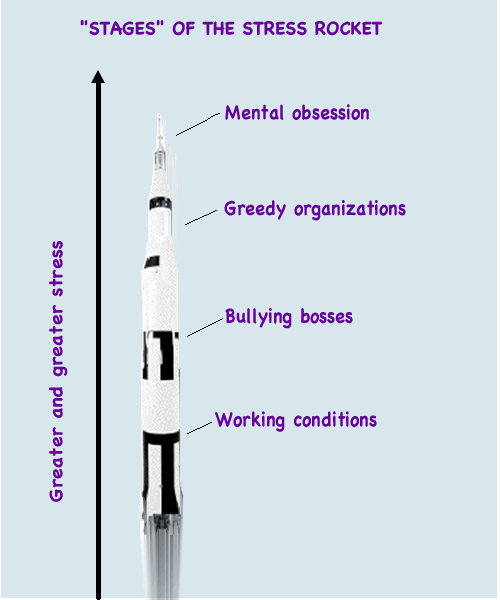
Stress and burnout can result from internal causes as much as external ones. It’s tempting always to blame greedy corporations and macho managers for the uncivilized and noxious state of our workplaces. They’re definitely guilty, but they aren’t the only ones to blame. All too often, people do it to themselves.

So what are your hooks? If you know, and are willing to share them, tell us. It might help others to avoid similar instant reactions and the problems that they cause.


Email Newsletter icon, E-mail Newsletter icon, Email List icon, E-mail List icon
Sign up for our Email Newsletter


Labels: , , ,

Add to Technorati Favorites Stumble Upon Toolbar

Tuesday, July 10, 2007

Stress-busting ideas: The one-minute check-in

Many people find that they have reached a serious state of stress before they even notice that anything is happening. On the basis that prevention is better than cure, here’s an idea to help you stay aware of what is going on and take action well before anything unpleasant happens.
Stress, overwhelm, anxiety, obsession: all of these creep up on you. They don’t arrive in an obvious way. One moment all is well, more or less. You probably know that you’re pushing yourself a little too hard, but it’s not something that you can’t cope with. Then you go one step too far. What was normal concern becomes anxiety; what was just a little extra effort becomes more than you can handle safely without doing yourself any harm.

It’s the same with extra working hours. You can handle them at first. Maybe it’s only only a temporary effort to deal with a crisis. Then, gradually but inexorably, working 9, 10, 12, 14 hours a day becomes normal for you. You don’t notice the effect until it’s way too late.

The one-minute check-in is a simple and practical way to get a handle on what’s happening. Here’s what you do:
  1. At regular intervals throughout the day, you stop for 60 seconds to bring your attention back to yourself.

  2. Each time, you ask what you are doing, how you feel, and —most important of all—what your patterns of work are. How long are you going without a break? How early did you start and what time is it now? How tired are you?

  3. You don’t cheat yourself. You make it a genuine inquiry into what is happening. No quick, superficial, comforting responses are accepted. That’s why it takes 60 seconds: 30 seconds to give yourself the edited version, then 30 more to get at the truth.

  4. Ask yourself where you are and what you’re doing. How long you’ve been doing it. How long until you can take a meaningful break or stop altogether. How you feel physically and mentally. What’s happening inside you—and where, if anywhere, it hurts.

  5. Don’t prejudge. Don’t make assumptions. Check yourself out carefully and notice what is going on. The purpose of the one-minute check-in is to allow yourself to be aware of your own functioning on a regular basis.

  6. Finally, act on what you find. If all is well, press on until your next one-minute check-in, say in an hour or two. If you need a break, take one. If you recognize that you’re long past being effective and only your stubbornness and anxiety are keeping you in place, pack up and go home right away.
Many of the stress-based problems people cause themselves are overlooked; dismissed as nothing to be concerned about. People take almost no vacation time and expect to be able to go on functioning at peak ability just the same. They skimp on sleep and imagine they are still fully alert. They drive themselves through a physically crippling schedule and imagine they’re tough enough to suffer no ill effects. Until pain or disaster strikes.

By checking in regularly, you can avoid all of this and stay on the right side of your personal limits. It will cost you perhaps 5 minutes a day to do it. It might save your health, your relationships, your career—and potentially your life.


Email Newsletter icon, E-mail Newsletter icon, Email List icon, E-mail List icon
Sign up for our Email Newsletter


Labels: , , ,

Add to Technorati Favorites Stumble Upon Toolbar

Monday, July 09, 2007

The 11 best ways to handle workplace stress you can’t avoid

Sometimes you can’t simply avoid stress or make it go away. How can you handle it when there’s no other alternative?

I often write on this web site about ways to avoid workplace stress or stop it happening in the first place. That’s obviously the best course of action, but this isn’t a world where you can always find the ideal situation, however hard you try. You need options to help you when stress cannot be avoided. Here are some suggestions.
What can you do when you can’t avoid a stressful situation or escape from one that has already grabbed you? Is the only course to try to tough it out?

I don’t think so. Here are some other approaches that you can try when prevention or avoidance aren’t available.
  1. Never neglect the obvious. Nothing will elude your attention as consistently as whatever you take for granted. Before you give up, or try some exotic remedy, try considering whether there are some totally obvious aspects of the situation or your working habits that are producing some of the stress. Perfectionism is a common one. Another is neglecting your physical needs for periods of rest, What are the most obvious (and therefore most neglected) actions you could take to improve your situation? Close your eyes and take a break from the world. Get up every 45 minutes for a brisk walk, even if it’s only around the office. Stop going over and over the same thoughts and simply move on.

  2. What ways of coping are hidden by convention or supposedly obvious “truths?” What aren’t you seeing because someone told you in the past that it won’t work, or wouldn’t be allowed? Are you maybe contributing to your own stress by following conventional working patterns, when the situation needs an unconventional style? What are you assuming won’t help, without even trying it?

  3. Which of your unconscious habits might be part of the problem? Worrying is a mental habit that can pile on the pressure. So is feeling guilty for feeling stress at all. How you work may also be part of the difficulty. Perhaps you always work directly on your computer, when some time making hand-written notes might help to break up the monotony and give your eyes a rest. We all become so used to our habitual way of doing something that we can’t even conceive of handling it differently. Try. It may feel odd and uncomfortable at first, but it might produce ways that can lessen the pressure.

  4. What distractions can you remove? Turn off the e-mail notifier. Close down IM. Decide not to answer phone calls for the next hour. Find somewhere to work away from your desk, where casual callers won’t find you. Distractions are terrible thieves of time and ruin your productivity. If you’re under pressure, especially time pressure, constant distractions will raise your blood pressure quicker than almost anything else.

  5. Slow down. Yes, I know that seems like the last thing that will help, but if that’s what you think, you’re wrong. Pressure tends to make you speed up, try to cut corners, jump to quick conclusions and snap judgments, go faster and faster. All of these increase the rate of mistakes and the need for re-working. Then that makes you feel even more stressed, so you speed up some more. It’s a vicious cycle that continually adds to the pressure. So slow down. It may feel counterintuitive, but it’s often the best way to save time overall.

  6. Don’t assume that you don’t already have the answer. Often the best way to produce a mental breakthrough—the kind that lets you jump right to a solution, without needing to spend half the time you thought it would require—is to take all the bits and pieces of ideas and thoughts you have already and play around with them. Shift them into new patterns. Try fitting pieces together that don’t seem to belong. You’ll be amazed at what will pop out. Best of all, since all the pieces are familiar to you, it may not take much time to craft the new combination into a workable solution.

  7. Eat regularly, but lightly. Drink often, avoiding alcohol or caffeine. This is simply commonsense. You’ll need energy to cope with the stress, so that means sufficient food. But not too much at a time, or you’ll start to feel sleepy and sluggish, which is the last thing that you need. Caffeine in large doses will keep you awake but send your mind buzzing like a hamster on a wheel. Alcohol will numb your brain.

  8. Move around as often as you can. Our brains and bodies are linked. If your body is stiff and cramped, your back aches from hunching over your work or sitting in a bad chair, your head aches from poor lighting or just the continual tension, and you feel lousy, you aren’t going to be able to produce your best work—and now, when the pressure is on, is when you need that most. Movement is good for you. Use it to help lessen your physical and mental tiredness.

  9. Get a regular change of scene. It’s easy for some place to become so associated in your mind with the pressure that you start to feel stressed and anxious just by going there. A change of scene can refresh your mind and help you lighten up. Anxiety makes you grim, and grim isn’t going to help you.

  10. Get as much sleep as you can. Anxious people often tell themselves that they won’t be able to sleep, so they stay up late working. But almost any sleep is going to help and it’s easy to over-estimate how long you’ve been lying awake in the dark. It may feel like hours, but it could be just a few minutes, while the rest of the time you were sleeping. It’s worth a try anyway. Depriving yourself of sleep is going to make the pressure worse. And, since one of the keys to getting to sleep is sticking to regular habits, make sure you go to bed at your usual time. Burning the midnight oil is best avoided if at all possible.

  11. Know when you’ve had enough. Sometimes, the only sane thing to do is give up and get some rest. Do it. Don’t kid yourself that you can keep going when all the others have given in. Knowing your own limits is the best way to preserve your health and avoid making mistakes you’ll regret bitterly. Whatever anyone else says, when it’s time to quit, just do it.


Email Newsletter icon, E-mail Newsletter icon, Email List icon, E-mail List icon
Sign up for our Email Newsletter


Labels: , , , ,

Add to Technorati Favorites Stumble Upon Toolbar

Friday, July 06, 2007

Learning the art of pure selfishness

Why time spent on office politics is time wasted . . . yet often essential for survival.

People are political and emotional creatures. We like to believe we use reason to work out what to do, but this is an illusion. A far more general tendency is to make a decision largely on the basis of politics or emotions, then use reason afterwards to justify what we have already decided. Here’s how it works and why it may increase your stress.
It’s half an hour before official closing time on a Friday, after a hectic week. A customer calls with a complicated, urgent request that will take at least three to four hours to handle. Do you put it off until Monday, even though the customer is desperate for a resolution? Or do you deal with it right away?

Someone who is angry, frustrated, or just feeling low will be most likely to shelve the whole problem until Monday, arguing it is the customer’s fault for waiting until the last minute, or claiming the work will be better when he or she is fresh on Monday. An employee who fears the customer, or the boss’s reaction if the customer complains, will likely deal with the problem right away, but rush through it as fast as possible, even if that means a skimped job. Someone who hopes to make a big new sale to that customer, or is keen to make a good impression on the boss, may stay late to get the job done, or even come in on the weekend to make sure the work is done properly.

In most cases, this kind of decision will be made on a political basis. What will be the political impact of staying late and helping the customer right away? Will it win you “brownie points” in the eyes of some powerful executives (so long as you make absolutely sure they know about it)? Will it be one in the eye for some rival, who has designs on a sale to that customer that you might get instead, if you make the customer happy with you? Can you make it into an obligation the customer will understand they need to repay some time?

Whenever people are faced with a decision without clear guidance, especially in a culture where getting it wrong is likely to lead to nasty personal consequences, they tend to think about what others will make of whatever they decide—powerful others mostly. Will they approve or criticize? Will you trespass on (or be in a position to take over) part of someone else’s turf? How much freedom do you have to make the decision without consultation? Will it be seen as a favor that can be called in later? How else can you use it to your personal, selfish advantage?

All this adds to whatever thinking is needed by the job itself. None of it is going to improve the decision, the way that the job is done, or the result either. It’s a source only of extra, unnecessary concern and worry. It adds to whatever stress comes from the work itself or the deadlines to be met. It even causes additional work. If you decided what to do rationally and simply did it, then moved on to the next task, life would be simpler and less likely to cause you anxiety. But rationality is no protection from office politics, which are neither rational nor concerned with the success of the business. Office politics are about power, pure and simple—and strictly personal power at that.

The basic causes of office politics.

Fear is one of the commonest workplace emotions today. The greater the level of fear in the culture—fear of losing your job, fear of losing your status, fear of being marked down as a troublemaker—the greater the need to worry about the outcome of whatever you do and seek some kind of reassurance or safety. Office politics seems to be able to help. By consulting someone who has influence, seeking protection, or avoiding anything that might upset a powerful person, you can gain a measure of safety and reassurance.

Turn this around, make yourself the person with power instead of the one who’s afraid, and you have another reason to waste time and effort in politicking (In strict efficiency terms, of course, it is clearly wasted). Patronage, the power of advancing friends and protecting them from harm, is the main benefit of becoming politically influential. People who aspire to political power are keen to find ways to use and extend their patronage, usually by offering protection and support to their friends when difficult decisions are to be faced. Conversely, making sure that people are clearly seen to have failed is an obvious way to destroy your rivals and lessen their power.

That’s why office politics play a significant role in many decisions. Each offers scope for extending patronage (adding more grateful people to your circle of dependents), lessening the influence of your competitors, and making you look good in the eyes of people with more power than you have at present.

In none of these cases does the politics assist in productivity, raise profits, add value to the customer, or provide anything else positive. What it does do is help people cope with negative situations due to uncivilized workplaces dominated by macho, power-crazed people. That’s why the most pervasive politics are found in macho corporate cultures, or those where fear has become a way of life.

So long as fear exists, there’s no practical way around this.

All of office politics depends on these three motives: to add to your power of patronage and lessen the standing of your rivals for power; to buy you protection from someone more powerful than you are; or to advance your merit in the eyes of people with greater power. None of these motives is to the benefit of the customer, the organization, or anyone beside yourself. Any loss from a political maneuver is always designed to fall to some real or imagined enemy.

How many talented people are held back, prevented from making a full contribution, or persuaded to leave (or even fired) because of purely political choices by someone? How many wrong decisions are made because they offer personal advantage to powerful people? How much time and money is wasted in activities with no rationale beyond providing an opportunity for playing politics?

All office politics is ultimately stressful and harmful. It is the art of pure selfishness made to look rational. Any organization where it thrives is less a group engaged in a collective enterprise and more a warring, competing, back-stabbing collection of individuals trying to advance themselves at the expense of all the rest. If that’s the culture, standing aside is no real option, since it virtually guarantees that you will be either marginalized, humiliated, or ejected.

That’s the reality of many organizations today, I guess. They complain about shortages of talent, yet frequently act in ways that ensure many of the best people will leave. They cut jobs and slash vital projects to save money, yet allow cultures to grow that waste huge amounts of time and money on political activities. Instead of making sure the best people get to the top, they tolerate systems that reward those who are most politically active and successful, regardless of any other ability.

I am well aware that this is very unlikely to change. Those in power always want to preserve the status quo, since it is their status quo and they are the ones who benefit from it most. Nevertheless, it’s sometimes worth reminding people of what is being tolerated in the name of expediency. A very large proportion of those who leave corporate jobs to set up their own businesses do so to escape the constant politicking. Insofar as that adds to the variety and creativity of the economy, and creates new endeavors, perhaps some benefit is ultimately there after all.


Email Newsletter icon, E-mail Newsletter icon, Email List icon, E-mail List icon
Sign up for our Email Newsletter


Labels: , , , , ,

Add to Technorati Favorites Stumble Upon Toolbar

Thursday, July 05, 2007

Stress-busters: How to worry less and live more

Today’s world creates anxiety like never before. It’s time to fight back.

I have to start this article with a confession. For most of my life, I have been a world champion worrier. I was able to worry about almost anything. And, if I didn’t have anything specific to worry about, I would worry that I must have missed what I ought to be fretting over. The workplace, of course, provides an endless menu of possible sources of worry, which is why it’s often so stressful. Anxiety produces stress and stress produces anxiety. They feed off each other, making a perpetual motion machine of worrying. If anything good can come out of all that anxiety, it might be this: my experience-based ideas on how and why to quit worrying so much.
Most worriers believe that they either must worry (they have genuine reasons to do so), or that they cannot stop themselves, even if they see it doesn’t make sense. Let’s begin with understanding the causes of worry and whether it might be of some use. Until you are convinced that worrying is of no benefit to you, you won’t give it up anyway.
  • Worrying is a form of superstition. A great deal of worrying is driven by the unstated fear that, if you don’t worry about some issue, you’ll somehow be punished for your slipshod attitude; that some universal force will spot your dereliction of worrying duty and bring you back into line by making all the bad things happen. Of course, once you recognize that this kind of crazy, childish behavior lies behind much of the anxiety you’re plaguing yourself with, it’s tough to go on doing it without laughing.

  • Worrying is totally useless as a way to solve whatever the problem is. As Chicago Tribune columnist Mary Schmich once said (not Kurt Vonnegut as I was told originally): “ . . . worrying is as effective as trying to solve an algebra equation by chewing bubble gum. The real troubles in your life are apt to be things that never crossed your worried mind, the kind that blindside you at 4 pm on some idle Tuesday.”

  • Worrying takes a heap of energy. Despite being useless in any practical sense, worrying absorbs a great deal of mental and even physical energy. After a day spent worrying, you will be as tired as if you had tried to calculate the value of pi to 300 decimal places while running a marathon. And you will still have achieved nothing.

  • Worrying is amazingly distracting. While you are worrying, your mind cannot settle on anything else. The worrying constantly gets in the way of whatever you try to do. People tell you things—sometimes important things. You don’t hear them or you forget them within seconds, because your mind is totally taken up with that wretched source of anxiety.
If you’re now convinced that worrying offers no benefits and considerable drawbacks, let’s consider some ways to give it up.
  • Don’t accept that you are helpless. I won’t say it will be easy to give it up, but worrying is just a habit. Perhaps it would be better to call it an addiction. Like all addictions, it’s going to be tough to quit, but you can do it. There will likely be some “cold turkey” to get through, but just think about all that extra energy and enjoyment of life that you’ll have once you’re no longer a slave to continual anxieties.

  • Practice letting go. Worrying is all about control. People worry because something is threatening to happen that they don’t like. If they can do something to stop it happening they will. There’s no cause to worry then, it’s over. But, in all too many cases, we aren’t able to stop whatever it is threatening us: we aren’t able to be in control. So we worry instead. It’s a form of quasi-control. By worrying about whatever it is, we imagine all the ways we would control it, if only we could. The more you are able to accept things the way they are, the less you will worry. No one ever worried about anything they simply accepted. And accepting whatever it is will probably be the best way to start responding to it positively as well, so you’ll get a double benefit.

  • Most worries are totally imaginary. We can all imagine truly terrible outcomes. They rarely happen. One way to curb your worries is to sit down and deliberately imagine the very worst that your mind can come up with. Two things will likely result: you’ll realize how ridiculous the whole thing is; and everything else will seem pretty tame by comparison.

  • Worries don’t exist. So you don’t need to waste time over them. It’s obvious. If a problem exists, it isn’t a worry, it’s a fact. You have to cope with it some way and that becomes an exercise in problem-solving, not worrying. Worries are always about what may happen, but hasn’t yet. Therefore, they don’t exist. When, and if, they do, they’ll be problems to be solved. Until then, they are nothing but rogue neurons in your brain.

  • Try planning instead. Planning is considering what might reasonably happen and getting yourself ready. It’s practical and useful. Even if events don’t work out that way, you will probably have learned something useful in the process. Worrying is imagining what will almost certainly never happen, and then imagining how you would fail to deal with that imaginary outcome.

  • Never feel guilty about not worrying. Not only is guilt a totally useless and entirely negative emotion, but you have nothing whatever to feel guilty about. To feel guilty about not worrying is like berating yourself for not thinking about ten yellow goldfishes balancing on the nose of an alligator. Both are simply thoughts, and ridiculous ones too. Why should you feel guilty about not thinking them?

  • Don’t think too much about what other people have achieved. It will only make you feel dissatisfied and start you worrying again. At least 50% of the good things that happen to people is pure chance; the rest is a mixture of solid effort and unexpectedly good outcomes from what began as mistakes. Do what you do and be happy.

  • If you start to take yourself seriously, take two aspirin and lie down in a darkened room until the fit passes. What do you know about yourself for certain? Most of your ideas don’t work, most of your hopes and plans fail, most of your triumphs were luck, and most of your choices were either made for you by others or happened by default. And you take a person like that seriously? All that stuff is just to impress other people, right? There was an old saying that went: “No one is a hero to his valet.” Hardly anyone has a valet nowadays, but you get my drift.


Email Newsletter icon, E-mail Newsletter icon, Email List icon, E-mail List icon
Sign up for our Email Newsletter


Labels: , , ,

Add to Technorati Favorites Stumble Upon Toolbar

Monday, June 25, 2007

How to work less and accomplish more

A simple way to increase your productivity without spending another minute working

There’s an easy way to get more done in the same total time. It doesn’t require fancy software, special organizational tools, or even understanding anything new. All it takes is to slow down and understand the realities of how you spend your time; then apply what you will learn.
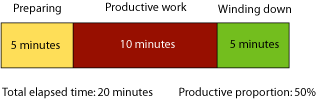
Let’s begin with a simple picture of spending 20 minutes working on a single task. It will take you a little while to get into the work, say 5 minutes. That’s for getting things together, settling down, and starting your mind working in the right direction. Before you leave the task, you’ll need maybe another 5 minutes to wind down, put things away, tidy up, and shift your thoughts to what you’ll need to be doing next.

Simple arithmetic shows that, of the 20 minutes total time elapsed, 10 minutes in total was available for productive work, with two sets of 5 minutes allowed for starting up and winding down. That gives a productivity ratio (productive to non-productive time) of exactly 50%. It look like this:


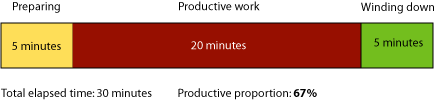
However, if you increase the total period of uninterrupted, focused time on that task to 30 minutes, your productivity ratio immediately increases to 67%, since it takes no more time to start up and wind down. You now have 20 minutes of fully productive time out of 30 minutes total time elapsed, like this:


If you can increase the uninterrupted time to 40 minutes (and the task will take at least that long to complete), your productivity ratio will rise to 75%. With one hour spent like this, productivity rises to 83%. And if you could set aside two hours free from interruption, your productivity ratio would be 92%.

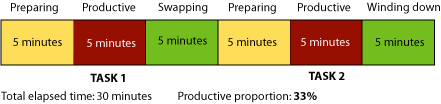
Now see what happens if you have uninterrupted time, as before, but decide to multi-task: that curse of much management thinking. We’ll go back to a period of 30 minutes in total, since that makes a chart that will fit on this page, and assume only two tasks for the sake of simplicity.

Because research has shown that it takes time to swap between tasks—the human brain can’t just jump fully-effective from one to the other—and you still have to allow start up time and wind down at the end, your total effective working time is sharply reduced. You still spent exactly 30 minutes, split between the two tasks, but your productivity ratio has fallen to 33% from the 50% in the first case in this article.


Being interrupted is the very worst thief of productivity, as this chart shows. With no multi-tasking and only two interruptions, 40 minutes being “busy” gives only 10 minutes of truly productive time: a productivity ratio of only 25%. Imagine how low that ratio will fall with more interruptions and a vain attempt at multi=tasking as well. Is it any wonder that people reach the end of a hectic day and cannot see any results for all that effort?


The lesson is simply this. To get the most done in the least time, focus on only one task, remove all possible interruptions, and never multi-task. And try to allocate as long a period to the task as you can, before you have to stop or change to something else. The longer the focused period, the higher the productive ratio of useful time to time spent in starting up, winding down, and the like. That’s why “chunking” time, thought much better than multi-tasking, still isn’t much of a help unless the “chunks” are good, big ones.


Email Newsletter icon, E-mail Newsletter icon, Email List icon, E-mail List icon
Sign up for our Email Newsletter


Labels: , , , ,

Add to Technorati Favorites Stumble Upon Toolbar

Friday, June 22, 2007

Why changing your self-talk could lower your stress

Cutting your stress level and increasing your pleasure in life and work could require little more than shutting your mental “ears” to phantom voices from your past.

Most of us, at one time or another, hear that depressing whine inside our heads that tells us nothing we do is ever good enough, successful enough, or creative enough to be of any real account; that we’ll never amount to anything and other people are probably sniggering at our feeble efforts anyway. This kind of self-talk is responsible for many people simply giving up and settling for mediocrity. Yet all that your mind is doing is trying to help you avoid future pain by scaring you away from taking risks. It’s time to ignore such tainted advice and forget the past upsets that caused the whining to start in the first place.
People who give advice on personal development or coping with workplace problems usually concentrate on what you might do to make things better. Recently, I came across an article on a British web site that takes a different tack. It looks at how you might need to think differently too: specifically, what beliefs you could have picked up in the past which are now holding you back.

The article is titled: “10 beliefs that could hold you back in life.“

Beliefs are tricky things. We often use the word to describe a fundamental outlook on the world, like a religious, ethical, or philosophical belief. That’s not what this is about, though some of these outlooks come complete with a set of supporting beliefs that apply to many other aspects of life. The type of belief that can raise your stress levels, block your career, and produce misery and frustration is the untested, unchallenged assumption about yourself that goes like this: “I’m a failure. I’ve always been a failure. I’ll never amount to anything. People just laugh at me when I try to do any better. I might as well accept it and give up.”

Understanding the self-talk monster

One useful way of thinking about this type of belief is to recognize it as merely negative self-talk: the monologue that plays continually inside your head, criticizing everything you do and dismissing your results as never good enough to help. Some people label it the Inner Critic, but I think that sounds too much like a theater reviewer or a grouchy panelist on American Idol. It also implies that this voice comes from something separate from you, whereas it’s nothing more than the output from a habitual set of beliefs and assumptions that you’ve picked up at various places and times along life’s path.

Self-talk is based on recollections of hurtful and negative things that others said to you—and that somehow were close enough to your own fears and misgivings to be taken up by your mind and treated as . . . well, not quite true, but near enough to one possible truth to be scary. Now your mind uses them as a means to prevent you from running into more hurt. In its own twisted way, this self-talk is trying to protect you from future pain. That’s why it grabs your attention, just as a reflex to jump back from a snake might do.

The easiest way to understand how to move away from this thought pattern is through an example.

Success has always been desirable, but in today’s world it can seem like the only thing that matters. Yet everyone is fallible, so we all make mistakes and feel bad as a result. In your pain at a poor outcome, you’re very likely to be rather sensitive to negative comments from others. A sly look, a half-suppressed giggle, an overheard comment can all convince you that the mere fact of failing has made you into a failure. That really hurts, so your mind decides to save you from more pain by accepting that label. After all, if you’re a failure, no one will have any future expectations of you, so it will be impossible to fail again.

With this belief in place, appropriately negative self-talk kicks into gear. As soon as you seem to be in danger of trying something difficult, you mind starts warning you off. Of course, you’ll fail again sometime—everyone does, without exception—so the mind takes this as confirmation that trying anything new and risky is simply going to result in more pain. The belief has been reinforced and the self-talk steps up to a higher gear as a result.

A protective response?

There are many, many variations on this “protective” response. You might tell yourself that you’re too stupid to be able to grasp anything tough; or too awkward ever to make friends; or too cowardly to be able to face down some bully in the workplace. Others include: “I’m too old to learn new tricks;” “I’m a nobody, so no one will listen to my ideas;” “It’s too risky to change;” “There’s nothing I can do to change anything;” and “Nobody would believe me if I told them.”

As a protective strategy, all this negative self-talk sucks. It may appear to save you from more hurt, but it does nothing to change the situation you’re already in. In essence, it says: “Stand still right here. I know it hurts—badly—but moving could make it hurt even worse.” So nothing changes for the better, and now you’re as frustrated as all Hell too.

The only answer to negative self-talk is to ignore it. Don’t argue with yourself, because what the self-talk says is, quite truthfully, based on certain facts from your past. But that’s just it; they are past. Over. Gone. Of no further account. No longer relevant.

How to fight back

Failing doesn’t make you a failure, because everyone fails at one time or another. Not instantly understanding something complicated doesn’t make you stupid; even the greatest genius has to find his or her way through hundreds of things not immediately understood on the way to some creative insight. No one is ever too old to learn. All these claims by your self-talk are complete garbage. They’re monsters made from smoke and mirrors to frighten you out of putting yourself at risk. Push ahead and they’ll disappear.

I suspect that the majority of stress people feel in difficult and negative workplace situations is self-inflicted. It’s not that the situation isn’t bad. It is, but listening to continual negative self-talk makes it many times worse and raises stress to unnecessary levels.

Like all techniques to lower stress, ignoring negative self-talk isn’t free or easy. It takes effort and it takes time. But the simple truth is that anyone can do it, and the results are more likely to add to your well-being and happiness than just about anything else. That alone should be sufficient incentive to start. And before your self-talk gets to you . . . no, it isn’t going to be a waste of time or another self-help fad that you’ll soon forget. It’s going to change your life.


Email Newsletter icon, E-mail Newsletter icon, Email List icon, E-mail List icon
Sign up for our Email Newsletter


Labels: , , ,

Add to Technorati Favorites Stumble Upon Toolbar

Thursday, June 21, 2007

Should you learn not to care — or just not to care so much?

Is being emotional the same as being passionate? Should you allow the jerks and weasels out there to keep on stressing you out?

I’ve been moved to write this piece after being soundly abused—with ample use of obscenities and expletives—by one or two people because I wrote in an article elsewhere: “Stop paying so much attention to how you feel. No one can control their emotions, good or bad. If you spend your attention on how you feel, you’ll be in a constant state of anxiety. If you feel good, you’ll start worrying about how to keep that feeling. If you feel bad, you’ll fret over how to feel better. You feel whatever you feel. Get over it. Just go on doing what you need to do, regardless of your emotions.” The abusers started me wondering why such simple words made them so angry. This article is the result.
I have two principal aims with this blog: to help people to overcome the problems of stress and anxiety caused by modern working practices, and to try to look as objectively and honestly as possible at some of the situations that lead to most upset and frustration.

Should you try to check your emotions?

In various postings, here and as a guest blogger elsewhere (like this recent post at Lifehack.org), I have tried to consider calmly the emotions raised by the difficulties and annoyances most people face in a typical working week. In essence, what I have seen is that allowing your emotions to run unchecked can add to your upset.

I don’t criticize anyone for what they feel. That would be silly, since none of us can stop our emotions from being aroused any more that we can stop ourselves from thinking by an effort of willpower. Nor do I suggest that there is anything “bad” about emotions. They are a natural part of being human, as is the capacity for rational thought. It's just that allowing negative emotions to take complete charge is likely to hurt you more than it does anyone else—which seems a poor strategy.

My suggestion has always been the same: that you can lessen your stress and frustration by simply getting on with things and letting time pass, so that you can stand back and look at the situation more objectively; and that to do so stops you from adding further fuel to already inflamed and stressful feelings.

It’s not a new idea either. The Buddha suggested it more than 2000 years ago. Whether you call it objectivity, detachment, or keeping things in perspective, it comes to much the same thing. It means accepting your emotions as natural, but refraining if you can from whipping them up into greater turmoil. Once you have allowed them to subside a little, you may see things differently. That is why it can be worth trying to put off saying or doing anything too drastic at a time when you’re likely not thinking as clearly as you could.

I find it incomprehensible, therefore, that whenever I have suggested this it results in abusive, often foul-mouthed, expletive-filled comments from people clearly in the grip of turbulent emotions.

Detachment, not disdain

I may be wrong in what I say (I don’t think so, but anyone has a right to differ with me on that), but I cannot understand why articles containing this set of ideas should provoke such a violent reaction. That’s why I was cheered to read a piece by Bob Sutton for HuffingtonPost.com called: “The Virtues of Emotional Detachment.” In it, he goes a little further than I do, saying:
I have argued for years that learning when not [to] care, what not [to] care about, and how to not care is just as important to career success and personal well-being as being passionate. I especially think that it is an essential skill for people who are trapped in asshole-infested workplaces and can’t get out — at least for now.
It’s interesting that Tom Peters takes quite violent exception to what Bob has written on this topic, quoting George Bernard Shaw to support his case:
“The reasonable man adapts himself to the world. The unreasonable one persists in trying to adapt the world to himself. Therefore, all progress depends upon the unreasonable man.”—George Bernard Shaw, Man and Superman: The Revolutionists’ Handbook.
I’m far from sure that Tom Peters and Bob Sutton are talking about the same thing. What I hear Tom Peters supporting is being passionate about what you believe. What I hear Bob Sutton saying is that you shouldn’t let the weasels get you down. Not the same thing at all. (It’s also worth pointing out, gently, that George Bernard Shaw, like many of us born and raised in the British Isles, was certainly not a person who wore his heart on his sleeve. What he was protesting about in this quotation was pragmatism: the tendency to “go with the flow” and compromise your principles away for the purpose of fitting in. He was not trying to promote being emotional, or even passionate. It can be misleading to take quotations out of context.)

Bob points to an exceptionally interesting post on Kitetail called:”Effective Strategies For Surviving Culture Tax"—“culture tax” being a way of describing “dealing with organizational cultures where the process of getting things done is draining and demotivating.“ In that piece, the author seems to me to sum up pretty well the case for lessening stress by trying to maintain some emotional detachment from the bad things of working life:
Once you recognize and accept the negative styles of the people you are working with, you are no longer the victim. With that, you can focus and direct your energy on how to effectively achieve your goal. [ . . .] I recommend practicing the Zen discipline of emotional detachment. Unfortunately, this is often misinterpreted as not caring and being disengaged. However, emotional detachment merely directs you not to be attached to an outcome or to an expectation. This practice will help you objectively evaluate the situation and recognize new opportunities as they arrive. After all, when one door closes another will open, but only if you are listening.

Caring . . . yet not hurting yourself

I suppose you might be able to so anesthetize your emotions that you no longer cared about anything much. Stress and burnout does that to some unfortunate people, whether they want it to happen or not. But I wouldn’t recommend it as a way of handling the frustrations, the anxieties, and the jerks in your workplace. It’s pretty much what is meant by the old saying about cutting off your nose to spite your face: doing yourself more damage as a human being through the “cure” than the disease did in the first place.

Despite Bob Sutton’s misgivings on the topic, I think that you can detach from a situation (in the Buddhist sense) and still care about it. You do it by looking at the situation as objectively as you can and reaching the best decision open to you about what action to take in the light of your overall goals. If passionate and deeply-felt involvement seems to you to be the best option to meet your objectives and make yourself feel good, go for it! If, however, you decide to “keep your powder dry” this time and be ready to fight another day, that’s fine too. And if, on mature reflection, you reach the decision that whatever it is isn’t worth your concern after all, why should that be somehow “wrong?”

“Attachment,” in the sense these authors are using it, means to cling to something—hope or hurt or expectation—long after reality has shown that it is hopeless to do so. It’s demanding that the universe reverse course to suit your requirements. That may be understandable, but it does cause a great deal of misery. What the Buddhists, as I understand them, suggest is that it’s better to avoid this: to “detach” and accept that the world is the way it is; then decide what to do next on that basis, as free from stress and emotional turmoil as any of us can ever be.

It’s possible I will be abused again for writing this. If that is in your mind, please stop for a moment and consider whether doing so is likely to change anything for the better. Disagree with me by all means, but don’t add to your stress or mine by getting so angry about it.


Email Newsletter icon, E-mail Newsletter icon, Email List icon, E-mail List icon
Sign up for our Email Newsletter


Labels: , ,

Add to Technorati Favorites Stumble Upon Toolbar