Monday, July 30, 2007

Getting comfortable with control

The secret of staying in charge and relaxed is knowing what is controllable

We live in a world obsessed with control: monitoring, measuring, assessing, rating, every kind of controlling. Whenever something goes wrong, we look for who is to blame; who should have been in control and stopped the problem before it developed—but didn’t. This is wholly unrealistic. It also contributes in a strongly negative way to the anxiety and stress that has become so common.
Trying to control the uncontrollable is a recipe for exhaustion and frustration. To be held responsible for what you cannot control induces anxiety and fear of unjust reprisals if it all goes wrong. The route to a better understanding of control begins with recognizing that there are three distinct facts that apply to whatever you are seeking to control:
  1. Some things cannot be controlled, whatever you do: the weather, other people’s thoughts, the results of most actions, external events.
  2. Some things can always be controlled: what you choose to say or do (with very limited exceptions), how you respond to your emotions and moods, what you believe.
  3. Many things that cannot be controlled directly, but can be influenced to a varying extent: public opinion, consumer behavior, other people’s actions, the effects of your actions.

The first group—the uncontrollable things—covers a great deal of what many of us are told that we must control. That’s why people get so stressed. You cannot, rationally, be held responsible for quarterly results, since they are not directly controllable by you . . . or anyone else. Part of the motivation for the scandals that erupt from time to time is people trying to to control the uncontrollable. If you can’t control results, maybe you can produce them by cheating or falsifying figures. All anyone can reasonably be held responsible for is making rational and sensible efforts to increase the likelihood of the desired results being obtained. Once that is done, the rest lies in the lap of chance.

Oddly, people treat the second group—things that are almost entirely controllable—as if they have little or no ability to control them at all.

They say they couldn’t help losing their temper (of course they could); they couldn’t stop themselves saying something hurtful (all it takes is not saying it); or they couldn’t seem to grasp what they needed to learn (which probably meant they failed to make the effort, or weren’t interested anyway).

None of this is true, yet we persist in excusing ourselves from responsibility in the one area where direct responsibility is possible: our own behavior. “I can’t help it!” people wail, when they certainly can. It may be tough or painful or unpleasant, but you are always responsible for 99% of your own actions. To pretend otherwise is to lie to yourself and to others.

Then there’s the category of what may be influenced, but not controlled. What are you responsible for there? Doing your best to influence things successfully, nothing more. You can influence customers to purchase, but you cannot make them do so by honest means. You can train, coach, support, and otherwise influence subordinates to do good work. You cannot force them to do so.

The limits of personal responsibility

It would greatly reduce stress, overwork, and macho management posturing if people recognized the limits of responsibility more clearly. It’s easy to toss slogans around and claim results are all that count and people must be judged by them. That doesn’t make it true . . . or even sensible.

Equally, to allow the notion that personal behavior is somehow outside people’s control is to open the door to an endless excuse for every kind of wrong-doing and laziness. Take the rubbish spread about motivation. No one needs to be “motivated” to take necessary action. You can do it, motivated or not. Nor can I motivate you or anyone else, since motivation is a feeling and other people’s feelings are firmly in the “uncontrollable” category.

The bad news is that a great deal of current management practice is deeply flawed because it assumes that people can—and must—control what cannot be controlled. You can measure, audit, analyze, rate, and chart it all you like, but you still can’t control outcomes, results, global trends, or market movements.

The good news is that no one needs to make their actions and behavior contingent on feeling inspired, motivated, happy, excited, or any other emotion. If you see a need for action and know what to do, you can simply do it. If speaking out seems right, then speak. If staying silent is correct and helpful, say nothing. It’s always your choice; always under your direct control.

Three steps to civilized attitudes on control

Work would be a far more pleasant and civilized place if we all followed three simple rules:
  1. Everyone must accept responsibility for his or her own speech and actions. No excuses.

  2. No one can be held accountable for results that are outside their control.

  3. Excellence is shown by controlling what can be controlled and skillfully influencing those areas where influence is possible.

That’s it. Follow those three steps and leaders would have to drop the macho nonsense of yelling for results at any price, and concentrate instead on skillful ways to draw the best from whoever works for them. Assholes and jerks would be held totally responsible for their noxious behavior, and no one would be allowed to wriggle out of personal responsibility by claiming that they “couldn’t help themselves” or “hadn’t been motivated.” Stress would be greatly reduced and no one would fear being criticised for what obviously was not their fault.

Not quite Nirvana, but a good step along the way there.


PLEASE NOTE: from August 1st, this blog will leave the Blogger platform and re-surface on Wordpress. I will leave all posts up to that point on Blogger, at the current URL.

New posts will be found from August 1st onwards at http://www.slowleadership.org/blog/



Email Newsletter icon, E-mail Newsletter icon, Email List icon, E-mail List icon
Sign up for our Email Newsletter


Labels: , ,

Add to Technorati Favorites Stumble Upon Toolbar

Friday, July 27, 2007

Whole Foods, but not the whole truth?

Why truth matters more in business life than many currently believe.

Truthfulness is often an early casualty in the path of macho management. Such “soft” virtues as honesty and truthfulness are treated with disdain by hamburger managers, obsessed as they are with getting results and winning by any and all available means. This is a bad mistake, and one that is nearly always punished in due course.
Here’s an interesting piece from yesterday’s Huffington Post on the topic of trust. The starting point is the case of the CEO of Whole Foods and his anonymous blogging that hyped his own business (and even praised his hair style) and knocked the competition.

A few short extracts will give you the flavor:
What signal does Mackey’s behavior send to Whole Foods executives and employees? That deception is practiced by their CEO and therefore an acceptable practice? What signal does this send to Whole Foods suppliers? That representations may not be what they seem?

Stephen M.R. Covey’s important recent book The Speed of Trust: The One Thing that Changes Everything, reminds us of the business case for being trustworthy and being seen as trustworthy. Character is first among equals in leadership requirements. Reputation takes years to build and seconds to destroy.

And Thomas Friedman’s excellent op-ed piece (“The Whole World Is Watching”) underscores a new fact of life these days: your behavior, words and deeds are part of a permanent record, enabled by the internet.
Hopefully, we are coming to an end of the tolerance given to unethical and unpleasant behavior by leaders, just as long as it “produces results.”

Of course businesses need results: their survival depends on them. But how those results are obtained isn’t irrelevant. Business is part of life and our society. It isn’t some separate sphere with its own rules and standards, independent of the demands of a free and civilized way of living.

People have always held their leaders accountable for their behavior—eventually. It may take a while. There’s often a period when leaders are given the benefit of the doubt; or when the novelty of an approach, or the presence of a fresh face, can obscure what is going on. Yet in the end, even the most ruthless and devious leader will make some error. At that point, all the envy and dislike that has been building up tends to come out and cause a violent delight in hastening their downfall.

Truth is too precious to ignore

Truth is the basis for all civilized societies. Without knowing, truthfully, what is happening, democracy is neither effective nor, ultimately, possible.
No one can be truly free if they are being kept in ignorance at the same time.

Truth is also essential to trust. Despite the faux-sophisticated sneers of macho managers and financial whiz-kids, all business depends utterly on trust. You have to believe that, in the vast majority of instances, people will honor contracts, deliver what they promised, and pay what has been agreed. Where there is no trust, every small thing has to be checked constantly; no one can be allowed to work without constant supervision; no message can be transmitted with being checked and re-checked every step of the way.

No truth = no trust = massive waste of resources

Can you imagine what all this would cost? How much every transaction would be slowed down by all the checking and auditing involved? How much time, energy, and money would go to waste on the conflicts, lawsuits, and bickering that would result? There is enough erosion of trust as it is to suggest just a tiny fraction of what would happen if trust broke down more significantly.

There used to be a time when society forced business leaders to practice greater honesty and trustworthiness. Sayings like “my word is my bond” summed up the prevailing notion that dishonesty and lying were not to be tolerated among those who controlled the business world.

Of course there were rogues too. There always have been. But they weren’t praised and excused in the way that they are today. Making money was more often seen as a slightly distasteful business: an activity that had to be conducted with one hand held over the nose. To be rich through business might well not win you respect in polite society. The only way to avoid the stigma of “trade” was to be known for your absolute probity—even if it cost you some of the potential profits.

This seems quaint today, when being rich can appear to absolve you from every character flaw and sin. In reality, that isn’t true. Lying, cheating, and betraying others to enrich yourself are still, I believe, intensely distasteful to most people. The public may be dazzled for a while by fame and glamor, but it always wears off.

For long-term success, the truth isn’t just something, it’s everything

From time to time, people ask me how they can choose the right path in life; how they can avoid stress and burnout; how they can be happy.

If I knew all those answers, I would be some kind of superman and I’m not. All I know are a few of the most important questions. And I know that telling and facing the truth is such an essential part of any answer to life’s problems that it’s hard to overestimate its importance.

If you don’t tell the truth, especially to yourself, you are living a lie and are so far off any sensible course that disaster seems inevitable. How can you find any answers to the problems of your life if you won’t be truthful about them, even to yourself? How can you get people to help you if you lie to them?

If you won’t face the truth, you’re a fool. You may be able to convince yourself of your deceptions and evasions. You may be able to convince other people too, at least for a time. But you can never, never, deceive reality. Try all you want, reality will proceed on the basis of a strict adherence to the facts. It will treat your fantasies with contempt and you with impersonal accuracy. All you will have done is compound any problems by closing your eyes and letting them come at you out of the dark.

Whether what the CEO of Whole Foods did was malicious or just foolish is almost beside the point. What really matters is that so many leaders believe that deceptive actions and suppression of the truth are acceptable. That’s the thing to worry about.

When our leaders become ethically blind, they ought to forfeit the right to lead. It’s up to all of us to enforce that law, before the universe enforces it for us.


Email Newsletter icon, E-mail Newsletter icon, Email List icon, E-mail List icon
Sign up for our Email Newsletter


Labels: , , ,

Add to Technorati Favorites Stumble Upon Toolbar

Monday, July 23, 2007

Debunking today’s mythology of leadership

Why future generations will smile at our foolishness.

Each generation sees the myths and beliefs of earlier generations as comic and childish. Today, we can’t see how the Ancient Greeks ever believed in such obviously human-like gods as Zeus or Apollo, with their feuds, love affairs, and petty jealousies. The beliefs of medieval alchemists seem amazingly silly. Victorian assumptions of the white man’s inherent superiority would be totally laughable, were it not for the sinister use made of them later—and the fact that some misguided people still hold to such nonsense even today.
What are today’s mythologies: the ones that our grandchildren’s grandchildren will smile over and dismiss as too laughable and primitive to be worth more than historical notice?

One that I would put into that category is our cult of the successful (or successfully self-promoting) business leader: the belief that those in charge of successful businesses are somehow endowed with rare wisdom and insight, far beyond the capabilities of ordinary people.

Isn’t it odd that, when things are going well, such people happily accept as much of the credit as possible; but when problems arise, they claim that it all happened without their knowledge?

How is it that organizations can spend millions on salary and share-options packages to attract and retain star executives; yet later accept their assurances that any scandals and ethical lapses were outside their control? Which position is correct: the leader as hero, single-handedly reversing the fortunes of some ailing business; or the leader as frail human being, doing his or her best in situations too complex for any one person to correct?

Let’s all agree that the hero leader is a myth, like tales of Sir Galahad or Robin Hood. Given the size of today’s large organizations, no single person can control more than a tiny fraction of their functioning, however long the hours that they work. It’s impossible for top executives even to know much of what is happening all the time, let alone control it.

Are CEOs mostly actors?

The majority of leaders spend more time in posturing, playing politics, and polishing their public images than in affecting the actual course of the business, which runs along quite smoothly without their input. Most of the time they are actors, speaking lines put into their mouths by speech-writers and PR people; putting their names to reports and documents that others have prepared for them; acting as the pubic face of whatever ruling clique is currently in charge of the running of the business.

Only occasionally are they called upon to make a real decision. That's how it seems, but even then, most of the decisions that bear their name are agreed quietly beforehand by those who are really in charge. That isn’t to say that the request made to a CEO—or even to the Board—doesn’t look like a decision. There are many techniques for presenting things in such a way that the decision you want is the only possible one for a committee, or an individual, to make. Indeed, no wise manager ever allows a matter to reach decision stage without being 100% certain that it will go the way he wants: the way he or she has slanted the presentation, adjusted the data, manipulated the figures, and chosen the “rival” options. The executives at the top can be relied upon to be so busy, so remote from any of the detail, and so eager to show their decisiveness that few, if any, ever question the information placed before them in any more than a superficial way.

Why the leadership cult?

Why do we have this cult of leadership? Why are scores of books published each year, thousands of training courses and seminars attended, and reams of newsprint devoted to this skill, this vague concept, this largely mythological entity known as leadership?

In part, I believe, because we all recognize, deep down, that we cannot control our organizations or our working lives. It’s this lack of real control that makes us so desperate to find something or someone that we just hope might improve our ability to influence events. We want to be in control; we think we ought to be in control—or we believe someone should be—and so we place that duty on someone and hope it might be true.

There’s also the human tendency to want a scapegoat when things go wrong. Whom can I blame? Whom, in the USA especially, can I sue? If someone is to be blamed, that person must have been in control—or ought to have been, if they were not. Look at how regularly CEOs are removed when things go wrong, even though they probably had little to do with it.

Our mythology of the hero-leader, working 70 hour weeks with his or her hands on all the levers of the organizational machine, is so much fanciful nonsense. Trying to achieve such a picture is killing people—quite literally. It’s all for nothing too.

So what should leaders do?

Truly successful leaders don't even try to control events. They recognize that the only way to direct a large group of people is through some ruling idea. That’s what they supply: a vision to believe in; a set of ideas to guide the thousands of individual decisions being made every day without any direct input from them.

“Without a vision, the people perish.” These biblical words sum it up. What we should be doing is seeking out leaders with imagination: people who can think and produce fresh visions for others to follow. Naturally, such people will need time and space to do their thinking. You can’t expect anyone to come up with strong strategic viewpoints if their days are filled with pointless meetings and administrative trivia. Nor if they’re exhausted by crippling work schedules and constant traveling.

Choosing leaders from those who get to the top by competitive guile and ruthlessness won’t work . That’s responsible for today’s cadre of self-promoting windbags in corporate boardrooms. Nor will the myth of leader as “man of action” serve our needs. Thought without action has long been the stock-in-trade of academic ivory towers, but action without thought—the hallmark of the current crop of macho managers—is far worse. Plenty of people can take action, but it requires someone (or some team) with real wisdom and insight to guide that action wisely.

Let’s drop the mythology, forget the Hollywood version of corporate leadership, and start allowing people of wisdom and understanding to fill top positions. Then give them the time to do what they are there for—think.


Email Newsletter icon, E-mail Newsletter icon, Email List icon, E-mail List icon
Sign up for our Email Newsletter


Labels: , ,

Add to Technorati Favorites Stumble Upon Toolbar

Friday, July 20, 2007

Making decisions . . . or telling stories?

Without sufficient time to think, people react by re-hashing the story of some past event.

Those who are too busy, too stressed, or too eager to jump into action are condemned to repeat the past with minor variations. Reaction replaces thought. That’s why so many needless mistakes are made and so many organizations today find themselves stuck in outdated patterns based on remembered glories.
What happens when you’re forced to make a decision almost in an instant? There’s obviously no time to weigh the options, consider fresh possibilities, or even analyze the circumstances in any depth. All that’s available are “gut feel” or memory. Both are based on “stories” you tell yourself about what to do.

These stories have become the automatic response of choice for tens of thousands of harried people every moment of every day: folk stories of management, tales of how others say that they coped, or the fading recollection of how they once coped themselves, sometime in the past.

It’s as if you were unexpectedly invited to tea at Buckingham Palace and based your behavior either on what your grandmother's friend used to say about good manners; your recollection of the Mad Hatter’s Tea Party in “Alice in Wonderland” (last read when you were six); or a particularly tense meal with an elderly relative that took place six years ago in Wisconsin. All of them probably make great stories—certainly “Alice in Wonderland” does—yet none is really a substitute for thought, research, or seeking advice on the topic of taking tea with the Queen of England.

I know this is an exaggerated example, but it’s here to make an important point. No matter how recent your past experience, or how seemingly useful some informative story you once heard or read, they cannot provide more than a general approximation to what might be needed in this situation, right now.

Principles versus rules

When you’re under pressure, your mind wants a quick answer. The greater the pressure, the more appealing an instant solution appears. Besides, there’s no time to trawl through a long list of half-recalled events or past topics. Instead, you jump for the first, most vivid tale that seems to fit.

What stories are best at doing is conveying general principles in a vivid way. A good story has power to communicate an idea far more effectively than a dry, analytical exposition. Events stick in your mind when they’re noteworthy or unusual. What is commonplace is quickly forgotten. What stories are not includes many things: a detailed explanation, a set of instructions, an analytical exploration of options, a careful review of the available evidence. For our purposes, the two most important are these: stories are not instructions and they are not rules.

Chained to the past

Sadly, that’s exactly how folk-stories, experience-stories, or example-stories are most often used: as a firm set of instructions on what to do when you’re faced with a decision and are too busy, too stressed, too exhausted, too confused, or too damn eager to take time to think carefully. Shooting from the hip has become the automatic choice for all too many leaders, especially in the USA; which is probably why they so often shoot themselves in the foot.

The past may, sometimes, offer guidance on how to deal with the future, but it’s never a foolproof guide. Something in the current situation is always unique. Some elements have changed since the last time. Parts will never have occurred before. Each repetition of past actions will be a little more “off” and liable to error, even if that story that you’re telling yourself ever really provided as good a solution as you think it did. There’s no good substitute for effective thought. It’s what distinguishes the human race from other creatures on this earth. Many animals have highly-tuned instincts, the ability to learn from experience, and senses that are far superior to ours. Yet only humans, so far as we now, can think in the way that we do.

Why throw that away to please those who treat you only as a means of getting the greatest number of tasks done, at the lowest possible cost, in the shortest possible time? You can be sure that any mistakes made will be counted against you; and all excuses will be summarily dismissed.

Instinctual reactions and experience-based ideas are extremely useful—but not in the way most people use them: as a quick solution to deal with an overloaded schedule. What they do best is help point your thinking in useful directions.

Self appointed experts know all the answers. True experts just know all the best questions.


Email Newsletter icon, E-mail Newsletter icon, Email List icon, E-mail List icon
Sign up for our Email Newsletter


Labels: , , ,

Add to Technorati Favorites Stumble Upon Toolbar

Wednesday, June 20, 2007

Interruptions and choice

Taking away people's freedom of choice through constant, compulsory interruptions is a poor strategy.


It’s the demands from others to meet their schedules that really messes up your day. And yes, sometimes you have no option save to go along. But what makes the most difference in the “frustration power” of these interruptions is denial of choice. If you can choose what to pay attention to and when to do it—focusing for as long as you need to and taking a break some other time to catch up on all the rest—most interruptions aren’t much of a problem. Unless, of course, your boss is a total jerk and wastes most of your time with pointless deamnds to pay attention to him.
We all know that continual distractions are bad for concentration and increase stress. What makes them even more frustrating is when you are denied the option to ignore them. When someone—the boss, an insensitive colleague, a boorish customer—grabs your attention and refuses to let go.

There is nothing worse than being deeply immersed in a piece of work—right in the “flow”—when somebody or something comes along and demands your attention—now!—completely distracting you. “This won’t take a moment,” they say. Of course, it takes far more than a moment. And by the time you get back to the piece of work that you were doing, you’ve lost your place, you’ve lost your flow, and it takes you maybe an hour or more to get back into the swing of things—if you ever do.

When someone’s days are so fragmented with meetings, e-mails, telephone calls, and other interruptions that they never have the time to get anything useful completed, it’s bound to cause them frustration and stress. It’s a rare person who doesn’t get angry. After all, you have your own work to do—important work that others will judge you on—and important work takes time and concentration.

If your time is broken up into little pieces and sandwiched between other activities, especially those that you cannot choose to reschedule or set aside, it’s made next to useless. It’s not just the total amount of time that matters (though that is important enough), it’s the amount of continuous, uninterrupted time that makes all the difference between feeling happy and satisfied with what you have done, and feeling frustrated, uncertain, and embarrassed over a job that you’ve thrown together in what few moments were left to you after everyone else had had their demands met.

Creativity is virtually impossible under such conditions. If you’re interrupted and distracted right at the moment when some truly important idea has just occurred to you, there’s the strong possibility that you will forget it well before you can write it down or capture the thought some other way. Research has proved that the single, most significant difference between people noted for their creativity and the rest of us is that the creative ones always note their ideas down straightaway . . . if they are allowed the time.

It’s hard to understand why organizations cannot see how counterproductive and morale-sapping it is to force people to work like this. Maybe it’s because of today’s unprecedented ease of communication that the expectation has grown that, because you can contact someone virtually instantly, they should deal with whatever you want instantly as well. No time for thought. No ability to set time aside, free of interruptions, to complete important tasks. No freedom to schedule their own work. And it’s bosses—the very ones who claim to be most concerned about driving up productivity—who are nearly always the very worst offenders, driving productivity down again and again by interrupting their subordinates or dragging them away to pointless meetings.

If you want an easy way to increase productivity for everyone, declare war on interruptions of every kind. Make it a capital offense to schedule more than one meeting during the day. Make sure no meeting lasts for a minute more than two hours. Urge everyone to establish set times for sending and reading e-mails. Ban lengthy circulation lists and outlaw the practice of cc-ing the whole organization on every e-mail. Then make it abundantly clear that anyone who sets aside important work simply to deal with an interruption (unless it’s a matter of life and death) is guilty of significant time wasting and will be dealt with accordingly. Most of the things that interrupt you at work are neither urgent nor important. They should be ignored. Most of the important ones are not urgent, so you should set them aside until a more convenient time. If you only do that, it will totally transform your day.

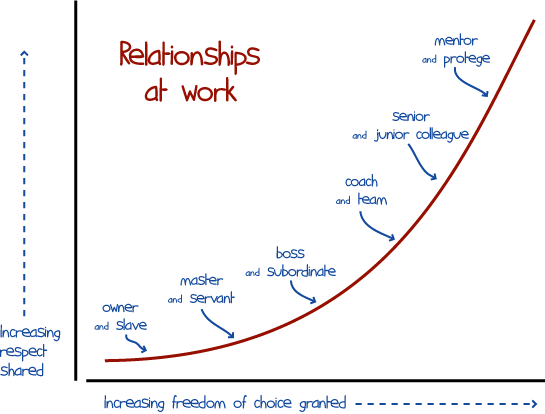
And, as the drawing at the head of this article shows, an essential element of being a free agent is the power to make your own choices most of the time. If that power of choice is denied, most people find it extremely stressful—likely intolerable for any long period. It reduces you to the status of a slave: a person of no account who must jump to deal with his or her master’s slightest whim. Being a wage slave is still being a slave. It diminishes you as a human being and destroys your dignity as a person with your own responsibilities and choices to make.

Your freedom to exercise the power of choice in scheduling your work, giving the most attention to what needs it most, is too important to lose. Demanding that others drop whatever they are doing to pay attention to you—even if you are the boss—is selfish, childish, and unprofessional. Those who do it merely show the world what jerks they are. Make sure that you are never one of them.


Email Newsletter icon, E-mail Newsletter icon, Email List icon, E-mail List icon
Sign up for our Email Newsletter


Labels: , , ,

Add to Technorati Favorites Stumble Upon Toolbar

Tuesday, June 19, 2007

Why slowing down is the best way to get there faster

It may seem counter-intuitive, but it works just about every time.

Going too fast denies you the opportunity to exercise life’s choices in a deliberate and conscious way. The result is a series of decisions made mostly by a mixture of short-cuts, snap choices, and rules of thumb. Bad decisions too, since there was no time to consider alternatives or delve into the detail. Like someone driving down an unfamiliar road, in the dark, and the rain, and without lights, the result is pretty predictable. Take your foot off the gas and try slowing down enough to think about where you’re going and what might lie ahead. You’ll likely get there faster . . . and in one piece too.
Rushing denies you the power of choice. When you’re going as fast as you can, there’s no time to think about options or consider alternatives. You have to make all decisions at high speed and that means relying on what you already know or what has worked in the past. It means using rules of thumb and quick-fixes. It means ignoring the subtleties and complexities of a situation, because you simply don’t have the time to take them into account.

Rushing also simplifies—but not in a positive way. It simplifies the way that looking at something as you drive past at 70 miles an hour simplifies it. You see that it’s a person, or an animal, or a vehicle, but there isn’t time for your mind to register any of the details. All you get is a quick impression. So that’s all you can work with.

For example, say that you want to improve customer relations. If you’re in a rush, there won’t be time to check through any of the data available in any depth. The best you’ll be able to do is to grab the headlines and work with those, likely missing some of what really matters. You make a snap choice and set off in broadly the right direction, but without sifting through the options for the best path to take. As a result, you run into problems—then assume you are headed in the wrong direction. So now you go off some other way and throw yourself totally off track.

One of the worst aspects of today’s macho management is that it encourages decision makers to operate with a minimum of input. Haste forces them to work with summaries and headlines prepared by others. They rarely have the chance to explore the options for themselves. Even choices that might involve massive costs and huge potential profits or losses are taken on the basis of headline figures summarized on a single sheet of paper or a few PowerPoint slides.

Why should this matter?

It matters because the power of choice is immensely powerful. In fact, it’s one of the most powerful tools that we have for changing ourselves and our world in positive (or negative) ways.

Every time you make a choice—even a simple one—you alter direction and put yourself on a new path towards encountering something you would not have met had your choice gone the other way.

Imagine trying to find your way to a set point in an unfamiliar city. Each choice—left turn, right turn, go straight ahead—sends you on a slightly different track. It might be the right one, or the wrong one, or one in between: neither right nor wrong in itself, but sending you towards your destination more or less directly. Every single choice has an effect. Individually, none is probably irreversible or bound to stop you from reaching where you want to go. But cumulatively, a series even of marginally poor choices will send you miles off course, while a series of sound choices will get you to your destination quickly and without stress.

That’s what I mean when I say that slowing down is the best way to go faster. By slowing down enough to make every choice a conscious and careful one, you avoid snap decisions that might take you miles out of your way.

The cost of speed

Our modern obsession with speed not only robs us of our choices. In many cases, we’re going so fast that we don’t even notice that they were choices to make until it’s too late. The choices were there though—and they were made, perhaps by default or even unconsciously. All because you failed to slow down enough to notice all those forks in the road and concealed turnings.

That’s what Hamburger Management does to you. It substitutes speed and thoughtlessness for choice. It bases decisions on slogans (Quicker! Cheaper! More! More!) instead of careful, rational analysis. Everything is short-term because, at that speed, trying to look ahead to the longer-term means you have to take your eyes of the road immediately ahead for a moment . . . so you smash into the car right in front of you.

Why are so many people so stressed? Because they’re being forced to go along at a pace that makes them feel permanently out of control. Just a little faster and they’ll be certain to crash. It’s enough to make anyone feel tense and afraid.

Don’t join in the mad rush to do everything faster and faster. That crowd’s composed mostly of lemmings—and we all know where they end up. By slowing down, you’ll be safer, waste less time on wrong turnings and the subsequent corrections, and lower your stress levels into the bargain.


Email Newsletter icon, E-mail Newsletter icon, Email List icon, E-mail List icon
Sign up for our Email Newsletter


Labels: , , , , , ,

Add to Technorati Favorites Stumble Upon Toolbar

Friday, June 15, 2007

Too much leadership?

When it comes to the ratio between “do-ers” and “supervisors,” many organizations are hopelessly out of whack.

Would you plan to win a boat race by reducing the number of people rowing the boat and replacing them with extra people steering? I didn’t think so. Yet that is pretty much what many of our corporations have done over the years. And while they’ve been cutting costs by removing rowers, they’ve been ignoring the costs caused by all those highly-paid steerers. In all the hype about a “war for talent,” it’s worth wondering what the impact has been from the massive loss of positions in the lower and middle parts of the organization in recent years.
I was amused by a management fable that popped up recently on a blog called “Cenek Report.” I won’t spoil it by reproducing bits and pieces. You should go read it for yourself *.

It’s kind of parable of competitiveness about two corporations, one Japanese and one American, who have a boat race. Each uses their own approach to organize their racing boat. The Japanese boat has eight rowers and one person steering. The American boat has one rower and eight people steering.

The rest of the parable charts the attempts by the American corporation to win the following year, using all the paraphernalia of “modern” management.

When they lose the next race by an even wider margin, they give up the idea entirely and distribute the money “saved” by abandoning the program as bonuses to their executives.

Sadly, there’s quite a bit of truth lurking behind the farce.

There’s far too much emphasis today on management theory and leadership prescriptions, while commonsense ideas about what produces good service, good operations, and good working conditions are ignored. It’s as if, in the rush to “professionalize” the workplace, everyone shies away from obvious questions, such as
  • Do we have enough people to do the work required?
  • Do they all know, clearly, what they are expected to do?
  • Do they have the time, the tools, and the skills to do it?
  • Are they paid enough to make what they do seem attractive?
  • Do they enjoy what they do and give it their best efforts?
  • Are the working conditions suitable to a civilized community?
There was a time when it was argued that holding costs down meant limiting wages because there were so many workers that even a small increase in each person’s wage would place a huge burden on the organization’s ability to compete. In contrast, executives argued, their salaries—even if they were much, much higher in each individual case—added up to only a small proportion of the total wage and salary budget.

After many years of cost cutting, a lot of companies now resemble the American boat in the parable. There are very few rowers left—most have been removed through downsizing, outsourcing, and cutbacks requiring “voluntary” overtime. The number of those steering the corporate boat hasn’t fallen much at all. People still cling to nonsensical ideas like “span of control” that stipulate a fixed allocation of supervisors to set numbers of employees. And that’s without the vast inflation in “support functions” such as human resources, legal, and finance. We're becoming a nation of more bosses and advisers than people to boss around or advise.

Logically, the best place to look for cost reductions nowadays must be in the executive suite and those support functions. Forget about head count. Lots of low-paid “heads” cost rather little, compared to even a few “heads” taking home multi-million-dollar packages. Unnecessary people? Try any support function you care to nominate.

If we want to have a business community that can be competitive in a global economy, as well as providing enough jobs and enjoyable working lives to enrich our society, we need to get back to commonsense observations. Instead of asking whether an organization “needs” yet another layer of management, or an additional specialist advisory function, how about asking how few leaders and advisers it could manage with? I suspect that the loss of many of these positions would scarcely be noticed—except through the subsequent increase in profits.

More rowers and fewer people steering (or advising from the riverbank) sounds like a sound recipe for better business and lower costs all round.

* The Cenek Report site must be the least readable site I have ever come across. I hesitate to speak of design, since it is minimalist to the point of being almost invisible to tired old eyes like mine. Be warned!


Email Newsletter icon, E-mail Newsletter icon, Email List icon, E-mail List icon
Sign up for our Email Newsletter


Labels: , , ,

Add to Technorati Favorites Stumble Upon Toolbar

Monday, June 11, 2007

Leaders all the way down

Why imitation may be flattery, but isn’t a good path to leadership.

When you look around at many organizational leaders today, it’s hard not to come to the conclusion that they aren’t truly being leaders—they’re just acting. They’re doing what it is they think leaders do. So how did the the leaders they so busily copy choose their actions? The same way. There’s an endless cycle of imitation going on. And, when you think about it, leadership that imitates what others do is no leadership at all.
Most people have heard the old story about the guru who explains that the earth travels through space supported on the back of four gigantic elephants. One of his pupils, trying to be cute, asks what could possibly be holding the elephants up.

“A gigantic turtle,” replies the guru.

The pupil can’t wait to ask the next question.

“So what is holding up the turtle, Master?”

“Another turtle,” the guru replies.

“And what holds that turtle up?” the pupil asks.

The guru regards his pupil wearily and holds up a hand. “Before you ask,” he says, “It’s turtles all the way down.”

Leadership can be like that. Every week, scores of people take up leadership positions for the first time. Not being sure what to do, they look around at the leaders who have gone before them and copy what they do. If they look for books to help them, they find that most of those books are filled with stories about the exploits of famous leaders of the past. Their message too is that to be a leader you have only to copy what these former paragons of leadership did. Even the hundreds of leadership training events each week are mostly taken up with recycling ideas from the past.

Is it any wonder, then, that most organizations are filled with people walking around acting the part of a leader—doing all the things that they’ve been told leaders should do—while almost no one is actually attempting to be a leader?

Acting the part

If you look up the word “leader” in a dictionary, you’ll find a range of definitions. Those that seem most relevant to organizations include “being the person in charge of a group or organization,” “being the person that others follow,” and “being the most successful or advanced person in some defined field.” Only two of these definitions of a leader, it seems to me, can be filled by someone whose way of being a leader is to act in a “leaderly” way by following what past leaders have done.

You can certainly be the person in charge of a group or organization if you’re only acting the part. You can fill such a role even if you’re incompetent, confused, or plain terrified—all states that are far more common amongst actual leaders than you might believe. Being in charge is a purely hierarchical statement. It says nothing about the quality or usefulness of what you do as a result of being in a leadership position.

You can also be the person that others follow, even if you’re merely acting a part. Indeed that’s pretty much the current state of affairs. The joke about the turtles that go all the way down hinges on what’s called an infinite regression: a question answered by the same statement every time, no matter how often you ask it. Management today is mostly based on a similar infinite regression. People learn to be leaders by acting the part, based on repeating what they see existing leaders doing. How did those leaders choose what to do? By imitating the leaders before them. And so it goes, in a potentially infinite series, with everyone acting a part based on imitating those before them.

That’s why many myths about leadership and management are so resistant to change. The actions that they produce aren’t there because they make sense or because people have though about them long and carefully. They remain because each generation of new leaders simply copies them from the generation before. (Generations of leaders come around much more often than generations of people, since leaders are appointed, not born to the role. Each time a leader moves on, or a new leadership role is created, a new generation is produced somewhere.)

True leadership

Only my last definition of a leader, “being the most successful or advanced person in some defined field,” defies production by imitation. Unfortunately for all those who still cling to the hope that leadership can be taught by means of principles derived from the actions of past leaders, this is the only definition that really makes a difference.

You can fill a hierarchical position labeled “leader” regardless of your competence or ability, as is proved every week. Other people will follow you if you look the part, but heaven knows where you will lead them. But being the most advanced and successful person in your field—however large or small that field may be—will not happen as a result of imitation. Only those who grapple with problems anew and find fresh answers, relevant to current circumstances, can meet that definition.

Many of our problems today are caused directly by so-called leaders acting the part and repeating the past, instead of making the time and effort needed to think through problems afresh, maybe finding better ones in the process—or at least ones that are better suited to today’s particular circumstances. Faux-leadership is little more than following a script written by someone else. Often that’s someone who has never been the leader of anything at all, but merely writes about it on a theoretical basis.

If you must copy, never copy what someone else does. Look for someone who has found their own answers to leadership’s challenges and copy how they found them: by continually thinking, exploring, testing, and revising. That’s the only way you’ll ever become a true leader—at least according to the only definition that matters.


Email Newsletter icon, E-mail Newsletter icon, Email List icon, E-mail List icon
Sign up for our Email Newsletter


Labels: ,

Add to Technorati Favorites Stumble Upon Toolbar

Wednesday, June 06, 2007

Making it past the “Law of Small Numbers”

Why haste impairs your judgment . . . and what to do about it.

The Law of Small Numbers is at work everywhere in business today. Put simply, it’s the tendency to jump to important conclusions on the basis of very small samples: letting a very little data drive some very big decisions. Why is it so prevalent? Haste, mostly. No one is willing to wait long enough to see whether the immediate outcome is confirmed by long-term results. But you don’t have to be one of them.

Any limited sample of data can be misleading. The smaller the sample, the more the effects of pure chance can skew the results. A few good results, one or two spectacular-seeming successes, can lead to the idea that they represent the basic truth on a project or a person’s ability. It’s the same with setbacks and errors. If things don’t go well immediately, people assume that they never will. So they cut their losses and bail out—perhaps right before the point when those chance-caused setbacks were about to end and the good times start.

Another common outcome of the Law of Small Numbers is a tendency to see patterns where none really exist. What may seem to be an obvious pattern can disappear entirely when a larger sample of data becomes available.

Suppose that you watched someone toss a coin 10 times and it came up heads every time. How sure could you be that he or she had a double-headed coin? Well, not very sure. It seems like a highly significant pattern, but it could quite easily arise by chance. There’s a 50:50 chance of heads coming up on every toss. That chance isn’t affected at all by previous tosses. The probability of getting heads on the next toss is exactly 50%, regardless of whether heads has come up once, ten, or a hundred times in a row.

Most people grossly underestimated how great a part luck, context, and specific circumstances play in our lives. They attribute a series of outcomes to a stable pattern after only a few examples. I’m not saying that everything is down to chance. That’s clearly not the case. Some choices and actions have a greater likelihood of success than others. But which ones? To decide which actions do indeed have the better track-record takes time and large samples of data. Only when you have tracked results for a significant period can you be fairly certain that the effects of chance can be isolated and removed from your judgment.

The more people work under pressure—the more that they feel they are judged purely by short-term outcomes—the harder it becomes to sort out what is truly beneficial or harmful from what merely seems so for a short time.

Many executives today stay in their jobs for less than two years. That might be enough time to discover whether someone in a job requiring limited skills is competent, but it’s not nearly long enough to see whether significant department- or corporation-wide decisions are soundly based. Worse, it encourages the executives to focus purely on “quick wins,” since they know that anything long-term won’t yield results until after they have departed for greener fields elsewhere; and very few people are willing to work hard to chalk up an achievement for their successor.

Life is not a short-term gamble

You may not be able to change the corporate culture right away (that takes time too!), nor affect how long you are kept in the same role, but you can surely avoid taking short-term, overly-risky gambles on inadequate data in your own life and work choices.

The key is always allowing enough time, and collecting enough data, to allow for the ever-present element of chance. It’s possible to develop a wonderful reputation for ability on the basis of a single result, much of which was due to luck. If that happens—and you gratefully accept it and join in the assumption that you are, indeed, brilliant—you’re creating a set of expectations that you may come to regret. Living up to a result that wasn’t really down to you is a recipe for extreme stress.

Bear this truth in mind too when you’re called upon to make judgments on others. The myth that anyone can make some kind of near-infallible judgment of character and ability on the basis of a single meeting is just that—a myth. Prejudice can definitely be near-instant. Just don’t kid yourself that some kind of magical intuition operates on first meeting.

And if you claim to have proof of the power of instant judgments based on intuition from instances in your own life, remember the ten coins that came up heads in a row. Chance demands that there will be some occasions when a snap judgment turns out to be correct. A bet on odds of many millions to one against will turn out positive sometimes (like winning the lottery). You could buy a lottery ticket tomorrow—just one—and win the jackpot. But that has no effect on the odds for the millions of people who spend tens of dollars on lottery tickets every week, often for decades, and never win a bean. How many successful instances of your intuition are needed to establish that it should be trusted? Many hundreds probably. How many can you recall? How many unsuccessful intuitions have you forgotten?

The less time that you give to any decision, the more of the outcome that you are leaving to chance. Slowing down is the best way to lower the risks in your life; hurrying the best way to increase them.

If you're really in a rush, you could always flip a coin.


Email Newsletter icon, E-mail Newsletter icon, Email List icon, E-mail List icon
Sign up for our Email Newsletter


Labels: , , ,

Add to Technorati Favorites Stumble Upon Toolbar

Monday, June 04, 2007

In the dark? Here’s how to get better information

The basic laws of office communication


What’s most often blamed for organizational problems? You guessed. It’s poor communication. And what probably claims most attention from consultants, writers, gurus and trainers? Same answer. Yet it never appears to improve significantly. Since modern organizations began to emerge, people have been complaining about communication problems. All the training and consulting should have solved the problem long ago, but they haven’t. Why should that be?

The answer lies in human nature: that endless source of difficulties for anyone wanting to make life tidy and predictable. Information in organizations flows upwards, downwards, and sideways according to four natural laws that are caused by some very human responses to the requirement to pass information along. Knowing these laws is essential if you want to save yourself endless trouble and frustration. Using them wisely will make you seem to be a born communicator. It’s the combination of the three laws that decides how much information each person will get and how heavily filtered it will be.

First Law: Upward flows will contain only good news

Bad news doesn’t move upwards in organizations easily. Typically, it doesn’t flow upwards at all. People’s immediate response to bad news is to bury it and hope it’s never found. Bosses encourage this by their tendency to kill the messenger. Being the bearer of bad news to those above you in the hierarchy isn’t good for your career or your job security.

In contrast, good news not only moves upwards easily, it’s often enriched and added to along the way. If there isn’t enough, more can be invented. Telling the boss what he or she wants to hear is commonplace, as is exaggerating every small success and forgetting all failures.

Second Law: Downward flows will be limited unless they are negative

In most organizations, information is only passed down the hierarchy on a “need to know” basis. Since bosses, especially those with large egos (that is most of them—and all Hamburger Managers) and a love of power (ditto), assume their subordinates need to know little, the downward flow of information is niggardly at best. Being “in the know” makes people feel important, so those who get information rarely feel much urge to pass it on.

“Need to know” may be important in communities of spies, but it’s hard to see why it applies so widely in other organizations, apart from the reasons given above. There are likely to be few topics where secrecy is genuinely needed, and a great many where it harms progress. But humans are human and most of them love a good secret.

The exception to the limit on information flowing downwards is blame. Blame flows downwards at great speed, since those above want to make sure none of it stays with them. Indeed, it keeps flowing downward until it reaches those who can’t manage to pass it on fast enough, or have no one to pass it to. There it sticks, even if they had nothing whatever to do with the original issue.

Third Law: Sideways flows will depend on trust and liking

Do people share information with their peers? Only if they like them. That means those closest together, physically and emotionally, share information most readily, but those further away on either count are left out. Where information has to cross departmental boundaries, it rarely makes it. Other departments are demonized, so based on being disliked and distrusted, they get next to nothing. Indeed, there’s often a tacit agreement to block information to them, or even falsify it.

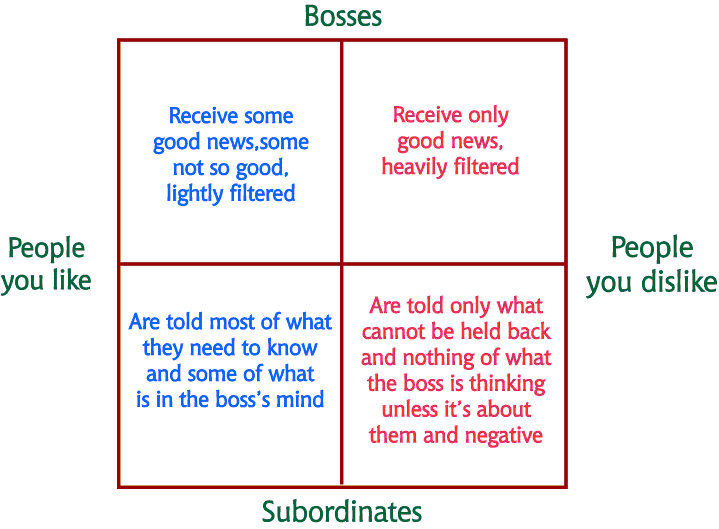
This law works in combination with the other two like this:
  • Bosses who are well-liked get more and better information from their subordinates. It’s less heavily filtered and may even contain some of the bad news.
  • Disliked bosses get only unalloyed good news, much of it fabricated. All negative data is suppressed.
  • Trusted subordinates are told most of what they need to know, and are usually told rather more as well—including what the boss is still thinking about.
  • Disliked and distrusted subordinates are told as little as possible, even if they really need to know. The only exception is anything negative about them, which is relayed promptly and in great detail.

Fourth Law: Bad news travels farther and faster than good

It’s human nature to pass on bad news quickly. You only have to watch the professional news media to realize that. Good news has to be very good to make the headlines. Bad news only has to be intriguing, odd-ball, or sexy.

The effect of this is a continual skewing of data towards the negative, especially over the short term. If a new initiative is launched, the quickest feedback will be the most extreme, whether positive or (especially) negative. That sometimes leads to organizations and people making bad judgments. Ideas are dropped on the basis of quick feedback that suggests problems. The good news takes its time to filter through and by then it’s too late.

If you want to get good information, make yourself liked and trusted, whether you’re in a boss or a subordinate relationship with the person who has the data. That’s why organizations that foster distrust through macho, Hamburger Management, constant cost-cutting, and treating staff like expendable widgets quickly get what they deserve: a virtual information blackout.

If you want the complete and accurate picture, give it time. Don’t get too despondent if the first news looks bleak. Don’t get too excited if the next wave of reports filtering up the hierarchy sound extremely rosy. All news is filtered somehow. Sometimes the only way to get anything like the truth is to go and see for yourself.


Email Newsletter icon, E-mail Newsletter icon, Email List icon, E-mail List icon
Sign up for our Email Newsletter


Labels: , , , ,

Add to Technorati Favorites Stumble Upon Toolbar

Tuesday, May 29, 2007

What do businesses and Las Vegas have in common?

Both typically produce big winners as a result of one or two lucky bets


Organizations fail because they rely more on repeating past successful behavior than risking failure by trying anything new. Individuals do the same. People are very poor at accepting the importance of chance and context in their lives. Focusing on your successes is a recipe for blindly repeating the past. Failures, however, always have a learning message and the potential for growth. Coyote explores why getting the reasons for success wrong dooms people and organizations to long-term mediocrity.

One of the enduring myths about the world of work is that effort is the key to success. Whether that effort comes in the form of long hours, constant endeavor, or sacrifice of much of the rest of what life has to offer, the belief that, somehow, hard work is always going to be rewarded is at the heart of much of the folklore that governs how people behave in the workplace.

This belief endures because it is both comforting and convenient: comforting to the individuals who do the hard work, and can always believe that it will help them win big one day—even if it hasn’t yet; and convenient to employers, who use it as a way to persuade staff to continue to make determined efforts on the basis of vague promises about the future.

But is it true?

Simple observation suggests that it is not—at least in most circumstances.

Of course, some degree of determination and persistence is important. Giving up too easily, or lacking determination enough to make the required effort, will doom almost any hopes of success. But they are rarely the prime reasons for success in themselves; and there are many, many instances where individuals and organizations have exerted themselves to an almost superhuman extent, only to fail. There are also many cases where someone, or some organization, has done very little, only to be “rewarded” with an amazing amount of success.

The decisions that count for most

Most businesses depend on a relatively small number of large, often risky, decisions. The launch of a new product line. Entry to a new market. Purchase of a competitor. Expansion overseas. To see these as “bets” is quite fair, because that’s what they are, however carefully they have been researched and discussed beforehand. An obvious, safe, incremental step isn’t going to produce large rewards, if only because everyone else will know about it too and probably already be doing it. It’s defensive, not a move to extend or enhance. Only decisions that aren’t obvious, carry risk, and take the organization into new territory stand a chance of creating significant profits and stealing a march on competitors.

The same is true for individuals. The solid, hard-working, cautious, risk-averse person who always does the obvious isn’t going to make it to the top—especially in competition with those willing to take bigger risks and flaunt their successes more openly.

These make-or-break decisions are bets on an uncertain future. Get a few right, and you’ll look like a genius—even if what won you that acclaim is almost entirely luck, or other factors outside your control. That’s why you often see high-profile leaders with a track-record of recent success suddenly run out of steam and appear clumsy and incompetent. They haven’t changed. They’ve just run out of their lucky streak, or found themselves in new circumstances unfavorable to their way of thinking or doing things.

Why success doesn’t help you learn

People are very poor at accepting the importance of chance and context in their lives—save when they are looking for an excuse for some bad mistake. We much prefer to believe that our successes are due to our own brilliance, while our failures are caused by bad luck and the mistakes of others.

This would be a harmless, if childish, failing were it not that it stops us from learning how to do better. Focusing on your successes is a recipe for continually repeating the past. There is not much to be learned from them, especially if you mis-attribute the reason for success to some personal action, when it was really the luck of being in the right place at the right time. Failures, however, always have a learning message—often one that is a vital step towards eventual success. But you cannot hear that message if you are always mis-attributing the reasons for your failures to bad luck, the errors of others, or unforeseeable events.

All the rush and haste of Hamburger Management leaves neither time nor inclination to sort out the true reasons for success or failure. Like the gambler in Las Vegas, the Hamburger Manager usually believes that he or she can somehow win over the odds consistently, even if no one else does. The result is the same in both cases: repeating the same behavior that once (supposedly) let you win big, until it causes you to lose even bigger. Organizations fail because they rely more on repeating past successful behavior than risking failure by trying anything new. Individuals do the same. It takes a long-term view to see the truth, but that’s something few people or organizations seem to possess.


Email Newsletter icon, E-mail Newsletter icon, Email List icon, E-mail List icon
Sign up for our Email Newsletter


Labels: , , ,

Add to Technorati Favorites Stumble Upon Toolbar

Thursday, May 03, 2007

Remember mercy? Boosting forgiveness can be more useful than you think

You’ll get more productivity, fewer relationship problems, more creativity too

Pointing out other people's mistakes, fretting over our own (and working to cover them up), and plotting ways to get even are all common activities that waste time at work. being willing to forgive and forget would save this time. Better still, it would help people take the risks needed to be more creative.
Alexander Kjerulf has an interesting posting on the subject of forgiveness, based on a survey by Sarah Warner, a recent graduate student of Luther College, who presented some of her research at the first Applied Positive Psychology Conference at the University of Warwick, UK.

Sarah found that workplaces with a culture of forgiveness had lower levels of interpersonal conflict and stress and higher levels of productivity. She didn’t mention creativity, but I would guess that a culture of forgiveness is good for that too. After all, creativity is mostly about trying new things, many of which are not going to work first time. If the organization will not to forgive you for these mistakes, the chances are that you will take fewer creative risks in the future.

Of course, in the macho world of Hamburger Management, forgiveness is always seen as weakness. All mistakes are punishable. Only constant “winners” are approved.

Sadly, there are no such animals. As Steve Roesler at All Things Workplace points out, if you have a Powerpoint slide with a graph whose curve always points upwards, you’re lying. I would add that if you have someone in the organization who never fails, you have a fraud, a liar, a cheat, or a cunning manipulator whom you should seriously consider firing. Everyone fails sometimes. The only way that you can produce and maintain an appearance of constant success is by lying and cheating to cover up your true blemishes.

Management staples such as performance appraisal and constant measurement of individual outputs leave little room for mercy. With every tiny blemish recored in detail, then saved to be brought up at the next appraisal, is it any wonder that people take such care to cover up errors? This may help them, but it’s a real problem for the organization. When mistakes, embarrassments, and poor results are covered up, management is denied the opportunity to put things right. Mistakes and misjudgments fester until disaster strikes, the truth can no longer be concealed, and there is panic. No one can lead an organization effectively if they are denied access to correct information, or given lies and half-truths as a means of hiding the bad news.

We all need forgiveness—very, very frequently—and we should therefore be equally ready to extend that forgiveness to other people. There are rather few mistakes in the business world that are truly unforgivable. Perhaps if we spent less time nursing our resentment, plotting to get even, and trying to point out others’ failings, we might find that we had a great deal more time to get on and do our own work better.


Email Newsletter icon, E-mail Newsletter icon, Email List icon, E-mail List icon
Sign up for our Email Newsletter


Technorati t